|
IECM 14.0 beta User Manual > Modules Included with the IECM > Low-Carbon Hydrogen Production & Transport > GET RESULTS > Water System > Cooling Tower Diagram |
|
The Cooling Tower Diagram diagram screen shows the major flows into and out of the wet cooling tower:
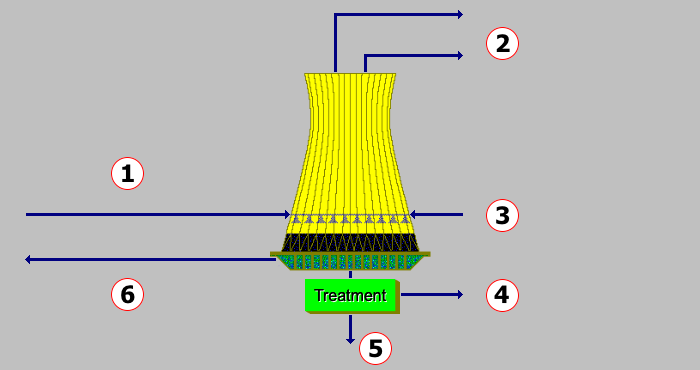
GET RESULTS: Water System: Cooling Tower Diagram
The following values are shown:
•Area 1:
•Cooling Water In: The amount of recirculating cooling water entering the wet tower. This depends on the plant size, steam cycle heat rate, and cooling water temperature drop range. It is the sum of cooling water through the main steam cycle and the amine-based carbon capture system, if applicable.
•Temperature: The temperature of recirculating cooling water entering the wet tower.
•Area 2:
•Drift Loss: A relatively small amount of entrained water lost as fine droplets in the air discharge from a tower, which is frequently referred to as tower drift loss.
•Evaporation: In wet cooling towers, water has direct contact with ambient air, and cooling is achieved mainly by the evaporation process in which some of the water leaves with the air. The evaporation process is the largest source of cooling tower water losses. That is estimated based on the mass and energy balance model. Evaporation loss varies with meteorological conditions and displays a seasonal pattern.
•Area 3:
•Makeup Water: The cooling tower operation is maintained by making up fresh water at the same rate as the water losses (evaporation, blowdown, and drift loss) from the tower.
•Area 4:
•Treated Blowdown: Because water evaporated in the cooling tower consists of pure water, the concentration of salts or other impurities will increase in the recirculating water. To avoid a high concentration and subsequent scaling of the surface within the tower, it is necessary to blow down a portion of the water that depends on the cycle of concentration and evaporation loss.
•Area 5:
•Waste: This is an intermittent waste stream that contains collected soil, dust, and suspended solids in the tower basin.
•Area 6:
•Cooling Water Out: The amount of recirculating cooling water exiting the wet tower. This depends on the plant size, steam cycle heat rate, and cooling water temperature drop range. It is the sum of cooling water through the main steam cycle and the amine-based carbon capture system, if applicable.
•Temperature: The temperature of recirculating cooling water exiting the wet tower.
Copyright © 2022-2026 University of Wyoming. All rights reserved. Visit us at https://www.iecm-online.com/