
Wyoming Law Review Hosts C.J. Box Symposium
The Wyoming Law Review hosted the C.J. Box Symposium Saturday, Oct. 18. The symposium focused on the prevalent legal themes in the novels of Wyoming author C.J. Box and the saw the gathering of fans of Box’s work, legal enthusiasts, law students, and academics for a day of education.
The event is the latest in the Law Review’s tradition of hosting a yearly symposium on contemporary legal issues.
“When I first started out to write fiction, I wanted to write a book that was true to what my vision of Wyoming was,” Box said in his keynote. “I wanted to include tip-of-the-spear issues that we all know about in Wyoming, like energy development, wilderness, individualism, environmentalism, outfitters and guides, hunting and fishing culture, federal versus state versus local control, wildlife management and endangered species law.”
“The vast amount of legal problems that C.J. Box presents was a huge inspiration for us,” Law Review Research Editor Connor Balliet said.
The day opened with a presentation on Sackett v. EPA—featured in the novel “Breaking Point”— by former Associate Dean of the College of Law Sam Kalen. The case had huge implications for the protection and regulation of wetlands in the United States and set the stage for the rest of the day.
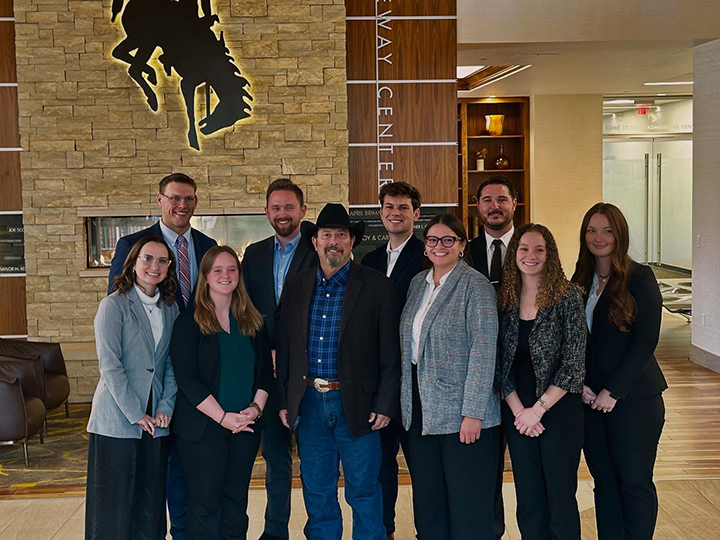
Wyoming Law Review students post with author C.J. Box.
Afterward came a presentation inspired by Box’s novel “Free Fire” which focused on the Zone of Death, a sliver of land in the Idaho section of Yellowstone National Park where, due to conflicting jurisdictions, a criminal could theoretically avoid prosecution for major crimes, including murder. The talk was given by Brian Kalt, the Michigan State University professor who originally discovered the loophole.
Another issue featured during the day was Corner Crossing, the act of stepping from the corner of a parcel of public land to the corner of an adjacent parcel of public land without touching the private land that borders them. Such land checkerboarding is especially common in Wyoming and appears in the novel “Three-Inch Teeth.” Ryan Semerad, a trial attorney who set the precedent for the legality of corner crossing by defending four Missouri hunters who corner crossed to hunt on otherwise inaccessible public land, presented on the phenomenon.
Box’s main series of novels focuses on Joe Pickett, a hardworking Wyoming game warden committed to conservation and justice. Fittingly, the symposium hosted a panel of real-life game wardens who provided a look into the work at the state Game & Fish Department. The panel included Chief Game Wardens Dan Smith (current) and Rick King (former) and Wildlife Biologist Martin Hicks.
“When I introduced Dan, he said ‘well, thanks for introducing me by my real name. Everybody at church always just calls me Joe Pickett.’ It just seems like it's a very common experience among all the game wardens,” Symposium/Article Editor Ryan Jenson said.
Professors Kelly Dunning and Temple Stoellinger of the University of Wyoming, along with Professor Heather Elliott of the University of Alabama School of Law, capped off the presentations with a panel discussion on the Endangered Species Act, its impact on society, and how it has evolved over time. The ESA features heavily in Box’s debut novel, “Open Season.”
Attendees were also treated to a demonstration on the art of falconry by master falconer Vahé Alaverdian on the back patio of the Gateway Center. Falconry appears in many of Box’s novels and is the favorite pastime of Pickett’s on-again-off-again sidekick Nate Romanowski.
“Even though the demonstration wasn't directly tied to the law, it implicates a lot of legal and other conservation questions that we care about as a big natural resources state,” Law Review Editor-in-Chief Ethan Drewes said of the demonstration.
The day ended with the keynote presentation by Box on storytelling and the law. Box discussed his writing process, his motivation for choosing a game warden as his protagonist, and how he contacts scholars to ensure that his treatment of the legal issues at the core of his novels is sound.
“He gave a lot of insight into his writing process, the legal issues, whether or not he feels a sort of obligation to portray certain legal issues in a specific way,” Law Review Managing Editor Isabelle Cruz said. “Hearing from a New York Times bestselling author about his writing process was really interesting.”
The Wyoming Law Review will publish a special edition related to the legal issues explored in the symposium in spring of 2026. The forthcoming issue will be available at scholarship.law.uwyo.edu/wlr/.

The University of Wyoming has earned its Research Level 1 (R1) status from the Carnegie Classification of Institutions of Higher Education, placing Wyoming's only four-year university with the top research universities in the United States.