
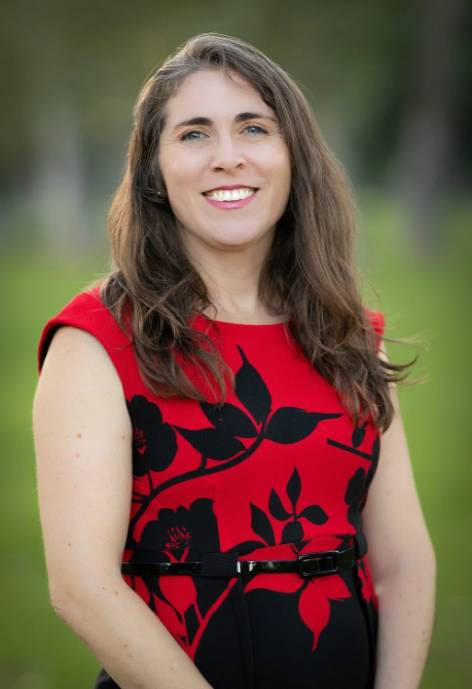
Kristen D. Landreville, Ph.D.
Department Head, Associate Professor
Department of Communication and Journalism
EDUCATION
Ph.D. in Communication, School of Communication, The Ohio State University, Columbus, OH (2010)
M.A. in Mass Communication, College of Journalism and Communications, University of Florida, Gainesville, FL (2006)
B.S. in Journalism, College of Journalism and Communications, University of Florida, Gainesville, FL (2004)
TEACHING & COURSES
Dr. Landreville is committed to collaborative instruction that emphasizes critical thinking, media literacy, and research methodology. Her core course offerings include:
Quantitative Research Methods in Communication (COJO 5070)
Mass Media and Society (COJO 4020)
Political Communication (COJO/POLS 3550)
Media, Science, and Society (COJO/ENR 4700)
Multimedia Production (COJO 3530)
Research OvervieW
Political Communication & Media Effects
Dr. Landreville’s research in political communication examines the psychological and behavioral processes underlying political media consumption, partisan polarization, and public discourse. Employing experimental design, content analysis, and public opinion surveys, she has investigated how political humor, satire, and late-night television shape political knowledge, emotion, and discussion intent. Her work has explored selective exposure, parasocial interactions, agenda building across social platforms, and the cognitive mechanisms influencing how citizens evaluate factual claims in an increasingly polarized news environment. These findings have been widely published in leading journals such as The International Journal of Press/Politics, Media Psychology, Journal of Broadcasting & Electronic Media, Mass Communication & Society, and Electronic News.
Climate Change & Environmental Communication
In the environmental domain, Dr. Landreville investigates how climate and risk communication, community engagement, and local knowledge co-production influence public attitudes and collective action regarding environmental shifts. Serving as a lead social scientist and communication expert on the $20 million NSF-funded WyACT (Wyoming Anticipating the Climate-Water Transition) project, she coordinates public opinion research and interpersonal science communication initiatives across Wyoming. Her scholarship focuses on breaking the “spiral of silence” surrounding climate adaptation in rural and natural resource-dependent communities, identifying predictors of public participation in water resource planning, and evaluating science communication pipelines that bridge ecological research with stakeholder decision-making. Her research has appeared in Journal of Risk Research, PLOS Climate, and Frontiers in Climate.
Societal & Ethical Implications of Emerging Technologies
Expanding into emerging biotechnology, Dr. Landreville conducts research on public engagement and the societal, ethical, and governance dimensions of microbiome engineering in indoor environments. Through her leadership in the Societal and Ethical Implications (SEI) Core of the NSF-funded PreMiEr Engineering Research Center across a five-university consortium, she assesses public risk-benefit perception and trust regarding natural versus genetically engineered microbes in the built environment. Her work applies Responsible Research and Innovation (RRI) frameworks to bridge the gap between bioengineers, industry stakeholders, and community members, with studies published in venues such as Journal of Responsible Innovation, Frontiers in Genetics, Frontiers in Public Health, Environment Systems and Decisions, and Sustainable Microbiology.
Selected Peer-Reviewed Publications (2019-2026)
Cooper, K. E., Landreville, K. D., Keller, M. L., Hansen, K., Shinker, J., Paige, G. B., Van Sandt, A. T., Donaldson, E., Kim, M., & Ehmke, M. (forthcoming). Emotions, political ideology, and socially situated risk perceptions of water-related natural hazards. Journal of Risk Research. http://doi.org/10.1080/13669877.2026.272262
Barry, N., Landreville, K. D., Larson, J. A., & Kuzma, J. (2026). Microbiome stewardship: Defining and cultivating healthy indoor environments. Sustainable Microbiology, special collection on Stewardship of Microbiomes in Human and Environmental Systems. https://doi.org/10.1093/sumbio/qvag035
Landreville, K. D., Kuzma, J., Barry, N., Benezra, A., Brown, J., Crook, N., Cummings, C., Deng, D., Graves Jr, J. L., Gunsch, C., Harris, A., Hecate, A.*, Li, Q.*, Lott, M., Morar, N., Mulligan, P., Noble, R., O’Doherty, K., & Smyth, D. (2026). Towards the responsible development of microbiome engineering in the built environment. Journal of Responsible Innovation. https://doi.org/10.1080/23299460.2026.2675073 *Graduate student.
Barry, N., Landreville, K. D., Blackwood, D., Yard, J.*, Noble, R., & Kuzma, J. (2026). Experiences with household mold and perceptions of microbiome engineering to mitigate mold. Frontiers in Public Health, section Environmental Health and Exposome, special issue on “The Health Impacts of Building Materials on Air Quality and Public Health.” https://doi.org/10.3389/fpubh.2026.1725172 *Undergraduate student.
Cummings, C., Landreville, K. D., & Kuzma, J. (2026). Public perceptions and support for introduced microbes to combat mold growth in disaster relief efforts. Environment Systems and Decisions, 46(3). https://doi.org/10.1007/s10669-025-10062-x
Cummings, C., Landreville, K. D., & Kuzma, J. (2025). Public perceptions and support for introduced microbes to combat hospital-acquired infections and antimicrobial resistance. PLOS ONE. https://doi.org/10.1371/journal.pone.0332578
Keller, M. L., Hansen, K., Shinker, J. J., Landreville, K. D., Cooper. K. E., Donaldson, E., Kim, M., Paige, G. B., & Van Sandt, A. (2025). Unwinding the spiral of silence in rural America: Looking backward with stories to plan forward. Frontiers in Climate, section Climate and Decision Making. https://doi.org/10.3389/fclim.2025.1398452
Cooper, K., Brinkerhoff, L.*, & Landreville, K. D. (2025). The world needs less plastic: The role of psychological distance and self-efficacy in environmental messages about plastic pollution. Frontiers in Communication, section Science and Environmental Communication. https://doi.org/10.3389/fcomm.2025.1579912 *Graduate student.
Cummings, C., Landreville, K. D., & Kuzma, J. (2025). Natural vs. genetically engineered microbiomes: Understanding public attitudes for indoor applications and pathways for future engagement. Frontiers in Genetics, section ELSI (Ethical, Legal, and Social Issues) in Science and Genetics. https://doi.org/10.3389/fgene.2025.1560601
Cummings, C., Landreville, K. D., & Kuzma, J. (2024). Taking the temperature of US public opinion about microbiome engineering. Frontiers in Public Health, section Environmental Health and Exposome. https://doi.org/10.3389/fpubh.2024.1477377
Connell, E.*, Landreville, K. D., Price Schultz, C., & Singh, R. (2024). Pooshing the boundaries of Instagram influencers: How celebrity and color strategy impact source credibility, parasocial interaction, and following intentions. Journal of Creative Communications. https://doi.org/10.1177/09732586241295383 *Graduate student.
Price Schultz, C., Perez, A.*, & Landreville, K. D. (2024). The Try Guys try cheating: Social media influencers in crisis. Southwestern Mass Communication Journal, 40(1). https://doi.org/10.58997/be6hzy42 *Graduate student.
Funk, J.*, Price Schultz, C., & Landreville, K. D. (2023). Taking alternative routes? Examining mainstream and alternative media consumption based on political identity. Media Watch, 14(1), 10-32. https://doi.org/10.1177/09760911221136911 *Graduate student.
Morales, E. A.,* Price Schultz, C. J., & Landreville, K. D. (2021). The impact of 280 characters: An analysis of Trump’s tweets and television news through the lens of agenda building. Electronic News, 15(1-2), 21-37. https://doi.org/10.1177/19312431211028610 *Graduate student.
Peifer, J., & Landreville, K. D. (2020). Spoofing presidential hopefuls: The roles of affective disposition, emotions, and intertextuality in prompting the social transmission of debate parody. International Journal of Communication, 14, 200-220. https://ijoc.org/index.php/ijoc/article/view/11439/2904
Landreville, K. D., & Niles, C.* (2019). “And that’s a fact!”: The roles of political ideology, PSRs, and perceived source credibility in estimating factual content in partisan news. Journal of Broadcasting & Electronic Media, 63(2), 177-194. https://doi.org/10.1080/08838151.2019.1622339 *Graduate student.

The University of Wyoming has earned its Research Level 1 (R1) status from the Carnegie Classification of Institutions of Higher Education, placing Wyoming's only four-year university with the top research universities in the United States.