
New Maps Reveal Striking Impacts on One of Arctic’s Largest Caribou Migrations
Published December 18, 2025
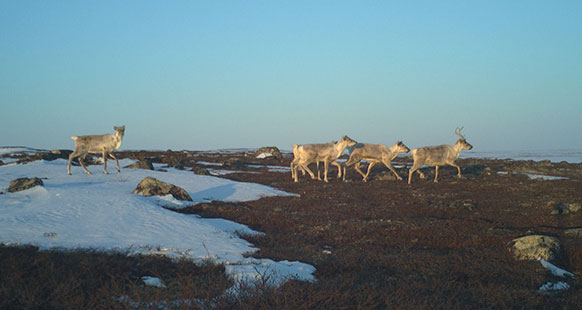
Caribou move along barren ground in northern Canada. The Bathurst caribou population has declined from 400,000 to less than 4,000 over the last 30 years, according to new surveys by the government of the Northwest Territories. (Government of Nunavut Photo)
For centuries, the migrations of massive herds of caribou defined the ecosystem and
lifeways of people across the vast North American Arctic. New migration maps published
today (Thursday) document a near complete collapse of one of the region’s formerly
vast caribou migrations.
The new, detailed maps reveal the recent toll that human development and a myriad
of pressures facing the Arctic have had on the long-distance movements of the Bathurst
caribou, named for their historic calving grounds near Bathurst Inlet, on the far
northern coast of Canada. Researchers from the State University of New York College
of Environmental Science and Forestry (SUNY-ESF) partnered with the Global Initiative
on Ungulate Migration, an international team of migration researchers headquartered
at the University of Wyoming, to map how the caribou migration has been altered.
Abundant migratory caribou have made landscapes more productive, provided a prey base
for the region’s carnivores and shaped the culture of the Indigenous communities that
have hunted them for countless generations. The Bathurst herd of barren-ground caribou
once ranged from Nunavut all the way to northern Saskatchewan, with some individuals
traveling over 300 miles on their yearly migrations.
Today, these migrations -- and the large herds they sustain -- are hanging in the
balance. The Bathurst caribou population has declined from 400,000 to less than 4,000 over the last 30 years, according to new surveys by the government of the Northwest
Territories.
“The steep decline of the Bathurst herd is not just a biological concern; it represents
a profound cultural and ecological loss,” says Orna Phelan, wildlife biologist with
the North Slave Metís Alliance, one of the Indigenous communities that stewards the
caribou. “Conserving this herd means safeguarding our history, our identity and the
health of the land we all share.”
Published in the Atlas of Ungulate Migration, the maps document the dramatic reduction in the Bathurst caribou migrations and
illustrate imminent threats from a proposed all-season road to connect current and
potential mines to newly accessible deep-water ports, effectively bisecting the range.
The maps also indicate where conservation efforts can yet prevent further disruption
to this epic migration.
Wildlife scientist Elie Gurarie, at SUNY-ESF, a member of the Global Initiative on
Ungulate Migration who has studied the Bathurst caribou for the last 10 years, says
the maps bring a renewed focus to the plight of the caribou.
“This project shows how interconnected and collaborative ecological science and conservation
are in the Arctic,” Gurarie says. “Mapping the Bathurst caribou herd isn’t just about
lines on a map; it’s about understanding a species whose vast habitats are beginning
to fragment, the pressures from roads and mines, and the cultural and material significance
these animals hold for Indigenous communities.”
The Atlas of Ungulate Migration represents a global effort to make migration maps
publicly available for conservation and land-use planning. It is led by the Global
Initiative on Ungulate Migration working under the auspices of the Convention on the
Conservation of Migratory Species of Wild Animals, a United Nations treaty. The Bathurst
herd is the first entry in the atlas for caribou, a circumpolar species facing an
urgent conservation need.
Although many human communities benefit from the ecological and economic benefits
of migratory ungulates, the caribou herds of the Arctic are one of the only wild,
migratory ungulate populations in the world to which Indigenous communities still
maintain strong traditional ties. The caribou are used for food and fiber and have
shaped Indigenous cultures around the global Arctic and sub-Arctic regions. Their
migrations are the longest known ungulate movements in North America.
The Bathurst herd is emblematic of the pressures facing migratory caribou worldwide,
which have declined by 65 percent over the last 20-30 years. Rising temperatures due
to climate change; an associated increase in insect harassment; poorer vegetation
quality; and more frequent rain-on-snow events that make lichen, their primary winter
food source, inaccessible under thick ice, increasingly stress the caribou populations.
These and other effects are compounded by the major impacts of expanding infrastructure.
The new maps illustrate where the proposed all-season road -- billed as the Arctic
Security Corridor -- will cut straight through the Bathurst’s core migration area,
very near the herd’s calving grounds. This road will allow for expanded access and
mineral exploration within the caribou’s migratory range and access to a deep-water
port. Three diamond mines already operate within their range -- in areas known to
be preferred by the caribou. Indigenous stewards and researchers have documented large-scale
caribou avoidance of these areas, as well as an almost complete impermeability of
the winter ice roads that service the mines.
But tracking data and detailed maps, when used for planning, make it possible to develop
in such a way as to not disrupt the seasonal migrations. If development happens in
the right places and in the right ways, researchers believe it doesn’t have to spell
the end of the Arctic’s caribou migrations. Indigenous-led guardians, harnessing traditional
knowledge and boots-on-the-ground observations, are intensively monitoring traffic
and caribou behavior on and around roads and mines.
Working in close partnership, Gurarie and colleagues are working to understand how
the caribou are responding to various kinds and levels of disturbance, with an eye
toward specific mitigation solutions that can make linear infrastructure more caribou-friendly.
Mapping approaches tested in Bathurst caribou range could have implications for the
other large caribou herds that still inhabit the circumpolar North, perhaps allowing
other regions to avoid stark population declines and to preserve the long-distance
movements caribou require.
“Among all the caribou’s astonishing adaptations to not only survive, but thrive,
in the Arctic, perhaps none is more important than the ability to move freely across
large landscapes,” Gurarie says. “By working closely with First Nations, Inuit, territorial
governments and nongovernmental organizations, we’re not only documenting change,
but also working on shaping solutions.”
About the Global Initiative on Ungulate Migration
Headquartered at the University of Wyoming, the Global Initiative on Ungulate Migration was created in 2020. The main aim of the initiative is to work collaboratively to create a global Atlas of Ungulate Migration (an inventory) using tracking data and expert knowledge; and stimulate research on drivers, mechanisms, threats and conservation solutions common to ungulate migration worldwide. Initiative participants include global experts representing the world's major terrestrial regions and most, if not all, of its longest migrations. The initiative seeks to spark conservation efforts worldwide by sharing and discussing new, ongoing and proven approaches to maintain migration corridors across large landscapes. Visit the atlas at www.cms.int/gium.
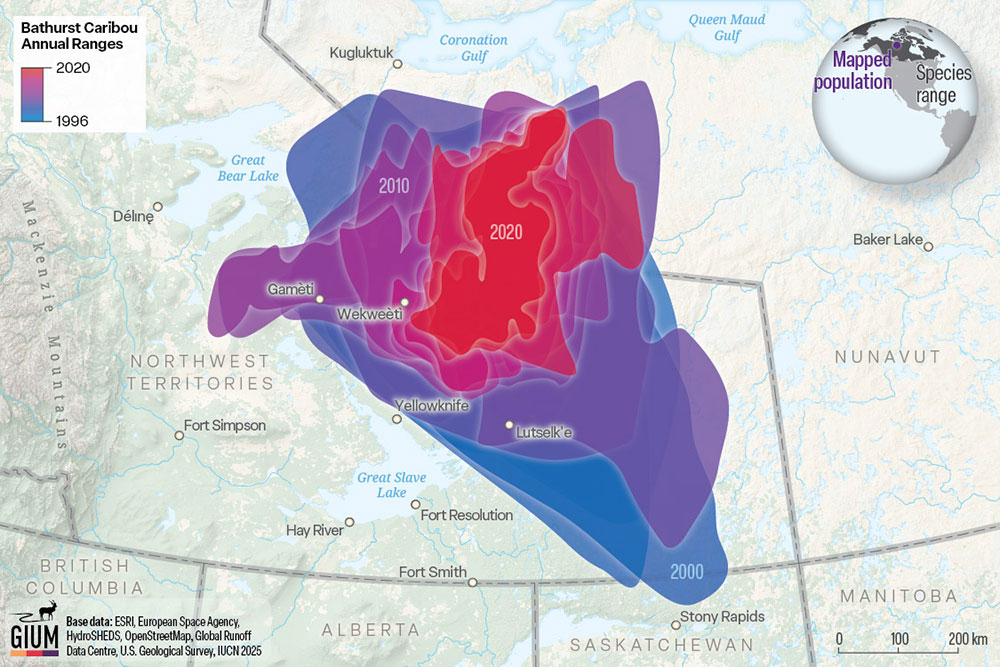
This new map shows the declining range of the Bathurst caribou herd in northern Canada. (Global Initiative on Ungulate Migration)

The University of Wyoming has earned its Research Level 1 (R1) status from the Carnegie Classification of Institutions of Higher Education, placing Wyoming's only four-year university with the top research universities in the United States.