
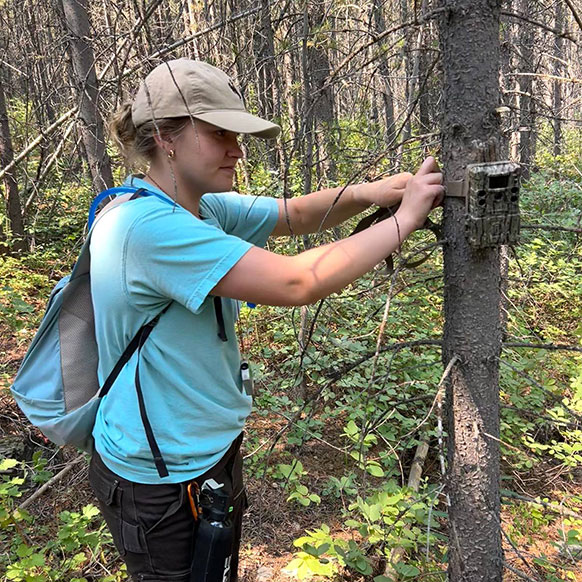
UW graduate student Lauren Wetterau attaches a wildlife camera to a tree to document biodiversity at a forest site in the greater Yellowstone ecosystem. She is one of the UW scientists featured in “Saving Yellowstone with Dennis Quaid,” a four-part series airing on Animal Planet. (Grace Peters Photo)
University of Wyoming scientists are front and center in a four-part television series,
“Saving Yellowstone with Dennis Quaid,” now airing on Animal Planet.
Assistant Professor Ellen Aiken, in the School of Computing, along with Associate
Professor Joe Holbrook, Dean John Koprowski and Professor Kevin Monteith, all from
the Haub School of Environment and Natural Resources, provide expertise on lesser-known
animal species that play important roles in conservation of the greater Yellowstone
ecosystem.
The first two episodes aired Nov. 26 and Dec. 3, and the next is scheduled Wednesday,
Dec. 10. Aiken offers expertise on golden eagles, Holbrook on coyotes and foxes, Monteith
on beavers and Koprowski on red squirrels.
“The episodes highlight the creative efforts and passion of the faculty and graduate
students at the University of Wyoming,” Koprowski says. “Most importantly, as the
first university to join the project in collaboration with the Jackson Fork Ranch,
the national and international leadership and strength of UW’s wildlife, natural resources
and environmental expertise are clearly on display.”
Koprowski says UW graduate students Ellen Yee, Emily Davis, Macy Jacobsen and Lauren
Wetterau are “truly the stars of the show.”
“Not only were students receiving great mentorship on the science, but all involved
were working to hone their storytelling skills to communicate the fascinating roles
of these lesser-known species in the greater Yellowstone ecosystem,” Koprowski says.
The series came from the vision of Joe Ricketts, owner of the Jackson Fork Ranch in Sublette County, who has provided a major gift to UW to support environmental stewardship and conservation across Wyoming.
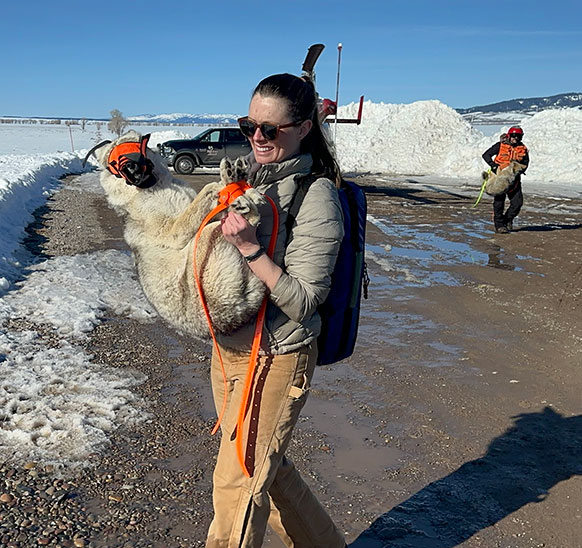
UW graduate student Emily Davis carries a helicopter-captured coyote on which to place a GPS collar in the greater Yellowstone ecosystem. Her Ph.D. research is part of the “Saving Yellowstone with Dennis Quaid” TV series. (Austin Smith Photo)
“A very unique aspect of the ‘Saving Yellowstone’ series is that the research funded
by the Jackson Fork Ranch and the people engaged in that research are highlighted
in the various episodes,” Koprowski says.
Well-known actor Quaid, who lived near Yellowstone National Park for years, is the
host of the series. He attended a conservation summit at the Jackson Fork Ranch in
August, where a trailer of the series was viewed, and told the group how he admired
wildlife conservationists who provide detailed insight into the challenges and solutions
in the ecosystem.
The series was produced by Warm Springs Productions in Missoula, Mont. A second season
of “Saving Yellowstone with Dennis Quaid” reportedly is already in production, with
four more episodes planned.
While the series is premiering on Animal Planet, episodes also may be available through Discovery and various platforms that carry Animal Planet content.

The University of Wyoming has earned its Research Level 1 (R1) status from the Carnegie Classification of Institutions of Higher Education, placing Wyoming's only four-year university with the top research universities in the United States.