
UW’s Biodiversity Institute Helps Coordinate Winter Moose Day Weekend Feb. 7-8
Published December 11, 2025
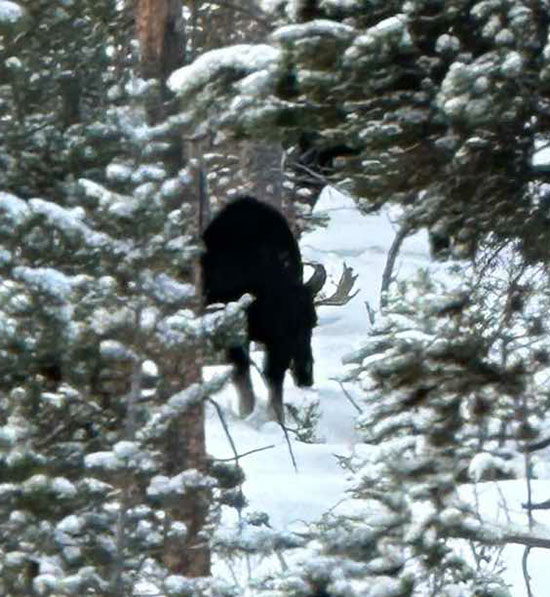
This moose was spotted along the Middle Crow route in Pole Mountain during the 2025 Winter Moose Day weekend. The 2026 Winter Moose Day weekend, coordinated, in part, by the University of Wyoming’s Biodiversity Institute, is scheduled Saturday-Sunday, Feb. 7-8, in the Vedauwoo/Happy Jack, Snowy Range and Arlington areas. Registration is open. (Ali Bennett Photo)
For those who have a little bit of patience and enjoy seeing wildlife, looking for
moose in the mountainous areas surrounding Laramie may qualify as a worthwhile outdoor
winter excursion.
For the 12th year in a row, community scientists will be called upon to help spot
and count moose populations in the mountains outside of Laramie for Winter Moose Day
weekend. Coordinated, in part, by the University of Wyoming’s Biodiversity Institute, the event is scheduled Saturday-Sunday, Feb. 7-8, in the Vedauwoo/Happy Jack, Snowy
Range Mountain and Arlington areas. Registration opened today (Thursday, Dec. 11),
with the deadline to register Wednesday, Jan. 28. To register, go here.
“The data collected during Winter Moose Day is used to estimate detectability of moose
by human surveyors. Despite being the largest member of the deer family, they can
often be hard to spot among the trees. This is important for population estimates
for conservation and management,” says Mason Lee, senior project coordinator for the
Biodiversity Institute. “But, more than that, Winter Moose Day is just a fun excuse
to enjoy a crisp winter morning in our national forests with your friends and family,
all while contributing to science.”
As in past years, volunteers will adopt survey routes and ski or snowshoe those routes
to chart all observations of moose or signs of moose. These can include tracks/hoof
prints in snow, bed areas, scat droppings, and browse on aspen and willows. To survey
while moose are most active, participants are asked to get to their routes as early
as dawn and to complete their surveys by noon.
The 2025 event drew 104 surveyors who made up 41 different survey groups that covered
18 of the available 30 observation routes. The same number of routes are available
each year. These include 17 in Pole Mountain, 12 in the Snowies and one in the Arlington
area.
In 2023, protocol was changed to allow multiple groups to independently survey the
same route. While this means there is a possibility that Moose Day surveyors may encounter
other Moose Day survey groups on their routes, the upside is that multiple independent
surveys help the Biodiversity Institute better estimate detection probability of moose
and moose signs.
“Despite how large moose are, they’re really good at hiding,” Lee says. “So, just
because an observer doesn’t report seeing a moose doesn’t mean the moose wasn’t there.
Having multiple groups allows us to correct for this potential underestimation.”
Winter Moose Day is often marked by strong winds and/or snowfall, both of which can
obscure or hide fresh tracks and other signs of moose, Lee says. This can result in
few sightings of moose signs. Volunteers are encouraged to collect weather and visibility
information on their routes.
Ideally, there would be at least one volunteer group to cover each of the 30 routes,
Lee says. But, because some of the routes are more difficult to traverse than others
or are farther away, all routes do not usually get adopted.
For safety reasons, survey groups should consist of at least two people. Groups can
be as large as people decide, Lee says. When groups record their data on Moose Day,
it is important to provide the number of people who were in the group to account for
effort in the detection probability estimates, Lee adds.
Because multiple groups can register to survey the same route, a lot more people can
participate in Moose Day than in previous years, says Lee, who adds the surveyors
are typically a mix of volunteers who participate annually as well as newcomers.
“As always, volunteers do not need to go out both days,” Lee adds. “They can go out
on the day that works best for their group that weekend.”
While observations of moose can still be voluntarily loaded into iNaturalist for public viewing, Lee says the Biodiversity Institute is no longer creating Moose
Day projects on the website, a joint initiative of the California Academy of Sciences
and the National Geographic Society.
Training, which is required for all first-time participants, will be Saturday, Jan.
31, 10 a.m.-noon, in the Berry Biodiversity Conservation Center auditorium. Information
will be available when people register, Lee says. Training includes a one-hour classroom
session and a one-hour outside training component.
“The training is required of new participants,” Lee says. “If they are unable to attend
the in-person training, we will have a recording and quiz that they must take before
receiving their materials.”
Data gathered from Winter Moose Day is shared with biologists at UW. These biologists
use the data collected by community scientists to further their understanding of the
population densities of local moose, their reproductive rates, their winter ranges
and how these variables change over time.
During the 2025 Winter Moose Day, five moose -- four adults and one calf -- were spotted
as well as many signs of moose that included scat and tracks, Lee says. A record 19
moose -- 15 adults and four calves -- were spotted during the 2022 Winter Moose Day.
According to surveyors’ detection data from last year, about 73 percent of moose spotted
were with the naked eye, followed by 12 percent of citizen scientists first seeing
a moose through binoculars. About 65 percent of spotters stated they were walking
when they saw a moose while another 35 percent reported being stopped when they viewed
a moose.
“Especially interesting is that our detection data shows that most detections of moose
occur by people who are moving, and they are initially able to spot the moose with
the naked eye,” Lee says. “This is the kind of information we’ve been collecting for
the past few years, so it is interesting to start seeing some results.”
Both the winter and summer Moose Day events are geared toward increasing the public’s
understanding of moose in the Laramie area and involving the public in asking and
answering questions. These events are an extension of the original program, Moose
Day, held by Nature Mapping Jackson Hole (NMJH) in Jackson each winter. NMJH is a
citizen-science program created by the Jackson Hole Wildlife Foundation.
The UW Biodiversity Institute fosters conservation of biodiversity through scientific discovery, creative dissemination, education and public engagement. In this setting, scientists and citizens, students and educators, come together to share a wealth of perspectives on the study and appreciation of biodiversity -- from microbes to poetry and ecosystems to economics. Learn more at www.wyomingbiodiversity.org.

The University of Wyoming has earned its Research Level 1 (R1) status from the Carnegie Classification of Institutions of Higher Education, placing Wyoming's only four-year university with the top research universities in the United States.