
Four UW Students to Present Research During Science Café in Jackson Hole Feb. 1
Published January 23, 2026
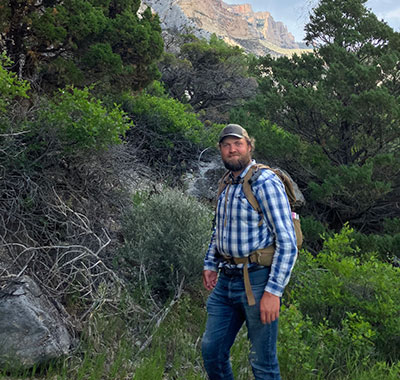
Daniel Coles
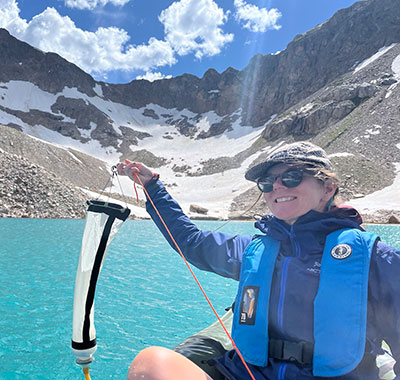
Meredith Journey
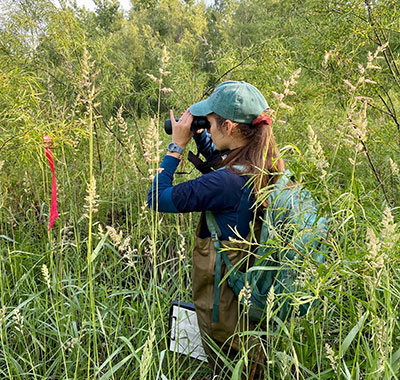
Lindsey Gapinski
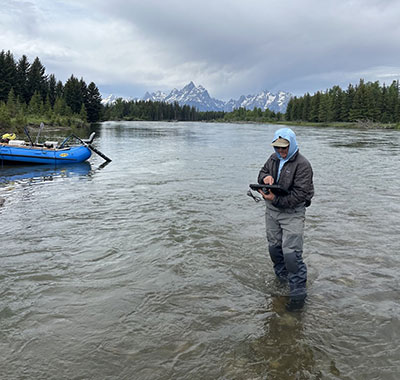
Chuck Williams
Four University of Wyoming graduate students will present their research to the public during a Science Café Sunday, Feb. 1, at 1:30 p.m.
The event, hosted by UW’s Biodiversity Institute, will take place at the Teton County Library, located at 125 Virginian Lane in Jackson Hole. The event is free and open to the public.
The four UW graduate students will present casual talks -- 10-15 minutes each -- about their research, with time for a question-and-answer session following each talk and at the end of the event.
“At the Biodiversity Institute, we believe it’s important that students receiving our biodiversity graduate student research enhancement grants communicate their projects with the public. We encourage our awardees to connect with communities through public outreach that best suits their projects and audiences,” says Abbey Morales, communications and marketing specialist for the Biodiversity Institute. “Our Science Cafés are particularly popular with communities and students as a way to share the amazing research that’s happening at the University of Wyoming. We’ve hosted Science Cafés all over the state -- in English and Spanish -- and look forward to connecting with people in a casual way.”
The four UW graduate students and their projects are:
-- Daniel Coles, “A Flora of the Bighorn Mountains: Insights into the Region's Botanical
History, Plant Diversity and Significant Discoveries.” His research presents a comprehensive
floristic inventory of Wyoming’s Bighorn Mountains. Through extensive fieldwork and
the collection of over 8,500 voucher specimens, this project documents the region’s
plant diversity; clarifies historical taxonomic uncertainties and misidentifications;
and updates species distributions.
“The presentation will begin with an overview of herbaria and floristic inventories, highlighting their role in documenting plant diversity and informing research, conservation and land management,” Coles says. “I will then introduce the botanical history of the Bighorn Mountains, beginning with the first known voucher specimen collected near Bald Mountain in 1891 by University of Wyoming agricultural scientist B. C. Buffum; followed by Aven Nelson’s small-scale inventory of the Goose Creek watershed in 1896; and then the first large-scale floristic inventory conducted by Ronald Hartman and Ernie Nelson in 1980.”
This historical context will lead into Coles’ comprehensive floristic inventory of the Bighorn Mountains, which he conducted from 2023-25. He will then discuss regional plant diversity, including endemic taxa and species of conservation concern, and conclude with notable introductions of non-native weedy species and significant range expansions of uncommon and rare taxa.
Coles, of Cheyenne, is a master’s student studying botany. He is in his final semester.
-- Meredith Journey, “Plankton at the Peak: Zooplankton of Wyoming’s High Alpine Lakes.” Journey is researching the Teton and Wind River ranges of Wyoming that are home to more than 2,000 alpine lakes.
Alpine lakes act as integrators of alpine watersheds and, as such, are important sentinels of ecosystem disturbance. High elevation ecosystems are harsh living environments and are home to highly specialized endemic species, including alpine-obligate invertebrate zooplankton. Zooplankton are important components of aquatic systems and are indicators of water quality and ecosystem health.
“In this talk, I will introduce the audience to Wyoming’s unique alpine zooplankton species and explore their important role in maintaining pristine and picturesque landscapes,” Journey says.
Journey, of Emerald Isle, N.C., is a third-year Ph.D. student studying aquatic biology.
-- Lindsey Gapinski, “Forest birds are declining … How community science can help!" Gapinski is investigating population declines in western forest birds, one of the most rapidly declining groups of breeding birds in North America.
Although these birds have experienced a 30-percent loss since 1970, there is relatively
little research being conducted to investigate the underlying mechanisms behind these
declines. Without knowing why this group of birds is declining, land managers and
policymakers cannot take effective action toward slowing or reversing their population
losses. Gapinski says it is important to address these declines to conserve biodiversity
and maintain functioning ecosystems, as these species play critical roles in the forests
of western North America.
“My talk will focus on the decline of western forest birds in North America and will highlight the great value of community science programs, such as the North American Breeding Bird Survey and eBird in addressing current problems in bird conservation,” Gapinski says.
Gapinski, of Mount Horeb, Wisc., is a second-year Ph.D. student in the Program in Ecology and Evolution.
-- Chuck Williams, “Float around and find out: Thermal mapping of the Snake River.” This project aims to describe how variations in water temperature over space and time shape thermal habitats in a 25-mile stretch of the Upper Snake River in Wyoming, which is critical habitat for the native Snake River cutthroat trout.
By combining stationary temperature loggers with high-resolution, longitudinal temperature profiling using a Fast Limnological Automated Measurement (FLAMe) system, this research will model fine-scale thermal dynamics and identify key areas of thermal stress as well as locations that could function as thermal refuge. The goal is to better understand how changing thermal conditions may impact biodiversity and community stability while providing resource managers with actionable data.
“I will be discussing seasonal and localized variation (i.e. tributaries) in water temperature on the Snake River,” Willliams says.
Williams, of Helena, Mont., is a second-year master’s student studying freshwater ecology.
For more information, go to the event’s Facebook page or email Morales at emorale3@uwyo.edu.

The University of Wyoming has earned its Research Level 1 (R1) status from the Carnegie Classification of Institutions of Higher Education, placing Wyoming's only four-year university with the top research universities in the United States.