
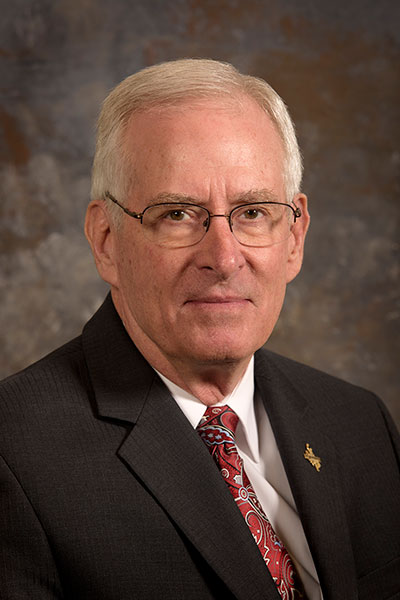
Kermit Brown
By Kermit Brown
In the discussion over a proposed annual reduction of $20 million to the block grant
the University of Wyoming receives from state government, assertions have been made
that the cut is necessary because UW has strayed from its founding purpose as a land-grant
university.
Nothing could be further from the truth.
In fact, Wyoming’s land-grant university remains absolutely true to the federal Morrill
Act of 1862 and its later iterations, as well as the founding principles in the state
statute adopted in the state’s first legislative session in 1890 and in the Wyoming
Constitution.
The Morrill Act called for the creation of public universities to “promote the liberal
and practical education of the industrial classes in the several pursuits and professions
in life,” specifically emphasizing “agriculture and the mechanic arts” but not excluding
“other scientific and classical studies.” Over the years, the land-grant mission has
grown to also encompass research and service to the state, activities UW undertakes
with a great sense of responsibility.
Wyoming’s founders added to the Morrill Act language with a more detailed mandate
in state statute. Because it’s so important, I’m quoting it extensively here:
“The objects of the university are to provide an efficient means of imparting to men
and women, without regard to color, on equal terms, a liberal education, together
with a thorough knowledge of the various branches connected with the scientific, industrial
and professional pursuits. To this end it shall embrace colleges or departments of
letters, of science and of the arts together with such professional or other departments
as in course of time may be connected therewith. The department of letters shall embrace
a liberal course of instruction in language, literature and philosophy, together with
such courses or parts of courses in the college or department of science as are deemed
necessary.
“The college, or department of science, shall embrace courses of instruction in the
mathematical, physical and natural sciences, together with such courses in language,
literature and philosophy as shall constitute a liberal education. The college or
department of the arts shall embrace courses of instruction in the practical and fine
arts and especially in the applications of science to the arts of mining and metallurgy,
mechanics, engineering, architecture, agriculture and commerce, together with instruction
in military tactics, and in such branches in the department of letters, as are necessary
to a proper fitness of students for their chosen pursuits, and as soon as the income
of the university will allow, in such order as the wants of the public shall seem
to require, the courses in the sciences and their practical applications shall be
expanded into full and distinct schools or departments.”
This direction from Wyoming’s founders has guided UW’s development over the decades,
and it’s reflected in the university’s structure and offerings today. While continuing
to emphasize agriculture and engineering, UW leaders have, in fact, added academic
colleges and degree programs to meet the demands of all Wyoming industries, as well
as to prepare students “for their chosen pursuits.” We now offer degrees in over 200
areas of study, producing teachers, nurses, engineers, accountants, natural resource
managers, lawyers, scientists, artists, entrepreneurs and many others who fill important
roles in Wyoming’s workforce and economy.
Because UW’s resources are limited, we recognize the importance of prioritizing. Even
as we add degree programs and certificates to meet the needs of students and employers,
the university constantly is assessing its offerings to determine what we should modify,
continue or drop. We have shed low-enrollment programs that don’t align with the state’s
needs, and we will continue to do so.
The problem with the $20 million annual cut proposed by the Legislature’s Joint Appropriations
Committee is that it would force us to drop programs that do fill the needs and wants
of students and the state. And it would make it much more difficult to adhere to the
Wyoming Constitution’s direction that a UW education be “as nearly free as possible.”
There is reason to believe that the assertion that UW has strayed from its founding
purpose as a land-grant university primarily has to do with some of what is taught
under the broad umbrella created by the Morrill Act and state statute, as well as
some of the non-academic programs and services the university has provided to students
and employees. On that front, UW has shown a willingness to comply with legislative
directives, most recently in the elimination of the university’s Office of Diversity,
Equity and Inclusion -- and in excising DEI concepts and advocacy from instruction,
a process that is ongoing.
While state statute gives UW’s Board of Trustees the responsibility to “prescribe
the studies to be pursued and the textbooks to be used” at the university, UW’s leaders
are always willing to engage in discussions with the state’s policymakers about the
university’s offerings -- and follow established processes to make appropriate changes.
The Legislature and the state’s elected officials represent the people of Wyoming,
and appropriations from the Legislature and the governor are what make it possible
to have a world-class land-grant and flagship university, as envisioned by the state’s
founders.
It would be a terrible shame if misunderstandings regarding what being a land-grant
university really means end up being the cause of unnecessary cuts that severely harm
UW’s ability to fulfill its land-grant mission. We hope the full Legislature will
recognize that potential harm and, instead, work with the university to make desired
adjustments -- as lawmakers and UW leaders have done for well over a century.
Kermit Brown is the chairman of the University of Wyoming Board of Trustees.

The University of Wyoming has earned its Research Level 1 (R1) status from the Carnegie Classification of Institutions of Higher Education, placing Wyoming's only four-year university with the top research universities in the United States.