
UW Planetarium to Host Artemis II Mission Launch Party During February
Published January 28, 2026
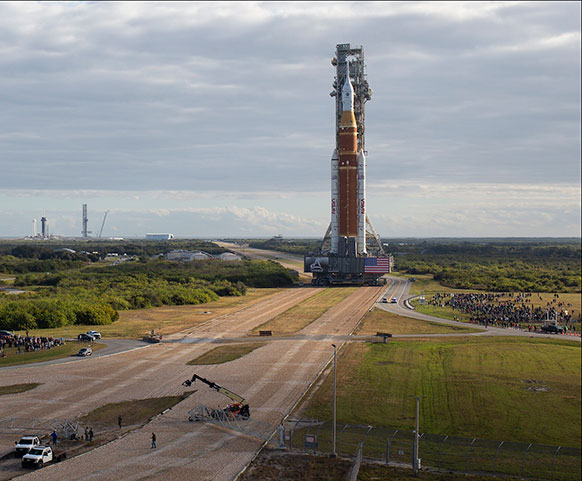
An SLS rocket stacked for the pending Artemis II mission is transported to the launch pad. The University of Wyoming Harry C. Vaughan Planetarium is planning to celebrate the expected Artemis II mission during February with a launch party. (NASA Photo)
The University of Wyoming Harry C. Vaughan Planetarium is planning to celebrate the expected Artemis II launch mission during February as well as recognize Valentine’s Day.
“We are anticipating the Artemis II mission to launch four astronauts on a journey around the moon this February. While the rocket is in position and the astronauts are on standby, the earliest available launch date is Feb. 6,” says Max Gilbraith, the planetarium’s director. “When we receive word that they are going to fuel up the rocket and have the astronauts embark, we will host a free, live watch party at the planetarium. For the rest of the month, we will have a variety of moon and space exploration themed programs.”
Additionally, the planetarium will recognize Valentine’s Day with a “Hearts in the Sky” program as well as a music and light show with a Valentine’s Day playlist at 8:30 p.m.
To get tickets or receive more information about programs, email planetarium@uwyo.edu or leave a voicemail and a callback phone number at (307) 766-6506. Tickets are $5 for the public or online tickets, and $3 for students, senior citizens, veterans, first responders and those under 18. Seating is free for children under 5. Bulk tickets/gift cards are available at $2 each when 10 or more tickets are purchased.
Reservations or pre-purchase is not required, and walk-ins are welcome. Tickets can be purchased online with a credit card, reserved by email or voicemail, or purchased at the start of the show. Cash or check is accepted at the door. The planetarium, which seats 64, is in the basement of the Physical Sciences Building. Seating is on a first-come, first-served basis outside of designated ADA/wheelchair seating.
To pay for tickets with a credit card, go to www.uwyo.edu/uwplanetarium/ticket.aspx. For a group larger than six, email the planetarium for a private show at https://uwyo.sjc1.qualtrics.com/jfe/form/SV_bKuqIynOn7gFK2F. Tickets for private shows are the same as the public programs.
A film and special live talk for audiences will be featured each week. All programs are approximately an hour in length. As time allows, a portion of the show also may focus on a live sky tour or supporting information related to the film’s topic.
The February schedule is:
-- Friday, Feb. 6, time and date TBD: “Artemis II Launch Party.” This is the earliest available date for the launch of four astronauts on the Artemis II mission that will orbit around the moon.
-- Friday, Feb. 6, 7 p.m.: “All About Apollo.” In 1962, JFK challenged the nation to land a man on the moon before the end of the decade. In July 1969, his challenge was met. But the U.S. didn’t stop there. From 1969-1972, NASA launched 17 missions to the moon. From “one small step” to the last footprint on the moon, this program goes in-depth about each mission to Earth’s nearest celestial neighbor.
-- Friday, Feb. 6, 8:30 p.m.: “Liquid Sky: Space Rock,” a music-based light show. Enjoy a custom playlist of “out-of-this-world” space rock music from artists in 5.1 surround sound. The 4K-resolution planetarium sky will become a canvas of color, patterns and movement with cutting-edge music visualization software and live VJ talent.
-- Saturday, Feb. 7, 2 p.m.: “Forward! To the Moon,” a full-dome movie. Narrator Kari Byron, from “Crash Test World” and “MythBusters,” takes viewers on a
journey beyond Earth toward a sustainable future in space. NASA’s 21st century Artemis
program is the next step in the mission to explore the universe and land the first
woman and person of color on the moon. This film is produced by Fiske Planetarium
in collaboration with Tend Studio.
-- Saturday, Feb. 7, 7 p.m.: “From Earth to the Universe,” a full-dome movie. This film takes the audience out to the colorful birthplaces and burial grounds of stars and still farther out beyond the Milky Way to the unimaginable immensity of myriad galaxies.
-- Saturday, Feb. 7, 8:30 p.m.: “Liquid Sky: Country,” a music-based light show. Enjoy a custom playlist of “out-of-this-world” country music from artists in 5.1 surround sound. The 4K-resolution planetarium sky will become a canvas of color, patterns and movement with cutting-edge music visualization software and live VJ talent.
-- Tuesday, Feb. 10, 7 p.m.: “Wyoming Skies: Herschel Objects.” The program provides an exploration of the stars, constellations, planets, meteor showers and other celestial phenomena visible from Wyoming for the season. Perhaps not as famous today as the Messier catalog, the Herschel catalog was the building block of the general catalog of astronomical objects and a more methodical approach to mapping deep sky objects. Learn the history and the amazing gems of the Herschel catalog assembled by William and his sister, Caroline, in 1786.
After the planetarium show finishes at 8 p.m., informal telescope observing on the rooftop of the Physical Sciences Building at the STAR Observatory will be available, weather permitting.
-- Friday, Feb. 13, 7 p.m.: “Astronomical Women.” This program follows the history and discoveries of the great female astronomers, scientists and engineers from Hypatia -- Annie Cannon to Vera Rubin -- and the female astronomers of today.
-- Friday, Feb. 13, 8:30 p.m.: “Liquid Sky: The Beatles,” a music-based light show. Enjoy a custom playlist of “out-of-this-world” music from the legendary British band in 5.1 surround sound. The 4K-resolution planetarium sky will become a canvas of color, patterns and movement with cutting-edge music visualization software and live VJ talent.
-- Saturday, Feb. 14, 2 p.m.: “Back to the Moon for Good,” a full-dome movie. This film opens with the first era of space exploration in the late 1960s and early 1970s. Viewers will learn about what that era of landers and orbiters taught the world about the moon.
-- Saturday, Feb. 14, 7 p.m.: “Hearts in the Sky.” This Valentine’s Day program will explore love. The night sky is rich in mythology relating the human condition to the stars. Hear the epic star myths of romance and betrayal, as well as the science about those far-away objects those myths describe.
-- Saturday, Feb. 14, 8:30 p.m.: “Liquid Sky: Valentine’s Day,” a music-based light show. Enjoy a custom playlist of “out-of-this-world” romantic music in 5.1 surround sound. The 4K-resolution planetarium sky will become a canvas of color, patterns and movement with cutting-edge music visualization software and live VJ talent.
-- Friday, Feb. 20, 7 p.m.: “Dust, Light, Dust.” This program explores the science behind the formation of stars; the various forms they take; and the stellar graveyard, including white dwarfs, neutron stars and black holes.
-- Friday, Feb. 20, 8:30 p.m.: “Liquid Sky: Metal,” a music-based light show. Enjoy a custom playlist of “out-of-this-world” metal music in 5.1 surround sound. The 4K-resolution planetarium sky melts and becomes a canvas of color, patterns and movement with cutting-edge music visualization software and live VJ talent.
-- Saturday, Feb. 21, 2 p.m.: “Phantom of the Universe: The Hunt for Dark Matter,” a full-dome movie. The film reveals the first hints of dark matter’s existence through the eyes of Fritz Zwicky, the scientist who coined the term. The film also describes the astral choreography witnessed by Vera Rubin in the Andromeda galaxy and journeys across space and time to the Large Hadron Collider at CERN, the European Laboratory for Particle Physics.
-- Saturday, Feb. 21, 7 p.m.: “One Sky,” a full-dome series of short films. Each short film represents the perspective of a different culture or Indigenous society from around the globe. Each film stands alone as a short story, or in combination, as a longer narrative organized around themes of finding patterns and developing tools. Short films are “The Forge of Artemis,” “Thunderbird,” “Jai Singh’s Dream,” “Celestial Canoe,” “The Samurai and Stars” and “Wayfinders.”
-- Saturday, Feb. 21, 8:30 p.m.: “Liquid Sky: Pop,” a music-based light show. Enjoy a custom playlist of “out-of-this-world” pop music in 5.1 surround sound. The 4K-resolution planetarium sky will become a canvas of color, patterns and movement with cutting-edge music visualization software and live VJ talent.
-- Tuesday, Feb. 24, 7 p.m.: “Wyoming Skies: Annular Eclipse Revisited.” The program provides an exploration of the stars, constellations, planets, meteor showers and other celestial phenomena visible from Wyoming for the season. The annular eclipse of February 2026 will only be visible from the very southern latitudes of Earth. The planetarium will recreate the eclipse scenario and explain this odd and rare occurrence. Gilbraith hopes some researchers in Antarctica will take pictures or video that can be shared.
After the planetarium show finishes at 8 p.m., informal telescope observing on the rooftop of the Physical Sciences Building at the STAR Observatory will be available, weather permitting.
-- Friday, Feb. 27, 7 p.m.: “Extreme Explorers.” Humans can’t survive most environments on Earth without purpose-built clothing, shelter, and advanced food and water infrastructure. What about space? Probes, landers, rovers and other crafts require incredible engineering to survive the extreme radiation, heat, cold, weather, chemistry and climates of deep space. Learn what it takes for robots and, maybe, people to endure in these places.
-- Friday, Feb. 27, 8:30 p.m.: “Liquid Sky: Retro Rock,” a music-based light show. Enjoy a custom playlist of “out-of-this-world” retro rock music from artists in 5.1 surround sound. The 4K-resolution planetarium sky will become a canvas of color, patterns and movement with cutting-edge music visualization software and live VJ talent.
-- Saturday, Feb. 28, 2 p.m.: “Dawn of the Space Age,” a full-dome movie. The program explores the launch of the first artificial satellite, Sputnik, the magnificent lunar landings and privately operated space flights.
-- Saturday, Feb. 28, 7 p.m.: “We Are Stars,” a full-dome movie. What are we made of? Where did it all come from? Explore the secrets of our cosmic chemistry and our explosive origins. Connect life on Earth to the evolution of the universe by following the formation of hydrogen atoms to the synthesis of carbon, and the molecules for life. Narrated by Andy Serkis.
-- Saturday, Feb. 28, 8:30 p.m.: “Liquid Sky: Indie Rock,” a music-based light show. Enjoy a custom playlist of “out-of-this-world” indie rock music in 5.1 surround sound. The 4K-resolution planetarium sky will become a canvas of color, patterns and movement with cutting-edge music visualization software and live VJ talent.
For more detailed descriptions of all programs, go to www.uwyo.edu/physics/planetarium/schedule.html.

The University of Wyoming has earned its Research Level 1 (R1) status from the Carnegie Classification of Institutions of Higher Education, placing Wyoming's only four-year university with the top research universities in the United States.