
Five Moose Spotted During UW Biodiversity Institute’s Winter Moose Day Weekend
Published February 16, 2026
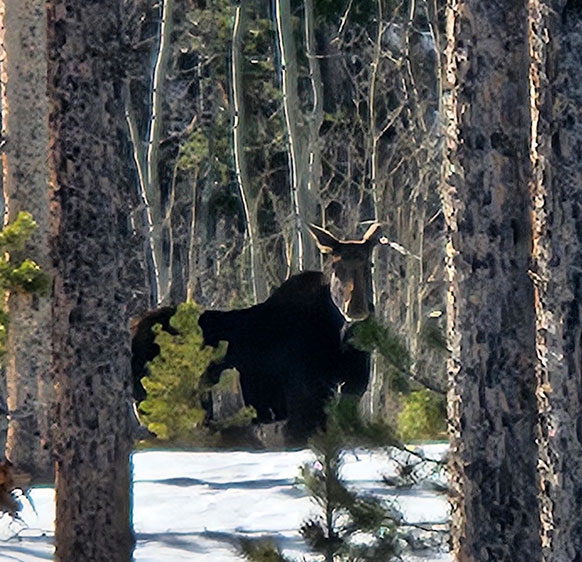
This moose was spotted along the Woods Creek loop in the Snowy Range area during Winter Moose Day weekend Feb. 7-8. Community scientists spotted five moose in the Snowy Range, Pole Mountain and Arlington areas during the event. Winter Moose Day is coordinated, in part, by the University of Wyoming’s Biodiversity Institute. (Ben Blasko Photo)
For the 12th year in a row, community scientists spotted moose and collected data
about their populations in three mountain ranges outside of Laramie during Winter
Moose Day weekend.
One hundred surveyors, traveling by snowshoes or skis, trekked 19 routes in the Snowy
Range, Pole Mountain and Arlington areas during the Feb. 7-8 event, which is coordinated,
in part, by the University of Wyoming’s Biodiversity Institute.
Volunteers looked for moose or signs of moose, including tracks/hoofprints in snow,
bed areas, scat droppings and browse on aspen and willows. In all, volunteers spotted
five moose -- two adult females and three moose of unknown sex and age.
“At least three moose also were seen as observers made their way to their routes,
but we don’t record these incidental observations in an official way,” says Mason
Lee, senior project coordinator of the Biodiversity Institute. “There were many observations
of fresh moose scat and suspected large herbivore tracks.”
The number of moose seen matched the 2025 winter count, Lee says. The winter record
sighting was in 2022 with 19 moose -- 15 adults and four calves.
Surveyors recorded visibility information, which includes sun coverage; snow coverage;
visibility conditions; whether there were other recreationists encountered on the
route; whether dogs were on the route; observations of live mammals, which included
any animals larger than a chipmunk; and observations of dead mammals, Lee says.
“All three survey groups on one of the Pole Mountain routes found what they suspect
is a young moose hide, although there were not skeletal remains in the area,” she
says. “One other group, on a different route, also found unknown mammal remains.”
The 100 surveyors made up 34 different survey groups. Twelve of the 17 routes in the
Pole Mountain area were surveyed; six of 12 routes in the Snowy Range area were covered;
and the one route in the Arlington area was trekked, Lee says.
Lee adds that 10 of the 19 routes were surveyed by more than one group -- a practice
that was first used during the 2022 Summer Moose Day. Surveyors are typically a mix
of some volunteers who participate annually as well as newcomers.
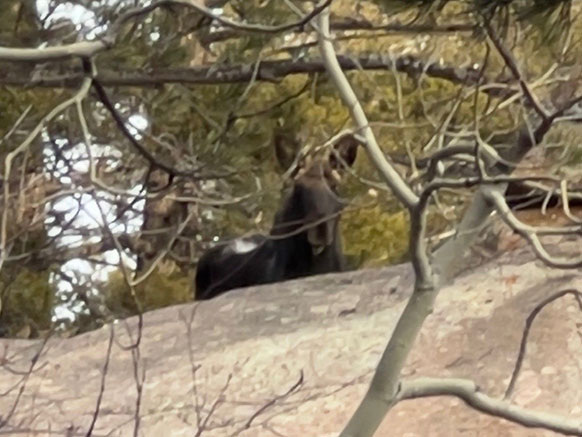
This moose was observed on the Turtle Rock trail in the Pole Mountain area during the recent Winter Moose Day weekend. (April Heaney Photo)
“It looks like we had good clear conditions on Moose Day weekend. Surveyors mostly
reported perfect visibility for their observations. Other non-Moose Day participants
were encountered on several Moose Day routes, and these non-participants had dogs
with them on six of the Moose Day routes,” Lee says. “Besides moose, mule deer, rabbits
and squirrels also were observed. To probably nobody’s surprise, most of the data
points reported from surveyors this year included either no snow or mixed snow/bare
earth within the visual area.”
The data gathered from Winter Moose Day will be shared with biologists at UW. These
biologists use the data collected by community scientists to further their understanding
of the population densities of local moose, their reproductive rates, their winter
ranges and how these variables change over time.
More information will be learned after Dave Christianson, an associate professor in
the UW Department of Ecosystem Science and Management, and his graduate students analyze the Moose Day data as well as external factors
that can affect moose counts, Lee says.
Both the winter and summer Moose Day events are geared toward increasing the public’s
understanding of moose in the Laramie area and involving the public in asking and
answering questions. These events are an extension of the original program, Moose
Day, held by Nature Mapping Jackson Hole (NMJH) in Jackson each winter. NMJH is a
citizen science program created by the Jackson Hole Wildlife Foundation.
The UW Biodiversity Institute fosters conservation of biodiversity through scientific discovery, creative dissemination, education and public engagement. In this setting, scientists, citizens, students and educators come together to share a wealth of perspectives on the study and appreciation of biodiversity -- from microbes to poetry and ecosystems to economics. Learn more at www.wyomingbiodiversity.org.

The University of Wyoming has earned its Research Level 1 (R1) status from the Carnegie Classification of Institutions of Higher Education, placing Wyoming's only four-year university with the top research universities in the United States.