
From Enemy Mascot to Wyoming Icon: The Surprising Origin of UW’s Pistol Pete
Published February 10, 2026
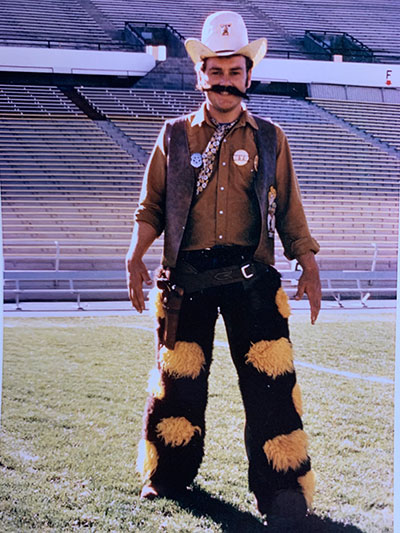
Donald Bogdan, a master’s student at UW in 1970, poses in the original Pistol Pete mascot costume he assembled. During his undergraduate days at San Jose State University, he was Sparti, that school’s mascot. Bogdan fell in love with Laramie when the Spartans visited War Memorial Stadium for a game against the Cowboys in 1969. A year later, he created Pistol Pete. (Donald Bogdan Collection and American Heritage Center Photo)
Very few University of Wyoming fans know that Pistol Pete began not as a Cowboy, but as a Spartan warrior who nearly sparked a riot at UW’s War Memorial Stadium.
A new article on WyoHistory.org reveals how Donald Bogdan, dressed as “Sparti,” the spear-carrying mascot for San Jose State University, created a moment of mayhem during a 1969 game in Laramie -- and fell so in love with Wyoming that he returned to create one of college sports’ most enduring mascot traditions.
“Sparti plants the spear and is looking across the sideline … and there are like 400 people running from that side of the field toward him,” recalled George Henderson, Bogdan’s college roommate and fellow San Jose State cheerleader.
Sparti had to hide in the stands for nearly the entire game, says Henderson during an interview with UW American Heritage Center archivist John Waggener, who penned the story for WyoHistory.org.
Despite the close call, Bogdan was charmed by Laramie during the homecoming weekend. After graduating from San Jose State, he applied to UW’s graduate program, was accepted and began his master’s studies in 1970.
Attending his first Wyoming football game as a student, Bogdan was shocked to discover that, while UW had Cowboy Joe, the Shetland pony, and the Pistol Pete logo, there was no human cowboy mascot leading cheers. At the urging of cheerleaders Susan Kamm and Tom Lintz, he assembled a cowboy outfit -- complete with chaps, vest, oversized mustache and a pistol that shot out a “BANG” flag -- and Pistol Pete was born.
For his tremendous enthusiasm, Bogdan received the prestigious Admiral Emory S. Land Award in October 1971. After earning his master’s degree in 1972, he returned to California to teach industrial arts.
Bogdan’s influence extended beyond Wyoming. His roommate, Henderson, whom Bogdan convinced to become a cheerleader, went on to fame as “Krazy George,” the professional cheerleader credited with inventing the stadium “wave” in the 1980s.
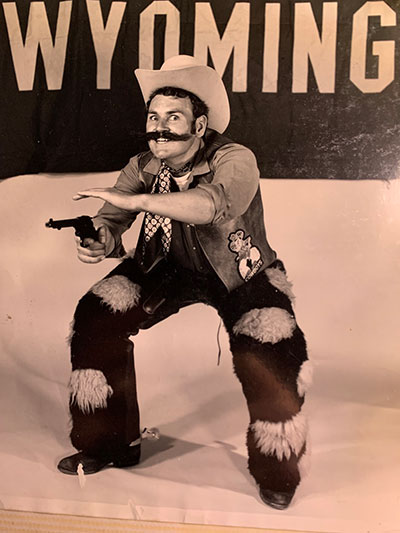
Donald Bogdan, UW’s original Pistol Pete mascot, poses with a quick draw of his prop gun. Since Bogdan first donned the costume, approximately 25 other UW students have carried on the tradition. The addition of a full cowboy costume with a pullover head in the early 1980s obscured Pete’s identity, adding to the mystique of Wyoming’s beloved mascot. For more than 55 years, Pistol Pete has rallied Cowboys and Cowgirls fans. (UW 1970-71 Yearbook Photo)
“My whole life would have never changed without Don Bogdan,” Henderson says.
Since Bogdan first donned the Pistol Pete outfit in 1970, approximately 25 other UW students have carried on the tradition. The addition of a full cowboy costume with a pullover head in the early 1980s obscured Pete’s identity, adding to the mystique of Wyoming’s beloved mascot.
For more than 55 years, Pistol Pete has rallied Cowboys and Cowgirls fans. Now, his remarkable origin story -- from enemy mascot to Wyoming icon -- is finally told.
The story is based on Waggener’s research from UW’s American Heritage Center, including interviews with Henderson, archival materials and photographs. The full article can be read at Wyohistory.org.
About WyoHistory.org
WyoHistory.org is an interactive encyclopedia of Wyoming history that encourages exploration of Wyoming and its past. The website is the primary source of online information about Wyoming history for teachers, students, tourists, public officials, history enthusiasts, scholars and others.
About the American Heritage Center
The American Heritage Center at UW is the university’s repository of manuscripts, rare books and university archives. Established in 1945, the AHC holds more than 90,000 cubic feet of historical documents, over 50,000 rare books and extensive collections focusing on Wyoming and the Rocky Mountain West. The AHC serves students and scholars from around the globe and provides fellowships, travel grants and educational outreach programs. Access to the AHC is free and open to all.

The University of Wyoming has earned its Research Level 1 (R1) status from the Carnegie Classification of Institutions of Higher Education, placing Wyoming's only four-year university with the top research universities in the United States.