
Partnership Among UW, Range, WYDOT Promises Safer Roads in Wyoming
Published February 18, 2026
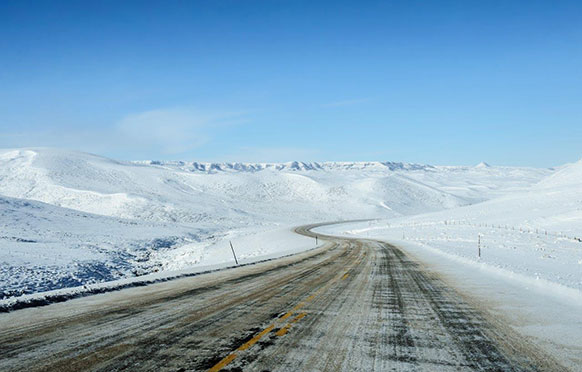
A UW-led project involving artificial intelligence and fiber-optic lines aims to make Wyoming highways safer, through traffic and weather monitoring. (UW Photo)
Anywhere else in the country, it might be called a back road, but here in Wyoming,
it’s a legitimate highway with nothing but sagebrush for company for hundreds of miles.
With no oversight to keep an eye on conditions, a truck off the road or a snowdrift
spanning a lane can quickly escalate into a major travel disruption for both commercial
drivers and residents, leading to accidents and costly delays.
Thanks to a pilot project led by University of Wyoming Associate Professor Diksha
Shukla in the Department of Electrical Engineering and Computer Science, these hazards
could be significantly reduced.
The project, titled “Feasibility of Employing AI Computer Vision and Distributed Fiber
Optic Sensing for Traffic and Weather Monitoring,” will deploy Distributed Acoustic
Sensing (DAS) in tandem with artificial intelligence-based computer vision to monitor
a section of U.S. Highway 85 just north of Cheyenne.
“DAS turns ordinary fiber-optic cables -- like the ones already running along Wyoming
highways -- into thousands of tiny vibration sensors. Every time a vehicle drives
by or weather affects the road, the cable ‘feels’ the vibrations, records them and
sends that information to a computer, which can figure out things like traffic speed,
congestion or even icy conditions,” Shukla says.
As a supplement to this acoustic-based system, an AI-based computer vision system
will use cameras and tailored algorithms to provide visual checks and balances. The
computer vision system can identify the presence of vehicles and analyze weather and
road conditions.
Shukla is excited about the potential benefits to the state for such a system.
“Together, these systems give a real-time, 360-degree view of traffic and weather,
without needing dozens of expensive roadside sensors or repeated manual checks,” Shukla
says. “Essentially, it’s like giving the roads their own ‘senses’ so WYDOT can see
what’s happening and respond faster to keep people safe and traffic moving smoothly.”
Shukla notes that these monitoring technologies will not collect any personal data
from vehicles, and residents are unlikely to notice that the pilot study is happening,
besides the occasional presence of a maintenance vehicle, as no new infrastructure
is needed.
This model would provide an extremely simple and cost-effective solution to the state
for increasing reliable traffic and road conditions data, serving as an invaluable
tool for WYDOT and drivers who rely on accurate travel information.
While the project officially launched in March 2024, the pilot study on Highway 85
is scheduled to begin soon and will run for six months, with completion projected
for this September.
Multiple partners are collaborating to make this project possible.
The research project is federally funded, with operational oversight provided by WYDOT.
Range, one of the largest fiber-optic carriers in Wyoming, owns and maintains the
fiber-optic network on which the project depends and is responsible for operations
in the field during the pilot project, including installation and connectivity of
the associated technologies. LUNA/OptaSense is furnishing the sensor technology that
converts existing fiber-optic cables into a distributed sensor array.
While Shukla’s team at UW is leading the project and is primarily responsible for
research and analysis, a team at the University of Cincinnati will lend its expertise
in evaluating technical performance of the equipment and costs associated with the
project.
Successful completion of the pilot study could see the implementation of the integrated
monitoring systems on roads across the state.
“The public can expect safer and more efficient travel along Wyoming highways as a result of this study,” Shukla says. “By using existing fiber-optic infrastructure to monitor traffic and weather in real time, WYDOT will be able to detect hazardous conditions, congestion and icy or snow-covered roads more quickly, allowing for faster response and improved safety.”

The University of Wyoming has earned its Research Level 1 (R1) status from the Carnegie Classification of Institutions of Higher Education, placing Wyoming's only four-year university with the top research universities in the United States.