
Three UW Students to Present Research During Science Café in Pinedale March 1
Published February 23, 2026
Olivia Beaudette
Lindsey Mitchell
Lauren Wetterau
Three University of Wyoming graduate students will present their research to the public during a Science Café Sunday, March 1, at 1:30 p.m. in Sublette County.
The event, hosted by UW’s Biodiversity Institute, will take place at the Sublette Board of Cooperative Educational Services, located at 665 N. Tyler Ave. in Pinedale. The event is free and open to the public.
The three UW graduate students will present casual talks -- 10-15 minutes each -- about their research, with time for a question-and-answer session following each talk and at the end of the event.
“At the Biodiversity Institute, we believe it’s important that students receiving our biodiversity graduate student research enhancement grants communicate their projects with the public. We encourage our awardees to connect with communities through public outreach that best suits their projects and audiences,” says Abbey Morales, communications and marketing specialist for the Biodiversity Institute. “Our Science Cafés are particularly popular with communities and students as a way to share the amazing research that’s happening at the University of Wyoming. We’ve hosted Science Cafés all over the state and look forward to connecting with people in a casual way.”
The three UW graduate students and their projects are:
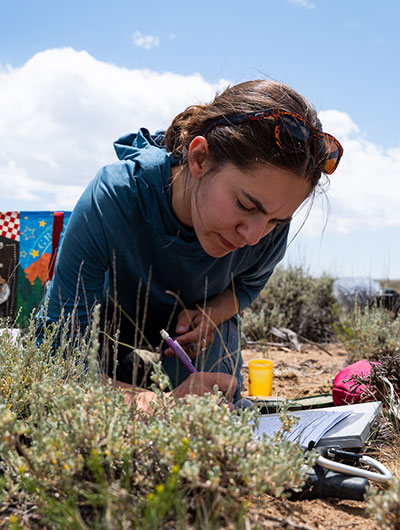
-- Olivia Beaudette, “From Bugs to Birds: The Role of Food in Songbird Survival.”
Beaudette’s research focuses on the early life stages of songbirds, when nestlings
are entirely reliant on their parents for the energy needed to grow and survive. Nestling
diets and food availability might influence survival during this risky life stage.
This information is important to effectively manage declining species, such as sagebrush
songbirds, which experience high rates of juvenile mortality.
Despite influencing many of the outcomes observed in wildlife populations, key information about food preferences; the distribution of those foods within the landscape; and their effects on animals is not well understood for many declining species, she says.
“In this talk, I will explore the hidden lives of songbirds as they prepare to leave the nest; the risks associated; and how they’re related to population declines in sagebrush songbirds,” Beaudette says.
Beaudette, of Manchester, N.H., is a second-year master’s student studying zoology.
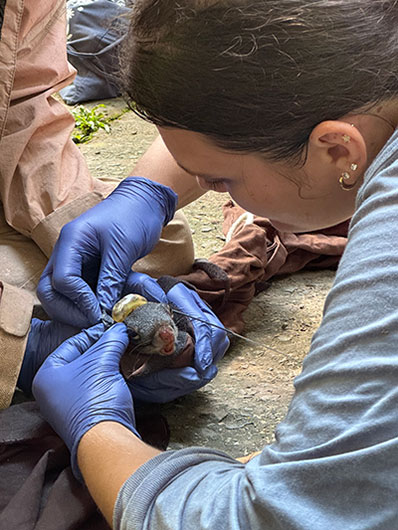
-- Lindsey Mitchell, “Small Mammals in a Changing Rainforest.” Tropical rainforests are among the most biodiverse and important ecosystems on Earth, providing critical habitat for wildlife along with essential ecosystem services. Despite their critical ecological role and the essential services provided, Southeast Asian rainforests are experiencing some of the highest deforestation rates in the world.
When thinking about important rainforest species, squirrels and tree shrews may not be the first animals to come to mind, Mitchell says. However, these small mammals play a crucial role in maintaining the health of the entire ecosystem through services such as seed dispersal.
For example, on the island of Borneo, there are 36 species of squirrels and five species of tree shrews, with diversity ranging from Bornean pygmy squirrels (Exilisciurus exilis) weighing just a quarter of an ounce to Thomas’ flying squirrels (Aeromys thomasi) that weigh 3 pounds. Although these species contribute essential ecosystem services to rainforests, they remain largely understudied.
Mitchell’s research will address two key questions: How do different squirrel and tree shrew species partition their resources and habitats, and are there any species that could serve as effective indicators of rainforest health?
The first question will provide important insight into Bornean squirrels’ and tree shrews’ ecology, filling knowledge gaps about how these species interact with their environment and each other. The second question seeks to identify an indicator species, which could provide valuable tools for assessing rainforest health, offering a more efficient and cost-effective approach to environmental monitoring.
“I will be sharing preliminary analysis on species diversity; home-range size of collared animals; and habitat use of these species,” Mitchell says. “Our findings will provide valuable baseline data on important rainforest species; offer science-based guidance for local conservation efforts; and contribute to global strategies aimed at preserving biodiversity in one of the world’s most critical and rapidly disappearing ecosystems.”
Mitchell, of Colorado Springs, Colo., is a second-year master’s student studying mammalogy and conservation biology.
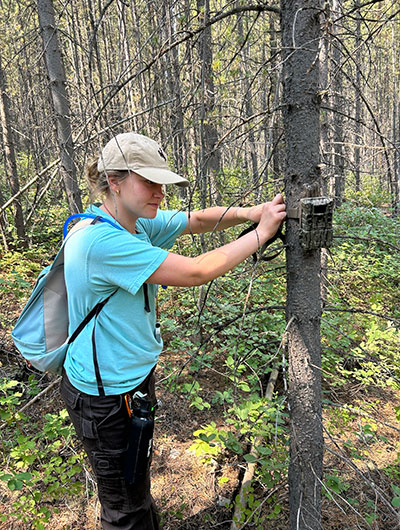
-- Lauren Wetterau, “Why it’s a good thing red squirrels are literally everywhere?” Wetterau is studying how red squirrels affect biodiversity and species abundance in coniferous forests within the greater Yellowstone ecosystem.
Red squirrels create centralized piles from the debris left over from pine cones, and these piles are known as middens. Unlike many other squirrel species, red squirrels are larder hoarders, so they store all of their pine cones in these middens to keep a stocked food supply year-round. As a result, other species within the forest are attracted to these middens because of the resources inside.
“We know of a couple individual species, such as grizzly bears, that benefit from middens. But my research aims to see if and how the middens impact the forest community as a whole,” Wetterau says. “We often view squirrels as pesky critters that won’t stop hogging the bird feeder or chattering at us on peaceful hikes. But I’m excited to challenge people to think of them in a new way and consider how much good they might be doing for the other animals in their ecosystem.”
Wetterau, of Columbus, Ind., is a third-year master’s student studying zoology and physiology.
For more information, go to the event’s Facebook page or email Morales at emorale3@uwyo.edu.

The University of Wyoming has earned its Research Level 1 (R1) status from the Carnegie Classification of Institutions of Higher Education, placing Wyoming's only four-year university with the top research universities in the United States.