
UW Physics and Astronomy Graduate Student Wins Major Astronomy Award
Published February 04, 2026
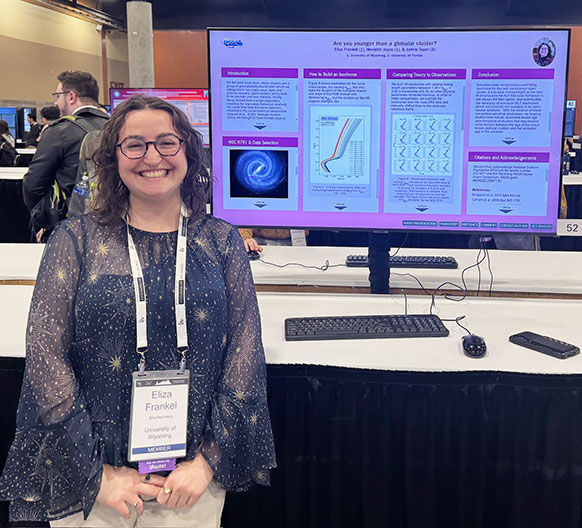
Eliza Frankel, a University of Wyoming physics and astronomy Ph.D. student, poses with her award-winning poster at a meeting of the American Astronomical Society in Phoenix, Ariz. in early January. Frankel was one of seven graduate students honored with the society’s Chambliss Astronomy Achievement Student Award. (Meridith Joyce Photo)
Eliza Frankel, a University of Wyoming Ph.D. student studying physics and astronomy,
was one of seven graduate students honored with the Chambliss Astronomy Achievement
Student Award at the 247th meeting of the American Astronomical Society (AAS) in Phoenix,
Ariz. in early January.
The award is given to students with exceptional research and oral presentation skills.
Frankel, of Atlanta, Ga., was one of 480 graduate students who participated in the
AAS poster competition.
Frankel’s research poster, titled “Are you younger than a globular cluster?”, points
to a serious problem in stellar astronomy: Why do some stellar models find that there
are stars older than the age of the universe?
To address this issue, Frankel has focused on one specific piece of stellar modeling
known as the mixing length parameter to see how stellar populations change when the
underlying physics of stellar evolution is altered. In her poster, she provides evidence
that it cannot be assumed all stars have the same characteristics as our sun, which
could be one reason star ages derived from models appear to be much older than our
universe.
Frankel’s research was conducted under the guidance of adviser Meridith Joyce, an
assistant professor in UW’s School of Computing.
Judges for the AAS complimented Frankel’s poster for its “effectiveness in conveying
the project’s conceptual framework within the broader context of astronomy” and strong
“organization and visual mechanics.”
At the meeting, Frankel was able to hear about the future of space missions and cutting-edge
discoveries in astronomy. This included a field trip to Arizona Science Center’s planetarium
to learn about observations and discoveries from the Vera C. Rubin Observatory.
“I was able to catch up with graduate students from around the country I had met previously,
as well as being able to meet other astronomers all at different career stages,” says
Frankel, a second-year Ph.D. student. “It makes me very excited for my future in the
field and all of the exciting things to come.”
The 127-year-old AAS is a major international organization with more than 8,000 members
comprising professional and amateur astronomers and educators. The organization provides
opportunities for students to network and learn about opportunities in their field.

The University of Wyoming has earned its Research Level 1 (R1) status from the Carnegie Classification of Institutions of Higher Education, placing Wyoming's only four-year university with the top research universities in the United States.