
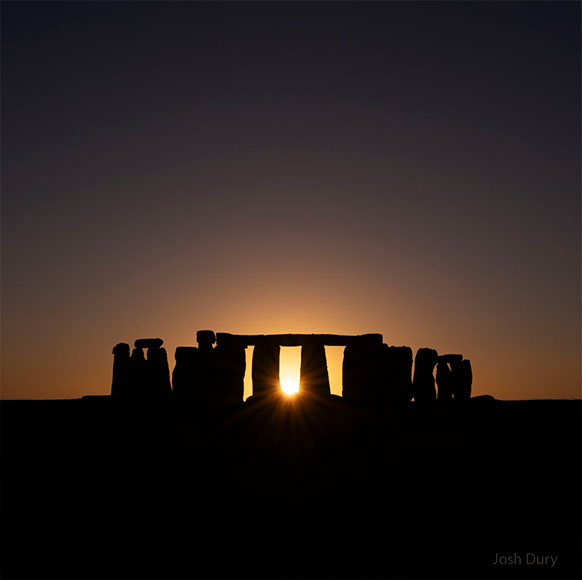
The sun sets over Stonehenge during the summer solstice -- the longest day and shortest night of the year. The image is meant to convey the alignment of the sun with the Earth for the spring equinox. A “Wyoming Skies” program will focus on the spring equinox at 7 p.m. Tuesday, March 24, in the UW Harry C. Vaughan Planetarium. (Josh Dury Photo)
A program about the spring equinox will be front and center at the University of Wyoming Harry C. Vaughan Planetarium during March.
“The highlight program might be the spring equinox program March 24,” says Max Gilbraith, the planetarium’s director.
During the spring equinox, the Earth’s axis and its orbit line up so that both the northern and southern hemispheres receive an equal amount of sunlight.
To get tickets or receive more information about programs, email planetarium@uwyo.edu or leave a voicemail and a callback phone number at (307) 766-6506. Tickets are $5 for the public or online tickets, and $3 for students, senior citizens, veterans, first responders and those under 18. Seating is free for children under 5. Bulk tickets/gift cards are available at $2 each when 10 or more tickets are purchased.
Reservations or pre-purchase is not required, and walk-ins are welcome. Tickets can be purchased online with a credit card, reserved by email or voicemail, or purchased at the start of the show. Cash or check is accepted at the door. The planetarium, which seats 64, is in the basement of the Physical Sciences Building. Seating is on a first-come, first-served basis outside of designated ADA/wheelchair seating.
To pay for tickets with a credit card, go to www.uwyo.edu/uwplanetarium/ticket.aspx. For a group larger than six, email the planetarium for a private show at https://uwyo.sjc1.qualtrics.com/jfe/form/SV_bKuqIynOn7gFK2F. Tickets for private shows are the same as the public programs.
A film and special live talk for audiences will be featured each week. All programs are approximately an hour in length. As time allows, a portion of the show also may focus on a live sky tour or supporting information related to the film’s topic.
The March schedule is:
-- Friday, March 6: The planetarium will be closed for a private event.
-- Saturday, March 7, 2 p.m.: “Forward! To the Moon,” a full-dome movie. Narrator Kari Byron, from “Crash Test World” and “MythBusters,” takes viewers on a journey beyond Earth toward a sustainable future in space. NASA’s 21st century Artemis program is the next step in the mission to explore the universe and land the first woman and person of color on the moon. This film is produced by Fiske Planetarium in collaboration with Tend Studio.
-- Saturday, March 7, 7 p.m.: “Back to the Moon for Good,” a full-dome movie. This film opens with the first era of space exploration in the late 1960s and early 1970s. Viewers will learn about what that era of landers and orbiters taught the world about the moon.
-- Saturday, March 7, 8:30 p.m.: “Liquid Sky: ABBA,” a music-based light show. Enjoy a custom playlist of “out-of-this-world” music from the Swedish pop band in 5.1 surround sound. The 4K-resolution planetarium sky will become a canvas of color, patterns and movement with cutting-edge music visualization software and live VJ talent.
-- Tuesday, March 10, 7 p.m.: “Wyoming Skies: Blood Moon Recap.” The program provides an exploration of the stars, constellations, planets, meteor showers and other celestial phenomena visible from Wyoming for the season. The early morning hours of Tuesday, March 3, will provide a total lunar eclipse that program attendees will be able to revisit virtually and through photography.
After the planetarium show finishes at 8 p.m., informal telescope observing on the rooftop of the Physical Sciences Building at the STAR Observatory will be available, weather permitting.
-- Friday, March 13, 7 p.m.: “Size of the Universe.” Have you ever wondered how far away the moon really is? Or what our solar system would look like if the sun was 100 times larger? Explore the universe in bite-sized chunks in distance scales that are understandable. Learn the true size of the universe.
-- Friday, March 13, 8:30 p.m.: “Liquid Sky: Indie Folk,” a music-based light show. Enjoy a custom playlist of “out-of-this-world” indie folk music in 5.1 surround sound. The 4K-resolution planetarium sky will become a canvas of color, patterns and movement with cutting-edge music visualization software and live VJ talent.
-- Saturday, March 14, 2 p.m.: “One Sky,” a full-dome series of short films. Each short film represents the perspective of a different culture or Indigenous society from around the globe. Each film stands alone as a short story, or in combination, as a longer narrative organized around themes of finding patterns and developing tools. Short films are “The Forge of Artemis,” “Thunderbird,” “Jai Singh’s Dream,” “Celestial Canoe,” “The Samurai and Stars” and “Wayfinders.”
-- Saturday, March 14, 7 p.m.: “Always Above” and “Dawn of the Space Age,” full-dome movies. “Always Above” looks at how much our modern way of life depends on the thousands of satellites that fly around our planet. Orbiting the Earth are satellites that allow us to communicate with one another, monitor the weather, help us get to where we’re going and keep our country safe.
“Dawn of the Space Age” explores the launch of the first artificial satellite, Sputnik, the magnificent lunar landings and privately operated space flights.
-- Saturday, March 14, 8:30 p.m.: “Liquid Sky: Women Who Rock,” a music-based light show. Enjoy a custom playlist of “out-of-this-world” music from female rock artists in 5.1 surround sound. The 4K-resolution planetarium sky will become a canvas of color, patterns and movement with cutting-edge music visualization software and live VJ talent.
-- Friday, March 20, 7 p.m.: “Meet the Planets.” This program provides a tour of the sun’s planets and moons. Learn the discoveries, exploration and feats of technology that have probed the solar system.
-- Friday, March 20, 8:30 p.m.: “Liquid Sky: Synthwave,” a music-based light show. Enjoy a custom playlist of “out-of-this-world” synthesizer music in 5.1 surround sound. The 4K-resolution planetarium sky melts and becomes a canvas of color, patterns and movement with cutting-edge music visualization software and live VJ talent.
-- Saturday, March 21, 2 p.m.: “The Great Solar System Adventure,” a full-dome movie. Join showman extraordinaire “The Great Schiaparelli” as he takes the audience on a death-defying space-time adventure within his wondrous observatorium. From the sun-scorched surface of Mercury to the icy expanses of Pluto and beyond, the audience will be subjected to the myriad dangers and wonders of our solar system.
-- Saturday, March 21, 7 p.m.: “We Are Stars,” a full-dome movie. What are we made of? Where did it all come from? Explore the secrets of our cosmic chemistry and our explosive origins. Connect life on Earth to the evolution of the universe by following the formation of hydrogen atoms to the synthesis of carbon, and the molecules for life. This film is narrated by Andy Serkis.
-- Saturday, March 21, 8:30 p.m.: “Liquid Sky: Pink Floyd’s ‘The Dark Side of the Moon,’” a music-based light show. Enjoy a custom playlist of “out-of-this-world” music from the classic album in 5.1 surround sound. The 4K-resolution planetarium sky will become a canvas of color, patterns and movement with cutting-edge music visualization software and live VJ talent.
-- Tuesday, March 24, 7 p.m.: “Wyoming Skies: Spring Equinox.” The program provides an exploration of the stars, constellations, planets, meteor showers and other celestial phenomena visible from Wyoming for the season. This week’s focus will be the constellations and objects in the early spring sky and the alignment of the spring equinox.
After the planetarium show finishes at 8 p.m., informal telescope observing on the rooftop of the Physical Sciences Building at the STAR Observatory will be available, weather permitting.
-- Friday, March 27, 7 p.m.: “Search for Extraterrestrial Life.” Astronomers use telescopes from ground and space to locate signs of life on other planets. Landers, rovers and probes visit the scattered planets and moons of our solar system to hunt for extraterrestrials.
-- Friday, March 27, 8:30 p.m.: “Liquid Sky: Tranquility/Relaxation,” a music-based light show. Enjoy a custom playlist of “out-of-this-world” relaxing tranquil music from artists in 5.1 surround sound. The 4K-resolution planetarium sky will become a canvas of color, patterns and movement with cutting-edge music visualization software and live VJ talent.
-- Saturday, March 28, 2 p.m.: “From Earth to the Universe,” a full-dome movie. This film takes the audience out to the colorful birthplaces and burial grounds of stars and still farther out beyond the Milky Way to the unimaginable immensity of myriad galaxies.
-- Saturday, March 28, 7 p.m.: “Dark Biosphere,” a full-dome movie. Deep beneath the Earth’s crust, hundreds of meters or kilometers below the surface -- with no light, no air and very little water, in pores and fissures of hard rock -- scientists have found an enormous biodiversity of micro-organisms that thrive in extreme conditions in an area known as the dark biosphere. This film is narrated by actor Viggo Mortensen.
-- Saturday, March 28, 8:30 p.m.: “Liquid Sky: Retro Rock,” a music-based light show. Enjoy a custom playlist of “out-of-this-world” retro rock music in 5.1 surround sound. The 4K-resolution planetarium sky will become a canvas of color, patterns and movement with cutting-edge music visualization software and live VJ talent.
For more detailed descriptions of all programs, go to www.uwyo.edu/physics/planetarium/schedule.html.

The University of Wyoming has earned its Research Level 1 (R1) status from the Carnegie Classification of Institutions of Higher Education, placing Wyoming's only four-year university with the top research universities in the United States.