
UW Researchers Measure How Much Bumble Bees Can Cool Body Temperature Through Wing Movement
Published February 23, 2026
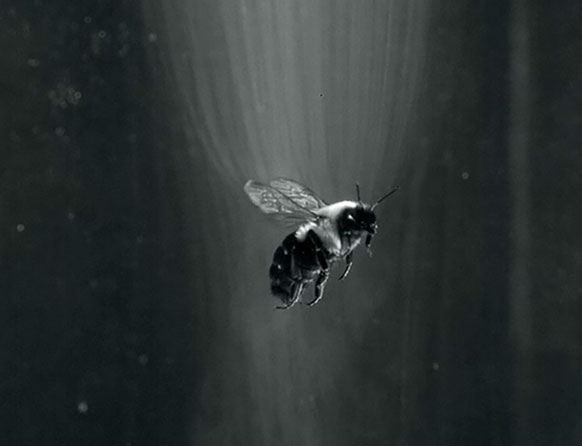
A bumblebee is observed flapping its wings in the fog of a vertical wind tunnel. Michael Dillon, a professor and the L. Floyd Clark Chair in the UW Department of Zoology and Physiology, and Jordan Glass, a postdoctoral research fellow in the department, headed a study that discovered a bumble bee flapping its wings downward can help cool the insect’s core body temperature as much as 41 degrees Fahrenheit. Their paper was published Feb. 18 in Proceedings of the Royal Society B: Biological Sciences. (Christopher Petranek Photo)
Like a duck that, on the surface, looks like it is calmly floating on the water while
paddling furiously underneath, a bumble bee hovering over a flower may look like it’s
not doing much to the naked eye.
But, to stay aloft, the insect’s wings are generating a significant amount of body
heat. The flapping, however, has another function: generating a breeze that creates
a fanning effect that cools and lowers the insect’s body temperature as much as 41
degrees Fahrenheit.
Michael Dillon, a professor and the L. Floyd Clark Chair in the University of Wyoming
Department of Zoology and Physiology, and Jordan Glass, a postdoctoral research fellow
in the department, headed a lab study that actually measured this phenomenon.
“At its core, the paper shows that, when a bumble bee flaps its wings to hover, it
generates a downward breeze that significantly cools its body,” Glass says. “Scientists
have long known that moving air can remove heat but, until now, no one had directly
measured how much cooling that self-generated airflow provides during free, hovering
flight. We show that this breeze is not minor -- it plays a meaningful role in stabilizing
body temperature.”
The paper, titled “Induced airflow cools hovering bumble bees,” was published Feb. 18 in Proceedings of the Royal Society B: Biological Sciences, the Royal Society’s flagship biological research journal that is dedicated to the
publication and dissemination of high-quality research.
Glass was the paper’s lead author, and Dillon was the senior author and principal
investigator on the project. Christopher Petranek was a UW master’s student in Dillon’s
lab at the time of the study and conducted most of the experimental work.
Understanding how flying insects manage heat exchange is critical for predicting their
survival in dynamic thermal environments, something that has largely not been studied,
according to the paper.
The same wings and flight muscles used by bumble bees for hovering create the cooling
effect. As the wings beat, they push air downward, forming a focused jet of moving
air over the part of the body directly below the wings during flight. That airflow
increases convective heat loss -- very similar to how a breeze cools our skin on a
hot day -- essentially carrying heat away from the thorax, where the flight muscles
generate most of the heat, Glass says.
As air temperature rises, bees do run a higher risk of overheating, especially in
direct sunlight, Glass says.
“Our simulations show that, at very high temperatures, hovering time can be limited.
However, bees do not suddenly ‘stall’ like an overheated engine,” Glass explains.
“The car radiator analogy captures the idea of heat buildup, but bees are dynamic
animals that can behaviorally adjust -- by seeking shade, altering flight behavior
or landing.”
During the study, the research team measured airflow from 36 freely hovering bumble
bees. The bees were filmed at high speed while the air currents generated by their
wings were recorded and measured up to about one meter per second.
The group then recreated those airflow speeds in a vertical wind tunnel, using 18
additional bees to measure cooling rates. Finally, the research team incorporated
these empirical measurements into heat-balance simulations that included metabolism,
body size, solar radiation and air flow, Glass says.
“The exact cooling depends on body size and environmental conditions, but the air
flow can shift a bee’s heat balance from gaining heat to losing heat,” he says. “In
our models, including self-induced air flow often kept body temperatures within a
safe flight range, while removing it caused temperatures to rise rapidly. The key
point is not a single number of degrees, but that this air flow substantially changes
whether a bee remains thermally stable.”
According to the paper, the study can prove valuable to inform broader warming climate
questions.
“Predicting how pollinators will cope with rising temperatures requires accurate models
of how they gain and lose heat,” Glass says. “By directly quantifying this overlooked
cooling mechanism, we improve those predictions. It gives scientists a clearer understanding
of how flying insects may respond to more frequent heat stress in a warming world.”
The research was funded by the National Science Foundation, the UW Research and Economic Development Division, and the UW Department of Zoology and Physiology.

The University of Wyoming has earned its Research Level 1 (R1) status from the Carnegie Classification of Institutions of Higher Education, placing Wyoming's only four-year university with the top research universities in the United States.