
UW Social Work Faculty Member Presents Research on Substance Use Treatment in Wyoming
Published February 18, 2026
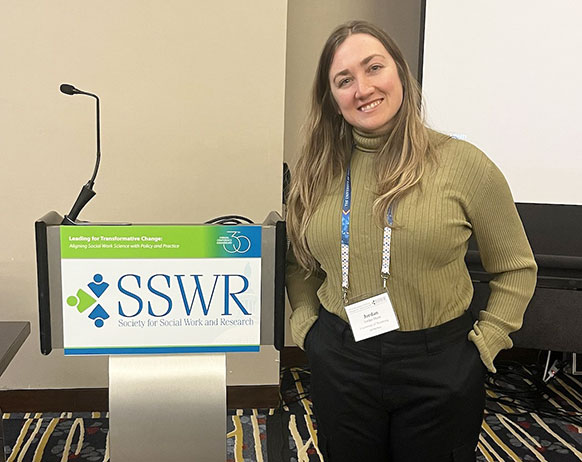
Jordan Dyett, an assistant professor in the UW Division of Social Work, recently presented her research findings that examine treatment for substance use across Wyoming at the 2026 Social Work Research Conference in Washington, D.C., in January. (Sarah Mountz Photo)
A faculty member with the University of Wyoming’s Division of Social Work recently
presented her research -- examining treatment for substance use across Wyoming --
on a national level.
Jordan Dyett, an assistant professor with the Division of Social Work, part of the
UW College of Health Sciences, presented her findings at the 2026 Social Work Research
Conference in Washington, D.C., in January. Funding for Dyett’s research was provided
by the Wyoming Survey and Analysis Center.
Dyett’s research focused specifically on examining how treatment providers are supporting
individuals with substance use histories and using community-based methods to identify
both barriers to treatment and effective solutions.
“Families across Wyoming navigate the impacts of substance use while seeking support
and recovery,” Dyett says. “While providers exist within the state, many face barriers
to effectively meeting the needs of their patients, due to things such as a lack of
transportation, affordable housing or limited funding to meet the needs of their patients.”
One of the most prominent challenges facing individuals dealing with substance use
issues is a shortage of health care providers trained in specific areas of substance
use and treatment. Members of rural communities, such as those found throughout Wyoming,
often must travel long distances to meet with a qualified care provider and, frequently,
weather and road conditions complicate things further. Others struggle to access health
care altogether due to limited access to transportation.
One solution Dyett found was taking a community-based approach to understand how providers
were still meeting the needs of their patients despite these challenges. In all, she
interviewed 36 providers around the state and 11 people receiving care. Interacting
with these individuals resulted in a better awareness of how providers used their
resources to best serve their community.
“Some providers helped patients access resources, such as telehealth, to connect them
with care, while others found creative solutions, including purchasing electric bikes
to reduce transportation barriers,” Dyett says.
“Dr. Dyett’s work reflects a strong commitment to improving access to substance use
services and care across Wyoming, and offers thoughtful, practical contributions,
with particular attention to reducing barriers for individuals and families,” says
Valerie Thompson-Ebanks, director of the UW Division of Social Work.
While participants remain anonymous, the experiences and outcomes of those involved
in Dyett’s research will inform the education and training of students preparing for
careers in rural and frontier social work.
“As Wyoming’s land-grant university, and through the collaborative work of the College
of Health Sciences, we have a responsibility to generate solutions that work in the
communities we serve,” says Patrick Hardigan, dean of the College of Health Sciences.
“Dr. Dyett’s research exemplifies how our faculty partner with providers and residents
to address real barriers to care in rural and frontier settings. The insights gained
not only strengthen services across the state but also prepare our students to enter
practice ready to meet Wyoming’s most pressing behavioral health needs.”
To learn more about the UW Division of Social Work, go to www.uwyo.edu/socialwork/index.html.

The University of Wyoming has earned its Research Level 1 (R1) status from the Carnegie Classification of Institutions of Higher Education, placing Wyoming's only four-year university with the top research universities in the United States.