
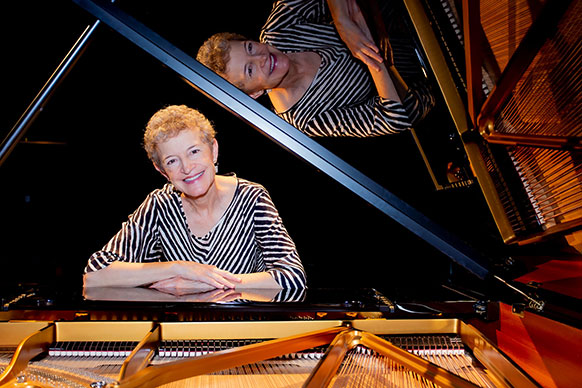
Theresa Bogard
Orchestras around the country are celebrating the United States’ 250th birthday, and the University of Wyoming Symphony Orchestra (UWSO) is no exception. For UWSO’s Thursday, March 5, concert, Conductor Michael Griffith has chosen works by three world-famous composers who, in his opinion, will still be performed in another 100 years: Aaron Copland, Leonard Bernstein and George Gershwin.
“There are so many great American composers,” Griffith says. “I speculated which will stand the test of time.”
The UWSO’s semiquincentennial concert will start at 7:30 p.m. in the Buchanan Center for the Performing Arts concert hall. Tickets are available at www.tix.com/ticket-sales/uwyo/6984, in person or at (307) 766-6666 at the Performing Arts box office, Monday through Friday, noon-6 p.m., and one hour before performances. UWSO concerts frequently sell out, so guests are encouraged to purchase them early.
Copland, a true American voice, captured the flavor of our land in his ballets such as
“Rodeo” and “Billy the Kid,” Griffith says. Gershwin tried to meld jazz, an original American art form, into classical music. Bernstein went even further -- taking elements from popular stage works, jazz, Latin American music, dance music and the most serious European traditions -- in creating his unique voice.
“Will these composers still be performed in 2126?” asks Griffith. “It’s impossible to know, but I think the answer is a resounding yes!”
Copland’s “Appalachian Spring” won the Pulitzer Prize for music in 1945. As a ballet, it tells the story of a newlywed couple in rural Pennsylvania. The music ranges from ethereal to square dance-like, with variations on the Shaker tune “Simple Gifts” as its climactic section. By turns atmospheric, fun, serious and folk-like, it’s the perfect example of America’s contribution to the orchestral repertoire, Griffith says.
The UWSO’s soloist for the evening, Theresa Bogard, a well-loved member of the UW music faculty, will present one of the finest American piano concertos: George Gershwin’s contribution to that form. The structure is purely classical. The harmonies, rhythms and melodies are clearly influenced by jazz. That was Gershwin’s artistic mission; he hoped to bring jazz music into the more formal setting of the orchestral concert hall. That he succeeded is evident, in this concerto, in “Rhapsody in Blue,” in his opera “Porgy and Bess” and in other works, Griffith says.
Bogard is playing her last performance with the orchestra before her retirement this spring, after a long and distinguished career. Over the years she has played two Beethoven concerti with UWSO, plus works by Ravel and Poulenc, among others. In her honor, a special reception will be held in the lobby after the concert.
The evening will open with the overture to “West Side Story” by Bernstein. “West Side Story” is one of Broadway’s most successful musicals, a perfect synthesis of theater and score, and of jazz and classical music. The overture opens with music from the “Tonight Quintet,” moving into the song “Somewhere” and ending with the famous “Mambo” from the dance at the gym. It’s the perfect opener to a concert celebrating the U.S.’s birthday, Griffith says.

The University of Wyoming has earned its Research Level 1 (R1) status from the Carnegie Classification of Institutions of Higher Education, placing Wyoming's only four-year university with the top research universities in the United States.