
UW’s Jay Kemmerer WORTH Institute Partners for Fishing Guide Course
Published February 17, 2026
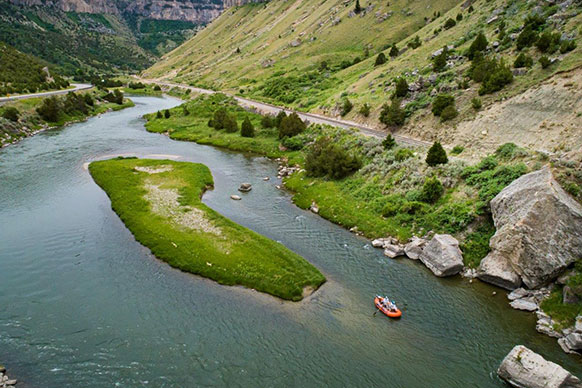
Anglers work a section of water in Wind River Canyon near Thermopolis. In collaboration with Wyoming fishing guides, UW’s Jay Kemmerer WORTH Institute is developing an advanced fishing guide certification course tailored specifically to Wyoming’s rivers, regulations and guiding traditions. (UW Photo)
The Jay Kemmerer Wyoming Outdoor Recreation, Tourism and Hospitality (WORTH) Institute
at the University of Wyoming has partnered with Wyoming fishing guides to support
the inaugural delivery of an advanced fishing guide certification course tailored
specifically to Wyoming’s rivers, regulations and guiding traditions.
The Fishing Outfitters Association of Montana currently offers “Guiding for the Future,”
an intensive professional development program for Montana outfitters and fishing guides
that blends self-paced online coursework with an in-person, on-the-water practicum.
Recognized for its depth and rigor, the program emphasizes conservation history, regulations,
ethics, hydrology, river ecology and professional guiding standards.
Wyoming-based outfitters Mike Dawes and AJ Sanders -- both longtime guide company
owners and instructors -- saw an opportunity to adapt the program for Wyoming’s unique
fisheries and regulatory environment. Sanders, owner of Wyoming Angling Co., and Dawes,
one of the owners of Westbank Anglers, worked together for decades running the Western
Rivers Guide School, which Sanders continues to lead today. Both are based in Jackson.
“Wyoming has some of the most iconic fisheries in the country, but our guides haven’t
had access to an advanced, Wyoming-specific professional certification,” Sanders says.
“This partnership allows us to build on a proven model while making it truly relevant
to the places and waters where we work.”
Dawes and Sanders partnered with the Jay Kemmerer WORTH Institute to adapt the existing
“Guiding for the Future” curriculum to Wyoming’s rivers, laws, conservation frameworks
and guiding culture. The collaboration resulted in the first cohort of Wyoming fishing
guides enrolling in the adapted course, which will culminate in an in-person practical
session on Wyoming waters this April.
This inaugural group of guides will play a key role in evaluating and refining the
curriculum to ensure it meets the needs of Wyoming’s guiding community and can serve
as a durable model for future cohorts.
“This course represents an important step in professionalizing fishing guide training
in Wyoming,” Dawes says. “It’s about elevating standards, supporting stewardship and
ensuring guides are equipped to deliver exceptional and responsible experiences.”
Once finalized, the program will offer an advanced certification for Wyoming fishing
guides, helping strengthen workforce development, conservation ethics and visitor
experiences statewide.
At the same time, Dan McCoy, director of the Jay Kemmerer WORTH Institute, notes that,
while fishing guides play a critical role in public land stewardship, angler education
and fisheries sustainability, the guiding profession lacks a nationally recognized
framework for core competencies and curriculum standards.
“Other outdoor professions -- such as avalanche education and professional trail building
-- have invested in clear competency standards and training pathways,” McCoy says.
“Fishing guiding is ripe for the same kind of thoughtful professionalization.”
Building on this work, senior undergraduate students in UW’s Outdoor Recreation and
Tourism Management Program will undertake a capstone research project examining fishing
guide schools nationwide and how other outdoor industries have developed training
standards. The project will produce a best-practices framework for fishing guide education,
including core competencies, curriculum structure and recommendations for an organization
to serve as a clearinghouse for guide training standards.
For more information, call Zach Blair, public relations coordinator at the WORTH Institute, at (307) 766-5063 or email zblair@uwyo.edu.

The University of Wyoming has earned its Research Level 1 (R1) status from the Carnegie Classification of Institutions of Higher Education, placing Wyoming's only four-year university with the top research universities in the United States.