
Interdisciplinary Education at UW’s Haub School Prepares Evanston Student for Conservation Challenges
Published March 06, 2026
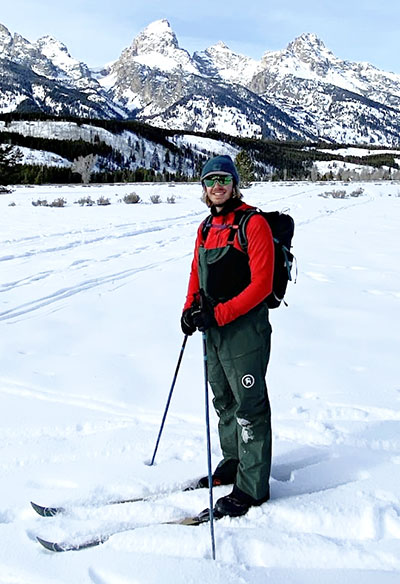
Riley Ovard
Growing up surrounded by natural wonder in Uinta County shaped Riley Ovard’s relationship
with the outdoors and his vision for the future. Now at the University of Wyoming’s
Haub School of Environment and Natural Resources, he’s discovered that same sense
of wonder through the program’s integration of science, policy, economics and social
perspectives.
“It’s super multidisciplinary. You’re not stuck in one way of thinking,” Ovard says.
“The professors challenge you to consider different perspectives, which makes you
adaptable to any situation.”
That adaptability is exactly what Ovard is looking for in his future career. While
still exploring options, he’s been drawn to wildfire management and envisions working
as a fire ecologist with the U.S. Forest Service.
“I want to work somewhere where I feel part of a community and where I’m making a
positive impact,” he says.
Beyond the classroom, the people have been the most rewarding part of his university
experience.
“All the friends I’ve made, the experts I’ve met -- it’s all been formative,” he says.
“I’ve gotten more from that than any class.”
Ovard graduates in May with a B.S. in environmental systems science and a concurrent
major in environment and natural resources. He also will graduate with minors in sustainability
and outdoor leadership as well as a certificate in geographic information science.
When asked what makes him a “Haubie,” Ovard’s answer includes community and an acceptance
of people.
“It’s the focus on community and the journey, not just the destination,” Ovard says.
“That willingness to accept people, no matter who or where they’re from. That’s the
Haub spirit.”
Three Decades of Impact
The Haub School prepares the next generation of natural resource professionals while
serving Wyoming’s wild and working lands and communities. The school has 1,275 alumni
spanning 1996-2025, with many working across the state in government, private industry,
nonprofits and education. The Haub School offers six undergraduate and seven graduate
programs integrating science, policy, law, economics and community engagement.
The school brings approximately $2 million annually in research funding to Wyoming
while supporting communities through four dedicated centers and institutes. Recent
milestones include a $5 million gift from Jay and Karen Kemmerer in 2025 to establish
the Wyoming Outdoor Recreation, Tourism and Hospitality Institute, supporting the
state’s second-largest industry.
Programs including the Wyoming Conservation Corps have trained over 150 young adults
and veterans since 2021, while the Biodiversity Institute connects people of all ages
to Wyoming’s wildlife through more than 40 annual programs reaching over 3,500 participants
statewide. The Ruckelshaus Institute facilitates collaborative, long-term solutions
to natural resource challenges, offers professional workforce development and publishes
the award-winning Western Confluence magazine, which reaches nearly 4,000 readers
in Wyoming.
To learn more, visit http://uwyo.edu/haub.
Tomé Scholars Program Now Accepting Applications
Established in 2021 through a major gift from UW alumni Carol and Ramon Tomé, the
Tomé Scholars to Fellows Program provides exceptional students with full-ride, four-year
scholarships and experiential learning opportunities to address complex environmental
challenges.
Recent expanded support from the Tomé Foundation has doubled the number of scholars
on campus. Applications for the upcoming academic year are due Sunday, March 15.
To learn more, visit www.uwyo.edu/haub/academics/academic-advising/tome-scholars-to-fellows.html.

The University of Wyoming has earned its Research Level 1 (R1) status from the Carnegie Classification of Institutions of Higher Education, placing Wyoming's only four-year university with the top research universities in the United States.