
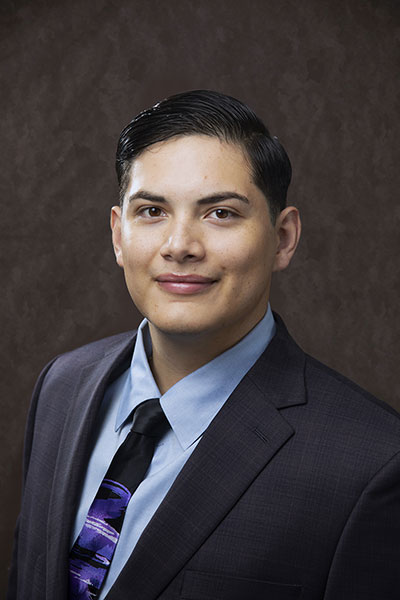
Carlos Garcia
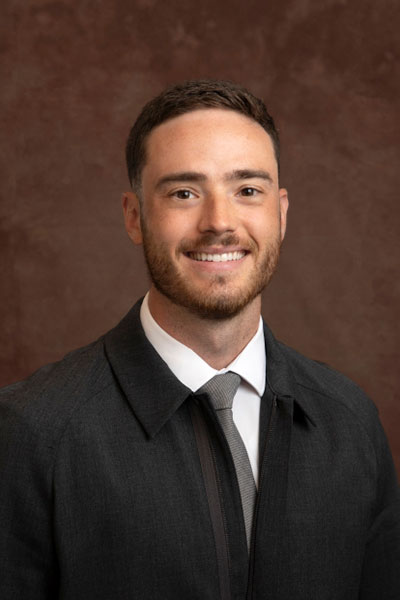
Kaden Moore
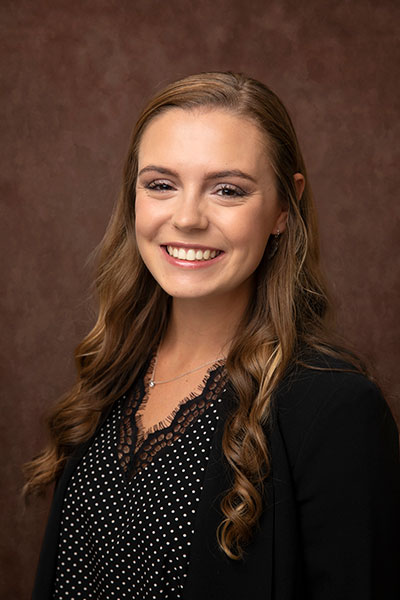
Rylie Pilon
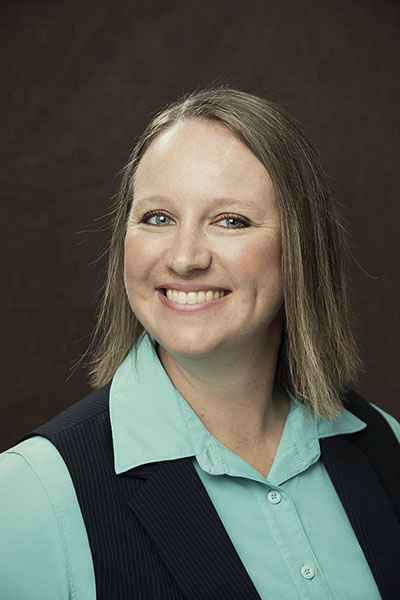
Cherol Minton
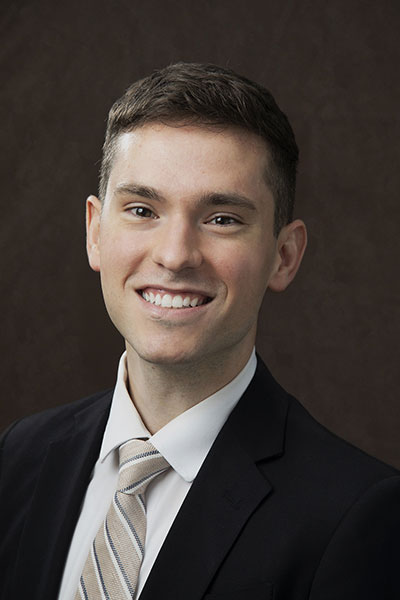
Jordan Moore
Students at the University of Wyoming’s College of Health Sciences, from a variety
of backgrounds, can become physicians and receive first-rate, hands-on medical education
across the Washington, Wyoming, Alaska, Montana and Idaho (WWAMI) regions thanks to
the Wyoming WWAMI Medical Education Program.
“The Wyoming WWAMI program offers three key advantages,” says Todd Guth, Wyoming WWAMI
director. “First, our affiliation with the University of Washington School of Medicine
(UWSOM) -- a top-ranked institution renowned for its excellence in academic training,
cutting-edge research and primary care education. Second, our small class size in
Wyoming WWAMI fosters deep connections with faculty and peers while enabling highly
individualized experiences in medical school training. Third, students gain unparalleled
clinical exposure by rotating across the Pacific Northwest -- including Alaska --
in rural and frontier communities, urban academic centers and regional referral hospitals
spanning five states.”
The Wyoming WWAMI Program’s roster of students, across cohorts, includes brothers
Kaden and Jordan Moore, of Powell, who share family ties as well as similar journeys
into medicine; Carlos Garcia, of Wheatland, who found medicine while earning his undergraduate
degree; Rylie Pilon, of Gillette, a former high school chemistry teacher and swim
coach; and Cherol Minton, of Moorcroft, a former teacher, environmental and bentonite
lab employee, certified nursing assistant, emergency medical technician and registered
nurse. With different backgrounds and interests, these future physicians found their
way to WWAMI.
Jordan Moore
Both brothers’ biographies on UW’s WWAMI webpage include international church missions,
young families and their sister, who has Down syndrome, as part of their journey toward
studying medicine.
Moore, a former UW Trustees Scholar who earned a bachelor’s degree in physiology and
a minor in developmental disabilities, is a first-year WWAMI student. Growing up,
he never thought of pursuing anything other than medicine.
When it came time to apply to medical school, he only applied to WWAMI. The program
offers, potentially, the ability to graduate with no debt -- depending on scholarships
and external factors -- if not significantly less than other programs, he says.
“The focus of the Wyoming WWAMI program is to train future physicians from Wyoming,
in Wyoming, for Wyoming,” Guth says. “Every student in the Wyoming WWAMI program benefits
from tuition support from the state of Wyoming in exchange for a service commitment
to return to serve the people and communities of Wyoming as a practicing physician.”
Moore is happy to return to Wyoming and practice medicine. He loved growing up in
Powell and would raise his son in Powell or a similar town, he says.
Moore, like Garcia and Minton, is a member of the entering class of 2025’s Targeted
Rural Underserved Track (TRUST) track. As part of this track, he will to return to
Powell for four weeks this summer and five months next year at Powell Valley Healthcare.
So far, his classes have included hands-on tutorials, such as physical exams and hospital
mornings, where the students interview, examine real patients and develop a potential
treatment plan.
These hands-on experiences, to his knowledge, set WWAMI apart as far as how early
students have these opportunities.
“So, that’s been really helpful. It makes you feel more comfortable thinking about
going on rotations,” he says.
Moore hasn’t decided on a specialty, he says, and won’t know what he wants to do until
he gets experience in rotations.
While he’s not sure if growing up with his sister was the primary driver for entering
medicine, it was a factor.
“I’ve always been drawn to working with people with disabilities because of her and,
so, getting to be in a field where you get to work in some capacity with people with
disabilities was very appealing,” he says.
If he became a pediatrician or went into general practice, he could become a go-to
for families who received prenatal Down syndrome diagnoses, or young children with
Down syndrome.
Because of the blessing his sister has been in his life, Moore would like to work
to make life better for people with developmental disabilities, he says. In his opinion,
there can sometimes be an attitude in the medical profession that Down syndrome and
other developmental disabilities are a negative thing.
“I want to kind of be the opposite voice and say, ‘This is so exciting. Let me tell
you about my sister,’” Moore says, referencing prenatal diagnoses. “Like, ‘Yes, this
is amazing; you’re so lucky to have this. It’s going to be hard, but it’s going to
be so rewarding.’”
Kaden Moore
While Jordan is in his first year, Kaden Moore is nearing the end of his third year
and also is leaving his options open in terms of specialties. Following his church
mission in Guatemala City, where he worked with, and developed connections with troubled
youth, he thought he may go into behavioral health, he says, pulling him away from
the interest he developed while attending his sister’s cardiology appointments as
a child. Then, ahead of pursuing an undergraduate degree at Brigham Young University-Idaho,
Moore got married and his father in-law, board-certified ophthalmologist in Cody,
provided exposure to ophthalmology.
Moore first became interested in WWAMI because he could return to Wyoming with much
of his tuition covered. He also researched the University of Washington School of
Medicine.
“They’re an excellent program, and being affiliated with them through an M.D. program
also was something I considered,” he says.
A WWAMI track in Billings, Mont., has allowed him, for the most part, to stay in one
area with his family. He also participated in a pediatrics rotation at Billings Clinic
as well as research opportunities.
A key experience for him, between his first and second year in WWAMI, was during the
Triple I program (independent investigative inquiry). Moore connected with UWSOM faculty;
was on-site at a busy trauma center; saw a variety of ophthalmologic conditions; and
participated in research.
Having that experience through WWAMI was a great opportunity, he says. Because ophthalmology
is something he’s interested in, it would be unfortunate if he was confined to only
Wyoming or another state in the WWAMI region without those resources or departments.
It opened doors to network with faculty members and explore opportunities, he adds.
As for Jordan, he’s capable and doesn’t need his advice, Kaden says, adding they both
have small families and can support each other when things get difficult.
Carlos Garcia
Like Jordan Moore, Garcia is a former Trustees Scholar in the first year of his WWAMI
journey. But, growing up, Garcia didn’t have experience with medicine.
When Garcia decided to pursue medical school, around his junior year at UW, WWAMI
was always his first choice, he says. He feels like he owes Wyoming a lot because
of the opportunities he and his family have had in the state.
“There’s been people in Wyoming that have helped my parents get going; I feel like
that’s helped me get going -- it’s given me the chance,” Garcia says. “So, if I can
pay my time back to Wyoming, I’d like to give it back.”
After earning the Trustees’ Scholarship, Garcia pursued his undergraduate degree in
physiology, but medical school was not yet on his mind. At one point, he considered
returning to work at his family’s construction company. Garcia has been working since
he was around 10 or 12 years old, he says. He and his father worked construction and
would landscape. This included installing sod at UW and, for a time, Garcia’s family
also owned a food truck.
When he began to consider medical school, he applied for a job at the Meredith and
Jeannie Ray Cancer Center in Laramie to see if it might be a good fit. After nearly
three years working at the center and his first year in WWAMI, Garcia is pretty set
on oncology as his specialty.
Oncology patients are vulnerable people who need good, intelligent care “but they
also need emotional care more than anything, and I think that’s where I do very well,”
Garcia says.
There have been many moments at the cancer center that influenced Garcia’s path into
medical school and oncology. An interaction with a particular hospice patient has
stuck with him.
“She came up to me, gave me a hug and said, ‘Hey, I think this is the last time I'll
see you here, but I want you to go out there, and you’re going to be a good doctor,’”
Garcia says. “She had that faith back then that I could do and that I would do it.
So, that kind of drives me now.”
Rylie Pilon
While Garcia found his path during his time at UW, Pilon and Minton first entered
different careers before entering medical school.
Pilon swam for UW while earning her bachelor’s degree in chemistry. She applied for
medical school her junior year but didn’t get in and chose not to reapply her senior
year. She was unsure of what to do, and a family friend mentioned Gillette’s need
for chemistry teachers.
Pilon was offered the job and, when a head coach position for girls swimming opened,
she took that on as well.
Teaching reshaped her ideas about learning, she says. Her students opened her eyes
to the importance of going to class and focusing on learning rather than only achieving.
“I think it really gave me perspective into how to be a better learner, honestly,
which was really cool,” says Pilon, a third-year WWAMI student. “I think it gave me
time to just kind of get more life experience, get to travel a little bit and do something
different, which I think has honestly helped me connect with patients.”
Pilon kept an open mind to teaching, but she always wanted to go into medicine. During
her second year of teaching, she applied for and was accepted into WWAMI -- her first
choice both times she applied.
WWAMI’s financial benefits are a great incentive that helped make medical school affordable
and achievable, she says. But she also loves that WWAMI incentivizes good physicians
to return to Wyoming.
“I get to come back and serve the communities that kind of helped me and I grew up
in,” Pilon says.
The small class sizes during the first 18 months at UW with a good faculty-to-student
ratio have been a beneficial way for her to learn, she says.
Diversity of training is another thing Pilon likes about the program, she adds. Students
can visit all five states in the WWAMI region and see urban Seattle medicine, rural
medicine and different communities.
During rotations, Pilon saw a stark difference between locations, which was “really
cool,” she says.
Her rotation in a remote community in Alaska for pediatrics was immediately followed
by a rotation at Harborview Medical Center in Seattle, the only Level I trauma center
in the region.
“We have access to all of the advisers in Seattle, on top of our Wyoming mentors and
faculty as well. So, we almost get double the support in that way,” Pilon says.
While she’s yet to do an anesthesiology rotation, Pilon is interested in that field.
She’s had good mentors and advisers, and rotation preceptors have helped her find
some time with anesthesiologists, she says. Her rotations also have helped her develop
an interest in OB-GYN.
Cherol Minton
Similar to Pilon, Minton’s first career was as a high school chemistry teacher.
Minton had thought about pre-medicine while earning her undergraduate degree at Westmont
College, in Montecito, Calif., and decided against it at the time. An experience as
a teacher’s assistant at Westmont College led her into teaching.
Eventually, she relocated to Wyoming and worked in an environmental lab after marrying
her husband. Layoffs then led her to working in the lab at a bentonite plant. In the
middle of another move and after having her first child, Minton walked out of the
hospital, turned to her husband and declared she wanted to go to nursing school. She
worked as a certified nursing assistant through her first year of nursing school and
graduated in 2020, she says.
Minton worked as a registered nurse for five years -- four of those as a critical
access nurse -- before entering medical school at the suggestion of a doctor she worked
with, who also teaches some of the Wyoming WWAMI classes. She declined to apply the
first year, but a second conversation, and the support of her husband, prompted her
to apply for WWAMI. She briefly considered medical school in Denver, but Laramie offered
closer proximity to her kids.
Her family is four hours away, she says, and she sees them every five to six weeks.
“So, it's a lot of face time. It was very hard feeling like I was abandoning my family,
but my kids are doing great. They're surviving,” Minton says. “They still beg me to
come home -- they’re getting there.”
It’s important to show them it’s never too late to find a field you love, she says,
and demonstrate that they can do hard things, “because life isn’t always easy, and,
so, sometimes you do the hard things because it’s the right thing to do, or it’s what
you need to do.”
Her WWAMI classmates have been helpful. They all carry and support one other, she
adds. Minton also has enjoyed the smaller class sizes and hands-on opportunities.
“I can’t imagine having a better group of people to teach us and people to work with,
and it’s just really been a great experience,” Minton says.
While Minton is keeping her options open, she is interested in returning to critical
access in the northeast corner of Wyoming where there is a need for physicians.
“I like that mix of inpatient and ER, and potentially also clinic and just all of
the variety,” Minton says. “I like that little bit of everything, being like a true
generalist. But we will see.”
About the Wyoming WWAMI Medical Education Program
The WWAMI Medical Education Program -- Wyoming’s medical school -- is a partnership
between the University of Wyoming and the University of Washington School of Medicine.
WWAMI reserves 20 seats each year for qualified Wyoming residents. Students accepted
to the program spend 18 months on the University of Wyoming campus. The third and
fourth years are spent at selected clinical sites throughout the WWAMI region.
To learn more about Wyoming-WWAMI, go to www.uwyo.edu/wwami/index.html.
About the University of Wyoming College of Health Sciences
UW’s College of Health Sciences trains health and wellness professionals and researchers
in a wide variety of disciplines, including medicine, nursing, pharmacy, speech-language
pathology, social work, kinesiology, public health, health administration and disability
studies. The college also oversees residency and fellowship programs in Casper and
Cheyenne, as well as operating a speech/hearing clinic in Laramie and primary care
clinics in Laramie, Casper and Cheyenne.
With more than 1,600 undergraduate, graduate and professional students, the college is dedicated to training the health and wellness workforce of Wyoming and conducting high-quality research and community engagement, with a particular focus on rural and frontier populations.

The University of Wyoming has earned its Research Level 1 (R1) status from the Carnegie Classification of Institutions of Higher Education, placing Wyoming's only four-year university with the top research universities in the United States.