
UW Biodiversity Institute to Host Salamander Migration Nights Training April 4
Published March 17, 2026
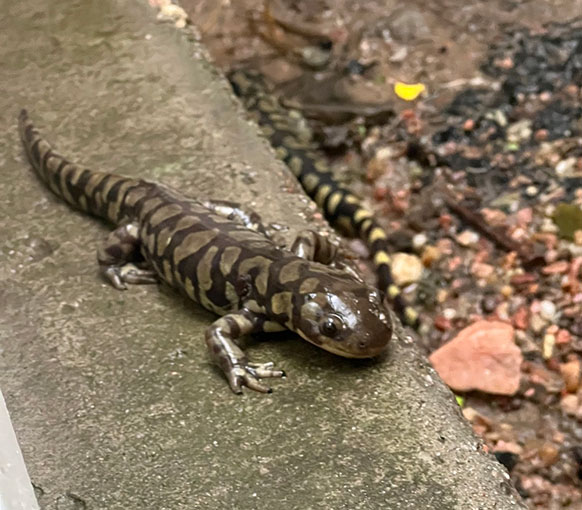
These salamanders were spotted in a window well of a Cheyenne home and represented a sighting report during the “Report a Salamander” project last spring, which is a component of the Laramie Salamander Migration Initiative hosted by the UW Biodiversity Center. (Erin Blackman Photo)
The University of Wyoming’s Biodiversity Institute will again focus on the Western
tiger salamander this spring and offer the public opportunities to help assist Wyoming’s
state amphibian with its annual migration journey from Laramie yards to the pond in
LaBonte Park.
The Laramie Salamander Migration Initiative will start with a volunteer training session
from 10-11 a.m. Saturday, April 4, in UW’s Berry Biodiversity Conservation Center.
Volunteers will learn what to do during “Migration Nights” that will occur during
April.
During Migration Nights, the public is asked to help adult salamanders safely cross
the road during their migrations. Each spring, on rainy nights, hundreds of Western
tiger salamanders -- taking up residence in the yards of Laramie homes -- find their
way to LaBonte Park.
Registration for the “Migration Nights” volunteer list is required of all volunteers,
new and returning. People who register will be those who receive an email when the
Biodiversity Institute’s research team expects a large migration. People can register
here. The training will not be live-streamed, but it will be recorded.
At the training session, volunteers will learn about tiger salamander ecology; why
salamanders need volunteer help in Laramie; and how they can help salamanders in Laramie
and/or around the state. Additionally, volunteers will learn specific protocols that
anybody going out to LaBonte Park will need to know to keep themselves and the salamanders
safe, and to allow Biodiversity Institute staff to collect their necessary data.
“2025 was a bit of an odd year for the migration. Our first mass migration occurred
March 29, which was an entire month earlier than it has been in the last six-plus
years,” Lee says. “I believe we likely missed the second mass migration, which probably
occurred late at night or in the early morning hours sometime between March 29 and
April 24. We had a small migration April 24. In total last year, we collected data
from 79 live salamanders.”
During 2024, volunteers counted 89 salamanders; in 2023, 117 were tallied; and 89
were calculated in 2022, the first year of the project.
Adult tiger salamanders are difficult to find because they spend much of the year
underground and, when they are above ground, they are primarily nocturnal. When they
reach LaBonte Park, they breed and lay thousands of eggs in the pond. After a few
weeks, the eggs will hatch, and small aquatic salamanders emerge. Toward the end of
the summer, the tiger salamanders undergo a metamorphosis to become terrestrial adult
salamanders. They migrate back to the yards around LaBonte Park, where they spend
the rest of the year in underground burrows until the following spring.
The research team will be stationed at the LaBonte Park covered picnic shelter near
Eighth and Canby streets as well as the shelter just north of the Feeding Laramie Valley
building on Ninth Street on the “big” migration nights. Researchers will collect information
on the sex and size of the salamanders before releasing them, Lee says.
Volunteers should report to the picnic shelter north of the Feeding Laramie Valley
building to collect high-visibility safety vests, gloves and buckets. Volunteers will
need to wear warm, waterproof clothing and headlamps.
Report a Salamander
The “Report a Salamander” project is another component of the Laramie Salamander Migration Initiative. Citizens are asked to submit reports on salamander
sightings in Laramie as well as around the state. Reports of live or dead adult salamanders
and larval salamanders are welcome. To submit a report, go here to fill out the requested information.
Last year, the Berry Biodiversity Institute received 40 reports of salamanders from
around the state, Lee says.
The Report a Salamander part of the initiative provides more information about where
tiger salamanders elsewhere in the state may need help on their migration nights;
where salamanders in Laramie are distributed; and can help determine whether a spring
migration was missed, Lee says.
“Last year, we had interesting observations in that we observed lots of metamorphic
salamanders leaving Labonte en masse throughout the summer. We thought they would
move in one or two mass migrations, like they do in the spring.” Lee says. “But there
were at least six summer nights where we counted well over 30 salamanders moving.”
For those who plan to participate in reporting salamanders, Lee says a good place
to check for the amphibians is in window wells, especially during the spring season.
“Window wells provide a nice area for salamanders to dig down into the soil for protection
during winter,” she says. “But when they emerge in the spring, they can be trapped
in the window wells and may perish without human intervention.”
The Biodiversity Institute’s graphic artist is putting together a visual report of
the salamander statistics from last year that will be shared via email and social
media by the end of the month and at the April 4 training, Lee says.
There will not be a “Salamander Saturday” event this year, but it may return in future
iterations of the initiative, Lee says.
For more information about the Laramie Salamander Migration Initiative, email Lee
at mlee37@uwyo.edu.
About the University of Wyoming Biodiversity Institute
The UW Biodiversity Institute fosters conservation of biodiversity through scientific discovery, creative dissemination, education and public engagement. In this setting, scientists, citizens, students and educators come together to share a wealth of perspectives on the study and appreciation of biodiversity -- from microbes to poetry and ecosystems to economics. For more information, go to www.wyomingbiodiversity.org.

The University of Wyoming has earned its Research Level 1 (R1) status from the Carnegie Classification of Institutions of Higher Education, placing Wyoming's only four-year university with the top research universities in the United States.