
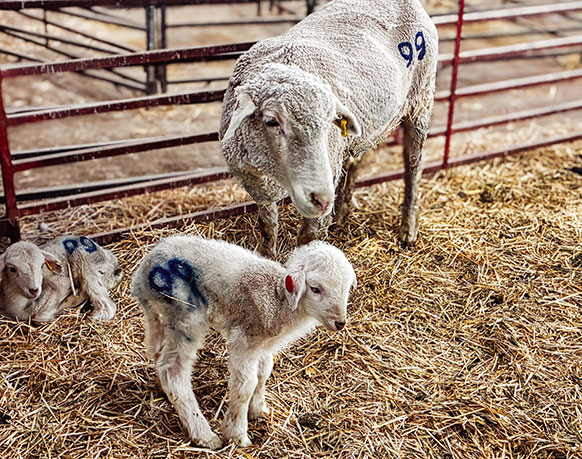
Newly born lambs are accompanied by their mother in lambing jugs at UW’s Laramie Research and Extension Center. (Grant Stewart Photo)
With lambing season in full swing, University of Wyoming Extension has published a
new online resource for producers seeking to minimize pregnancy loss in their flocks.
Titled “Why Ewes Don’t Always Deliver What They Scan: Understanding Fetal Loss in
Sheep,” the new publication synthesizes recent scientific studies to explain when,
how and why pregnancies may go awry, then outlines best practices for optimizing performance.
“A benchmark in profitable and sustainable sheep production systems is maximizing
pounds of lamb weaned per ewe, and doing so requires attention to detail during every
stage of breeding and pregnancy,” says Whit Stewart, a UW Extension sheep specialist
and associate professor of animal science. “This bulletin brings together timely knowledge
and recent advances that help producers better understand how to support the ewe so
she can successfully carry more lambs to full term.”
Co-written by Stewart and Johnson County Extension Educator Micah Most, the new publication
starts by identifying key milestones and pitfalls at each stage of pregnancy.
While a typical pregnancy lasts about 147 days, research suggests that most embryo
losses occur before day 29, the authors report. Nutrition, stress and environmental
factors influence potential losses throughout the pregnancy but are especially important
during the first trimester.
“Because early losses are difficult to detect, maintaining optimal nutrition and stress-free
conditions throughout pregnancy -- especially during early development -- is key to
maximizing embryonic, fetal and newborn lamb survival,” the publication states.
In sheep, pregnancy losses are often partial: It’s not unusual for a ewe to birth
just one lamb even after an early scan indicated twins or triplets. Research shows
that partial losses can be linked to specific sires and even the ratio of male and
female fetuses in a single pregnancy.
Still, while some factors are outside a producer’s control, preventing undernutrition
can help improve embryonic survival rates. Proper nutrition, disease prevention, ample
forage resources and a low-stress environment are all essential to increasing the
odds of a healthy pregnancy.
The authors recommend working with a veterinarian to create a veterinary health plan
that includes administering relevant vaccinations as well as practicing good hygiene,
implementing quarantine measures as needed and confirming diagnoses early.
Research-based strategies to support pregnancy health also include minimizing environmental
and social stressors. In a state where shearing often occurs mid-gestation and weather
conditions can be harsh, this is especially important, the authors note.
“Not every fertilized oocyte becomes a lamb on the ground,” they acknowledge. “But
understanding why -- whether it is early embryonic loss, infection-induced fetal loss
or the effects of nutrition and hormonal signaling -- helps Wyoming producers make
more informed management decisions.”
To read the full publication, visit https://www.wyoextension.org/publications/Search_Details.php?pubid=2157&pub=B-1410. Email Stewart at whit.stewart@uwyo.edu or Most at mmost@uwyo.edu with questions.
About University of Wyoming Extension
UW Extension serves Wyoming communities by helping residents apply university research and resources to practical problems. Since 1914, UW Extension has provided educational programs and tools to the state’s 23 counties and the Wind River Indian Reservation. From 4-H programming and pesticide safety education to food preservation and nutrition courses, UW Extension upholds the university’s land-grant mission by offering learning opportunities for people of all ages. UW Extension staff members help Wyoming residents boost agricultural production; care for lawns and gardens; cultivate future leaders; support individual and community well-being; and develop thriving businesses. To learn more, visit www.uwyo.edu/uwe or call (307) 766-5124.

The University of Wyoming has earned its Research Level 1 (R1) status from the Carnegie Classification of Institutions of Higher Education, placing Wyoming's only four-year university with the top research universities in the United States.