
UW Student Bridges Science, Community Through Conservation Communication
Published March 13, 2026
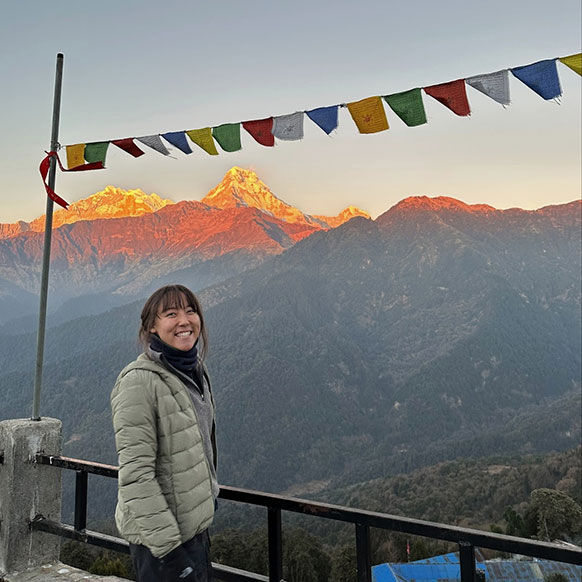
UW graduate student Sera Glass, of Torrington, takes in a spectacular view during a recent trip to Nepal. She is pursuing a Master of Science in environment, natural resources and society. (Cris Welch Photo)
Growing up in Torrington, a small town in Goshen County where the nearest neighboring
community is across the Nebraska border, shaped how Sera Glass views both space and
community. Those formative experiences in rural Wyoming now inform her graduate work
at the University of Wyoming’s Haub School of Environment and Natural Resources.
“Growing up in such a small town shaped the way I view spaces and locations,” Glass
says. “It’s such a small community where everyone is looking out for everyone. It’s
like a small family.”
Now pursuing her Master of Science in environment, natural resources and society,
Glass is focused on science communication and bridging the gap between research and
the communities it’s meant to serve.
“I’m passionate about making the connection between data that’s being collected and
how it’s actually impacting communities, which is often forgotten,” she says. “I want
to work with communities to help them understand the science that affects their lives.”
What drew Glass to the Haub School was its interdisciplinary approach.
“There’s a commitment to consistently grow, not only within environmental and conservation
issues, but also in relevant disciplines tied to these same issues,” she says. “The
biggest thing that makes me a ‘Haubie’ is constantly searching for those connections
and interdisciplinarity.”
Her favorite university experience came recently when she joined the Haub School’s
Wild and Working Lands Global Seminar Program in Nepal.
“We trekked Poon Hill to see the sunrise over the Annapurna mountain range. It was
phenomenal,” she says. “I was able to make many new connections who have contributed
to my own understanding of conservation and community engagement.”
Three Decades of Impact
UW’s Haub School prepares the next generation of natural resource professionals while serving Wyoming’s wild and working lands and communities. With 1,275 alumni (1996-2025), many working across the state in government, private industry, nonprofits and education, the school offers six undergraduate and seven graduate programs integrating science, policy, law, economics and community engagement.
The school brings about $2 million annually in research funding to Wyoming while supporting communities through four dedicated centers and institutes. Recent milestones include a $5 million gift from Jay and Karen Kemmerer in 2025 to establish the Wyoming Outdoor Recreation, Tourism and Hospitality (WORTH) Institute, supporting the state's second-largest industry.
Haub School programs, including the Wyoming Conservation Corps, have trained over 150 young adults and veterans since 2021, while the Biodiversity Institute connects people of all ages to Wyoming’s wildlife through 40-plus annual programs reaching over 3,500 participants statewide. The school’s Ruckelshaus Institute facilitates collaborative, long-term solutions to natural resource challenges, offers professional workforce development, and publishes the award-winning Western Confluence magazine, reaching nearly 4,000 readers across the state. Learn more at www.uwyo.edu/haub.
Additionally, the Haub School’s Tomé Scholars to Fellows Program -- established in 2021 through a major gift from UW alumni Carol and Ramon Tomé -- provides exceptional students with full-ride, four-year scholarships and experiential learning opportunities to address complex environmental challenges. Recent expanded support from the Tomé Foundation has doubled the number of scholars on campus. Applications for the upcoming academic year are due Saturday, March 15. Learn more at www.bit.ly/tomescholars.

The University of Wyoming has earned its Research Level 1 (R1) status from the Carnegie Classification of Institutions of Higher Education, placing Wyoming's only four-year university with the top research universities in the United States.