
UW Student Combines Conservation, Tourism to Help Shape Wyoming’s Outdoor Future
Published March 20, 2026
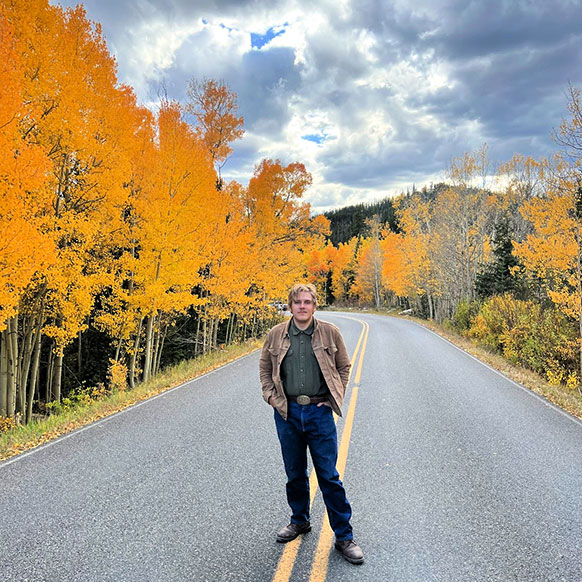
Jakob Haenisch, a senior in the University of Wyoming’s Outdoor Recreation and Tourism Management Program in the Haub School of Environment and Natural Resources, is preparing to merge his passions for conservation, outdoor recreation and tourism into a career that benefits both the environment and visitor experiences. (UW Haub School Photo)
For Jakob Haenisch, growing up in Laramie meant being surrounded by natural resources
and endless opportunities to explore. Those early adventures with his father across
the Mountain West set him on a path that now defines his future career.
“I always loved being a tourist in my own community,” Haenisch says. “Growing up,
I had access to some of the most inspiring high school teachers and landscapes.”
Now a senior in the University of Wyoming’s Outdoor Recreation and Tourism Management
Program in the Haub School of Environment and Natural Resources, Haenisch is preparing
to merge his passions for conservation, outdoor recreation and tourism into a career
that benefits both the environment and visitor experiences.
“I want to explore how you can combine conservation and private tourism industries
to improve both the environment and people’s expectations when it comes to tourism,”
he says.
Throughout his time at the Haub School, Haenisch has been mentored by faculty members
who bring real-world experience to the classroom. Associate Lecturer Richard Vercoe,
Haenisch says, has had the greatest impact on his career development. “I love hearing
his stories and advice from his many different outdoor recreation and conservation
experiences.”
Beyond coursework, Haenisch credits the program with developing his most valuable
professional skill: networking.
“The Outdoor Recreation and Tourism Management Program has helped me open up, talk
more effectively and present myself better to potential employers and government organizations,”
he says. “This skill has opened many doors and will continue to open many doors in
the future.”
With experience in Wyoming State Parks and his current work in the hospitality industry,
Haenisch is building a diverse background that positions him uniquely to help shape
Wyoming’s outdoor recreation future.
His advice to other students considering the Haub School?
“Try to get as many experiences as possible and say yes to every single opportunity
that crosses your path,” he says. “If you don't have any, go looking for them.”
Three Decades of Impact
UW’s Haub School prepares the next generation of natural resource professionals while
serving Wyoming’s wild and working lands and communities. With 1,275 alumni (1996-2025),
many working across the state in government, private industry, nonprofits and education,
the school offers six undergraduate and seven graduate programs integrating science,
policy, law, economics and community engagement.
The school brings about $2 million annually in research funding to Wyoming while supporting
communities through four dedicated centers and institutes. Recent milestones include
a $5 million gift from Jay and Karen Kemmerer in 2025 to establish the Wyoming Outdoor
Recreation, Tourism and Hospitality (WORTH) Institute, supporting the state's second-largest
industry.
Haub School programs, including the Wyoming Conservation Corps, have trained over
150 young adults and veterans since 2021, while the Biodiversity Institute connects
people of all ages to Wyoming’s wildlife through 40-plus annual programs reaching
over 3,500 participants statewide. The school’s Ruckelshaus Institute facilitates
collaborative, long-term solutions to natural resource challenges, offers professional
workforce development, and publishes the award-winning Western Confluence magazine,
reaching nearly 4,000 readers across the state. Learn more at www.uwyo.edu/haub.
Additionally, the Haub School’s Tomé Scholars to Fellows Program -- established in
2021 through a major gift from UW alumni Carol and Ramon Tomé -- provides exceptional
students with full-ride, four-year scholarships and experiential learning opportunities
to address complex environmental challenges. Recent expanded support from the Tomé
Foundation has doubled the number of scholars on campus. Learn more at www.bit.ly/tomescholars.

The University of Wyoming has earned its Research Level 1 (R1) status from the Carnegie Classification of Institutions of Higher Education, placing Wyoming's only four-year university with the top research universities in the United States.