
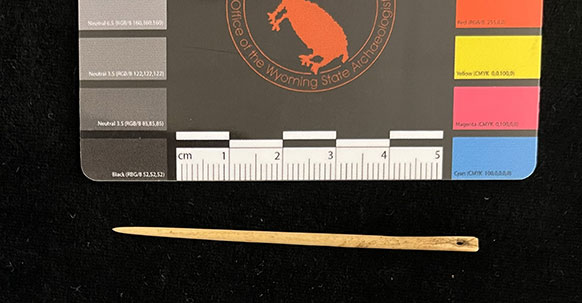
This bone needle from an archaeological site in Wyoming is an example of bone needles found around the world used by ancient peoples to produce clothing and survive in cold climates. They also served a variety of purposes, from medicine to ceremony, according to newly published UW research. (UW Photo)
A study led by McKenna Litynski, a recent Ph.D. graduate in anthropology and adjunct
assistant professor at the University of Wyoming, confirms that ancient needles and
awls enabled humans to survive in cold climates and shows these tools served a variety
of purposes beyond clothing production, from medicine to ceremony.
Some 100,000 years ago, humans began to expand around the globe, including into some
of the world’s coldest environments. Scholars have long hypothesized that this remarkable
expansion was made possible by a profoundly humble technology: the bone sewing needle.
The theory suggests that the invention of the needle allowed early humans to make
tailored leather clothing which, in turn, allowed survival in frigid climates. While
plausible, the theory has been difficult to verify.
However, Litynski led a quantitative study that provides strong support for the theory.
Drawing on hundreds of ethnographic documents from the 18th through 20th centuries
in North America, she analyzed patterns of needle and awl use.
Her article, which was co-written by UW Department of Anthropology Professors Sean Field and
Randy Haas and is published in the peer-reviewed journal PLOS ONE, shows that clothing
production is the most common activity associated with sewing needles and awls.
Statistical modeling also revealed that mentions of these tools increase significantly
in colder environments, confirming the role of sewing technology in thermoregulation
and survival.
The study also uncovered a surprising pattern in the data. While manufacturing clothing
accounted for 14 percent of observations, needles and awls were widely used for other
purposes, including medical suturing, fishing, tattooing, basketry and ceremonial
activities, meaning needles and awls are not limited to cold environments.
These findings demonstrate that the sewing needle not only helped humans survive in
extreme climates, but also played a versatile role in daily life and cultural practices.

McKenna Litynski
The research provides new insight into how environmental and social factors shaped
human behavior and tool use, offering archaeologists a richer understanding of one
of the most common artifact types in the perishable archaeological record.
“Ultimately, it is not only the tools themselves that are significant, but also the
people who once used these objects in the past,” Litynski says. “It is through examining
needles and awls from different lenses that archaeologists like me can reveal their
capacity to unravel the broader story of human ingenuity, adaptability and cultural
evolution over the last several thousands of years and throughout the world.”
Litynski is an archaeologist with research interests in zooarchaeology, environmental archaeology, hunter-gatherers and experimental archaeology. To learn more about her research, email her at mlitynsk@uwyo.edu.

The University of Wyoming has earned its Research Level 1 (R1) status from the Carnegie Classification of Institutions of Higher Education, placing Wyoming's only four-year university with the top research universities in the United States.