
UW’s Wyoming Institute for Disabilities Works to Improve Early ID of Developmental Delays
Published March 10, 2026
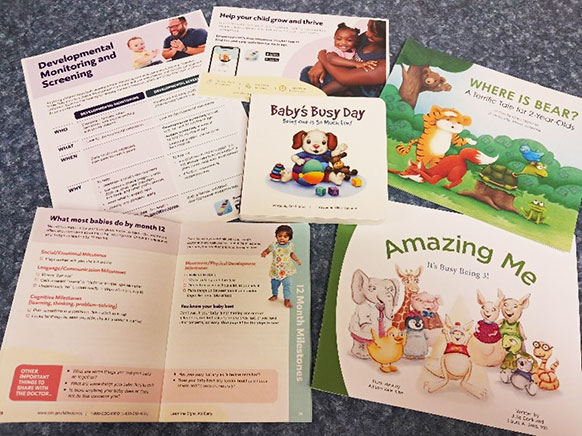
Books, brochures and other materials that are part of the national Learn the Signs - Act Early initiative are available through UW’s Wyoming Institute for Disabilities. (WIND Photo)
The Wyoming Institute for Disabilities (WIND) at the University of Wyoming has partnered
with the American Academy of Pediatrics and the Centers for Disease Control and Prevention
(CDC) to improve early identification of developmental delays and disabilities, including
autism.
The partnership is part of the national Learn the Signs - Act Early (LTSAE) initiative.
At the center of this work in Wyoming is Cari Glantz, WIND’s education and early intervention
program leader, who serves as Wyoming’s Act Early ambassador. Act Early ambassadors
are a select group of professionals who expand the reach of LTSAE by supporting early
identification efforts across states, territories and tribal communities.
LTSAE offers free, research-based materials, developmental milestone checklists and
tools designed to help families and professionals track development from birth through
age 5. Materials include milestone checklists; a mobile milestone tracker app; and
educational resources for families and professionals to promote early developmental
awareness and timely intervention.
Wyoming’s commitment to early identification
Under Glantz’s leadership and collaboration as a member of the Governor’s Early Intervention
Council, Wyoming continues to strengthen its statewide developmental monitoring and
referral systems.
Her work includes:
-- Fostering broad partnerships that integrate LTSAE resources across community and
early childhood programs, such as Wyoming child development centers supporting early
childhood educators in using milestone tracking tools and shared developmental language.
-- The Women, Infants and Children Program, which enhances coordination across early
intervention and community-based systems.
-- Through Wyoming libraries, expanding public access to LTSAE books and materials
for parents and caregivers.
-- The Wyoming Department of Health’s Early Intervention Education Program, which
partners to share information about how children can receive free developmental screenings
at their local child-development centers.
“I am excited to partner with families and community providers across Wyoming to support
this important initiative,” Glantz says. “Not only are we helping to identify where
early intervention supports may be needed, but we’re also sharing how families can
celebrate their children’s growth through each developmental milestone.”
These partnerships reflect Wyoming’s commitment to ensuring that families have the
tools they need to monitor their children’s development and access services early
if concerns arise.
“As a land-grant institution, University of Wyoming is deeply committed to improving
the health and well-being of communities across our state,” says Patrick Hardigan,
dean of the UW College of Health Sciences. “The work of the Wyoming Institute for
Disabilities through the Learn the Signs - Act Early initiative, in partnership with
the American Academy of Pediatrics and the Centers for Disease Control and Prevention,
demonstrates how research, outreach and community collaboration can make a meaningful
difference for Wyoming families. We are proud of Cari Glantz’s leadership and the
strong partnerships being built across Wyoming to ensure families, educators and health
professionals have the tools they need to support healthy child development.”
Why early identification matters
Early identification of developmental delays is critical. Many children are not diagnosed
until after entering school, even though early intervention services have the most
impact when support can be provided as early as possible.
By increasing the visibility and adoption of LTSAE resources, Glantz and other Act
Early ambassadors work to ensure families, educators and health care providers work
together to help more children get screened, identified and connected to early supports.
WIND core components
LTSAE is part of larger initiatives for training and capacity-building programs. For
more information about WIND’s disabilities community education and training programs,
go to www.uwyo.edu/wind/cet/index.html.
To learn how to order free materials, visit the Act Early Wyoming website at www.uwyo.edu/wind/wyactearly/index.html.
The CDC’s Learn the Signs - Act Early website is at https://www.cdc.gov/act-early/.
To contact Glantz, email her at cglantz@uwyo.edu.

The University of Wyoming has earned its Research Level 1 (R1) status from the Carnegie Classification of Institutions of Higher Education, placing Wyoming's only four-year university with the top research universities in the United States.