
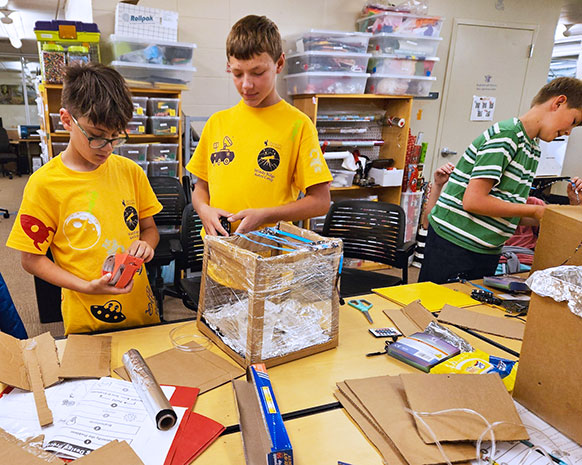
Students at the 2025 Astro Camp work on building their chambers that will facilitate the growth of plant life on a spaceship. The Windy Ridge Foundation Astro Camp is scheduled Sunday-Saturday, July 12-18, on the UW campus. Twenty-four students, who will be entering seventh or eighth grade this fall, will be selected to participate. (Chad Sharpe Photo)
Select middle school students will have an opportunity this summer to explore traveling to and colonizing planets during the Windy Ridge Foundation Astro Camp Sunday-Saturday, July 12-18, on the University of Wyoming campus.
Campers, who will be entering seventh or eighth grade this fall, will be chosen based on demonstrated interest and academic potential in math, science, engineering and space. As part of the application process, students must submit written essays on why they want to attend the science camp.
“For 2026, we will keep the theme of learning about the science and engineering challenges behind designing and executing a mission to a planet outside of our solar system,” says Danny Dale, director of Astro Camp and the Harry C. Vaughan Professor of Astronomy in the UW Department of Physics and Astronomy.
Twenty-four students from all backgrounds and economic statuses will be selected. Participants will be selected with a goal of having an equal number of male and female campers. Last year, the camp expanded eligibility to students beyond Wyoming, Colorado, Nebraska and South Dakota.
“Though we now allow for participants from any U.S. state, we admittedly do not advertise much outside of Wyoming,” Dale says. “Last year, 22 out of the 24 campers were from Wyoming and two were from Colorado.”
The camp is free to selected participants. On-campus housing and dining will be provided for attending students.
The application deadline is Thursday, April 30, but applications submitted by Friday, May 8, will be considered, pending camp capacity. To apply, go here.
Once again, campers will take field trips to two local mountain ranges -- Vedauwoo and the Snowy Range.
On the Vedauwoo hike, students will be challenged to consider they are exploring another planet and to find examples of food and shelter. Students also will be tasked with identifying various plant specimens and collecting water samples from a beaver pond for later purification and analysis by microscope for signs of life, Dale says.
On the Snowy Range hike, campers will learn about the differences in plant life at different elevations.
“We plan to continue our tradition of incorporating into the curriculum two different mountain hikes. On both hikes, we introduce students to a variety of plant species and geological features and then challenge them to identify them on our hikes,” Dale says. “Another goal of the hikes is to introduce the students to the effects on the environment that come with changes in elevation in mountain settings. Finally, we ask the students to identify sources of food and shelter, as if they were on an alien planet for the first time and needed to figure out a way to survive in the new environment.”
In addition to Dale, the camp includes three in-service science teachers from Wyoming high schools; five UW undergraduate students who will serve as camp counselors; and Max Gilbraith, coordinator of UW’s Harry C. Vaughan Planetarium, who serves as the camp’s assistant director. Astro Camp was moved to mid-July this year to better match the availability of camp staff, Dale says.
“We want our participants to come away with an excitement for science, engineering and math,” Dale says. “We also want to reassure them that it’s perfectly fine to be interested in school and in being smart and curious. Finally, they should know that the process of science is just an extension of their natural curiosity.”
In 2020, the Windy Ridge Foundation made a $250,000 gift to support the Windy Ridge Foundation Astro Camp, which aims to educate the next generation of scientists and engineers while introducing the K-12 community to science programs offered through UW. The gift provided enough funding for five years of the camp, Dale says. In 2024, the Windy Ridge Foundation committed to another three years of Astro Camp funding beyond the original five-year commitment.
“We are fortunate to receive the continued support of the Windy Ridge Foundation and to benefit from the original vision of Harry C. Vaughan, who was passionate about STEM education,” Dale says.

The University of Wyoming has earned its Research Level 1 (R1) status from the Carnegie Classification of Institutions of Higher Education, placing Wyoming's only four-year university with the top research universities in the United States.