
Amaranth Species Pose Growing Threat in Wyoming, UW Extension Reports
Published April 21, 2026
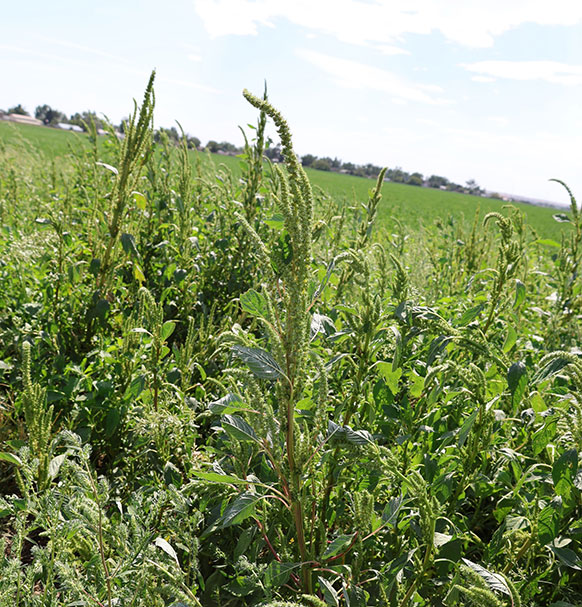
Powell’s amaranth grows in a Wyoming field. A statewide survey conducted over the past two years suggests that Powell’s amaranth may be more common in Wyoming than previously realized, perhaps due to misidentification as redroot pigweed. (Kelsey Brock Photo)
Palmer amaranth and other weedy species in the amaranth family pose a growing threat
to agricultural operations across the West, with a new invader -- waterhemp -- first
documented in Wyoming last summer.
Seven amaranth species, including both native and nonnative species, have been observed
in Wyoming so far. As agricultural weeds, redroot pigweed, Palmer amaranth and waterhemp
are the most concerning, a recently updated University of Wyoming Extension bulletin
reports.
Weedy amaranth species thrive in agricultural settings, roadsides and other disturbed
areas. Their aggressive spread is aided by prolific seed production, which allows
them to outcompete crops, as well as their rapid growth and ability to develop herbicide
resistance.
Especially in cases where they develop resistance to multiple types of herbicides,
amaranth species can decimate crop yields and are both difficult and costly to control.
During drought, amaranth species can accumulate high levels of nitrates, in some cases
becoming poisonous to livestock. They also can serve as hosts for a variety of pests
and pathogens.
Palmer amaranth, one of the most notorious amaranth species, was first observed in
Wyoming in 2018, spreading across the state’s southeastern border from Nebraska. In
2023, the weed also was documented in the Big Horn Basin.
Palmer amaranth is particularly difficult to control, as it emerges throughout the
growing season, rapidly develops herbicide resistance and, in ideal conditions, may
grow up to 3 inches per day.
Last year, waterhemp was discovered in a sugar beet field in the Big Horn Basin, its
first observed appearance in the state. Like Palmer amaranth, waterhemp is considered
one of the most damaging weeds of row crops when left unmanaged, UW Extension reports.
“Palmer and waterhemp are new threats, and we’re anticipating significant economic
impacts, especially to row crops,” says Kelsey Brock, a UW Extension invasive plant
specialist and an assistant professor of plant sciences.
Over the past two years, Brock has partnered with the Wyoming Weed and Pest Council
to conduct a statewide amaranth survey. In addition to documenting cases of Palmer
amaranth and, most recently, waterhemp, the survey suggests that Powell’s amaranth
is potentially very common, though often mistaken for redroot pigweed.
“These weeds can be very hard to identify,” Brock notes. “If people see an odd-looking
pigweed or see one that’s coming up at a different time or in a different place or
just won’t go away with the usual management efforts, it’s possible it could be a
completely different species.”
She encourages Wyoming residents to bring samples of odd-looking pigweed plants to
a local weed and pest office or UW Extension office for identification.
For those interested in learning more about weeds in the amaranth family, Brock and
UW colleagues have updated a 2017 UW Extension bulletin to reflect new sightings in
Wyoming and the latest scientific research on amaranth control. The publication introduces
readers to the threats posed by species currently found in Wyoming and nearby states,
then outlines dispersal mechanisms, control options and each species’ defining characteristics.
“The goal of this resource is to alert people to the pigweeds we have in the state
and to the fact that there are more that are just beyond our borders,” Brock explains.
“We want people to know about the risks these weeds pose.”
To view a free downloadable copy of the publication, go here.
For questions or assistance with identification, email Brock at kbrock5@uwyo.edu or call (307) 766-3113.
About University of Wyoming Extension
UW Extension serves Wyoming communities by helping residents apply university research and resources to practical problems. Since 1914, UW Extension has provided educational programs and tools to the state’s 23 counties and the Wind River Indian Reservation. From 4-H programming and pesticide safety education to food preservation and nutrition courses, UW Extension upholds the university’s land-grant mission by offering learning opportunities for people of all ages. UW Extension staff members help Wyoming residents boost agricultural production; care for lawns and gardens; cultivate future leaders; support individual and community well-being; and develop thriving businesses. To learn more, visit www.uwyo.edu/uwe or call (307) 766-5124.

The University of Wyoming has earned its Research Level 1 (R1) status from the Carnegie Classification of Institutions of Higher Education, placing Wyoming's only four-year university with the top research universities in the United States.