
‘Nellie: The First Woman Governor at America’s Milestones’ Opens at UW’s American Heritage Center
Published April 07, 2026
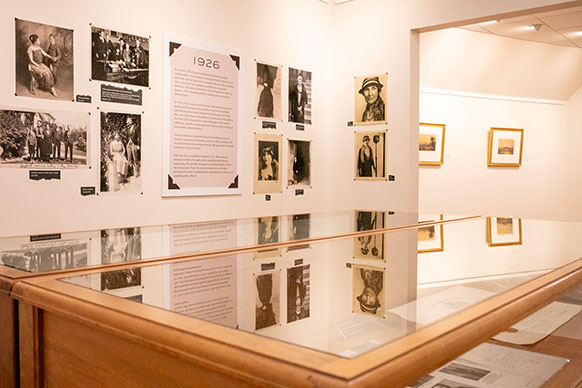
A new exhibition, “Nellie: The First Woman Governor at America’s Milestones,” is on display at the University of Wyoming’s American Heritage Center this month through April 2027 in Gallery One. (AHC Photo)
A new exhibition, “Nellie: The First Woman Governor at America’s Milestones,” is now on display at the University of Wyoming’s American Heritage Center (AHC).
The exhibit runs this month through April 2027 in Gallery One.
Drawing primarily from the AHC’s Nellie Tayloe Ross papers, the exhibition examines
Ross’s life and career through key moments in American history. Born in 1876 during
the nation’s centennial, Ross became the first woman governor in the United States
in 1925 and later served for two decades as director of the United States Mint. She
lived to see the nation’s bicentennial in 1976.
The exhibition uses the United States’ 100th, 150th and 200th anniversaries to trace
Ross’s development from her early life through her years in public service. It highlights
her governorship during a period of economic hardship in Wyoming; her transition to
federal leadership during the Great Depression; and her long tenure overseeing the
U.S. Mint through major national events, including World War II.
Items on display include photographs; her oath of office; a scrapbook documenting
her inauguration; the certificate signed by President Franklin D. Roosevelt appointing
her to the U.S. Mint; and a coin bearing her likeness.
“Nellie Tayloe Ross is a central figure in Wyoming and American history,” says Kail
Moede, exhibit curator. “In curating this exhibit, I wanted to frame her life through
key national milestones, especially as the country approaches its 250th anniversary.
To highlight Nellie is to highlight Wyoming’s place in American history. The exhibit,
designed to reflect her scrapbooks, brings those connections together.”
Ross chose to donate her papers to the AHC, ensuring her legacy would remain in Wyoming.
As the United States approaches its 250th anniversary, her life continues to offer
a clear connection to the nation’s second century and its evolving history.
For more information, visit the AHC website at www.uwyo.edu/ahc or the center’s exhibit page at www.uwyo.edu/ahc/exhibits.html.

The University of Wyoming has earned its Research Level 1 (R1) status from the Carnegie Classification of Institutions of Higher Education, placing Wyoming's only four-year university with the top research universities in the United States.