
Sinks Canyon State Park Program Highlights UW Planetarium’s May Schedule
Published April 29, 2026
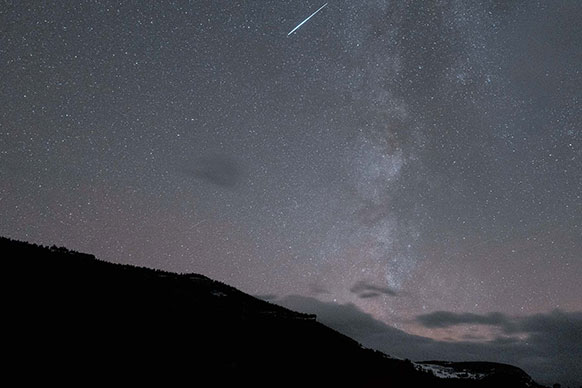
In this 2023 photo, a shooting star is seen over Sinks Canyon State Park. The UW Harry C. Vaughan Planetarium will host “Observing Night at Sinks Canyon State Park Visitor Center, Lander, Wyoming” from 8-10 p.m. Saturday, May 16. (DarkSky International Photo)
During May, the University of Wyoming Harry C. Vaughan Planetarium will host an evening outreach event at Sinks Canyon State Park in Lander and two “Wyoming Skies” programs that will focus on the moon.
“At Sinks Canyon State Park, we will be conducting an outreach event, weather permitting, and set up some telescopes and do a live night sky presentation and observing session. The event is free and open to the public,” says Max Gilbraith, the planetarium’s director, of the event scheduled Saturday, May 16. “Our topical ‘Wyoming Skies’ programs will each highlight different aspects of the moon. With the new moon coinciding with closest approach, it will make earthshine more visible. During the full moon, which also will be a blue moon, the moon will be a ‘micro’ moon and appear smaller than normal.”
To get tickets or receive more information about programs, email planetarium@uwyo.edu or leave a voicemail and a callback phone number at (307) 766-6506. Tickets are $5 for the public or online tickets, and $3 for students, senior citizens, veterans, first responders and those under 18. Seating is free for children under 5. Bulk tickets/gift cards are available at $2 each when 10 or more tickets are purchased.
Reservations or pre-purchase is not required, and walk-ins are welcome. Tickets can be purchased online with a credit card, reserved by email or voicemail, or purchased at the start of the show. Cash or check is accepted at the door. The planetarium, which seats 64, is in the basement of the Physical Sciences Building. Seating is on a first-come, first-served basis outside of designated ADA/wheelchair seating.
To pay for tickets with a credit card, go to www.uwyo.edu/uwplanetarium/ticket.aspx. For a group larger than six, email the planetarium for a private show at https://uwyo.sjc1.qualtrics.com/jfe/form/SV_bKuqIynOn7gFK2F. Tickets for private shows are the same as the public programs.
A film and special live talk for audiences will be featured each week. All programs are approximately an hour in length. As time allows, a portion of the show also may focus on a live sky tour or supporting information related to the film’s topic.
The May schedule is:
-- Friday, May 1, 7 p.m.: “Astrobiology.” Is there anybody out there, or are we alone in the universe? The search for extraterrestrial life continues as scientists scour the solar system for ancient signs or modern signs of life; radio telescopes listen for signs from E.T.; and next-generation telescopes explore the planets of other star systems.
-- Friday, May 1, 8:30 p.m.: “Liquid Sky: Pop,” a music-based light show. Enjoy a custom playlist of “out-of-this-world” pop music in 5.1 surround sound. The 4K-resolution planetarium sky will become a canvas of color, patterns and movement with cutting-edge music visualization software and live VJ talent.
-- Saturday, May 2, 2 p.m.: “Back to the Moon for Good,” a full-dome movie. This film opens with the first era of space exploration in the late 1960s and early 1970s. Viewers will learn about what that era of landers and orbiters taught the world about the moon.
-- Saturday, May 2, 7 p.m.: “Cosmic Mashups: Gravity, Galaxies and Supermassive Black Holes,” a full-dome movie. Supermassive black holes are found in most galaxies, and scientists are beginning to uncover how the merging of galaxies activates galactic centers. This film is produced by Fiske Planetarium, a University of Colorado-Boulder professor and a former graduate student through a National Science Foundation grant.
-- Saturday, May 2, 8:30 p.m.: “Liquid Sky: The Beatles,” a music-based light show. Enjoy a custom playlist of “out-of-this-world” music from the legendary British band in 5.1 surround sound. The 4K-resolution planetarium sky will become a canvas of color, patterns and movement with cutting-edge music visualization software and live VJ talent.
-- Friday, May 8, 7 p.m.: “Astronomical Women.” This program follows the history and discoveries of the great female astronomers, scientists and engineers from Hypatia; Annie Cannon to Vera Rubin; and the female astronomers of today.
-- Friday, May 8, 8:30 p.m.: “Liquid Sky: Space Rock,” a music-based light show. Enjoy a custom playlist of “out-of-this-world” space rock from artists in 5.1 surround sound. The 4K-resolution planetarium sky will become a canvas of color, patterns and movement with cutting-edge music visualization software and live VJ talent.
-- Saturday, May 9, 2 p.m.: “Big Astronomy: People, Places, Discoveries,” a full-dome movie. The film takes a journey to three world-class observatories in Chile’s rugged Andes Mountains and arid Atacama Desert -- remote, extreme regions that have the perfect conditions for astronomical research. Featured is an inspiring cast of astronomers, engineers, technicians and support staff who keep the megamachines running.
-- Saturday, May 9, 7 p.m.: “Dark Matter Mystery,” a full-dome movie. Dark matter is a theoretical form of invisible mass, which is believed to be present in galaxies, but it has never been seen or detected. This film takes the audience on the biggest quest of contemporary astrophysics: solving the dark matter mystery.
-- Saturday, May 9, 8:30 p.m.: “Liquid Sky: Metal,” a music-based light show. Enjoy a custom playlist of “out-of-this-world” music from heavy metal artists in 5.1 surround sound. The 4K-resolution planetarium sky will become a canvas of color, patterns and movement with cutting-edge music visualization software and live VJ talent.
-- Tuesday, May 12, 7 p.m.: “Wyoming Skies: Earthshine in the Crescent Moon.” The program provides an exploration of the stars, constellations, planets, meteor showers and other celestial phenomena visible from Wyoming for the season. A supermoon during a new moon is not particularly noticeable but, in the crescent phases immediately preceding and following the proximity of the moon to Earth, does make the “earthshine” or reflection of Earth’s dayside onto the dark side of the moon more pronounced.
After the planetarium show finishes at 8 p.m., informal telescope observing on the rooftop of the Physical Sciences Building at the STAR Observatory will be available, weather permitting.
-- Friday, May 15, 7 p.m.: “Wyoming Skies: Aurora: Dancing Lights.” For millennia, our ancestors looked in awe at the “dawn in the north” or the Aurora Borealis. What causes this display? Where does it occur? Do other planets also have aurorae? Take a tour from the surface of the sun out to the magnetic poles of the solar system to find out.
-- Friday, May 15, 8:30 p.m.: “Liquid Sky: Pink Floyd’s ‘The Dark Side of the Moon,’” a music-based light show. Enjoy a custom playlist of “out-of-this-world” music from the classic album in 5.1 surround sound. The 4K-resolution planetarium sky will become a canvas of color, patterns and movement with cutting-edge music visualization software and live VJ talent.
-- Saturday, May 16, 8-10 p.m.: “Observing Night at Sinks Canyon State Park Visitor
Center, Lander, Wyoming:” Sinks Canyon State Park is Wyoming’s first-ever International
Dark Sky Park named by DarkSky International. This designation is a monumental achievement
toward helping to protect and preserve the integrity of the dark skies in Sinks Canyon
for both humans and wildlife. Sinks Canyon State Park is a 600-acre park located 7.4
miles southwest of Lander and nestled in a deep, glacially made canyon.
Weather permitting, several telescopes will be set up for dark-sky observing at the
park’s visitor center. The event is free and open to the public. It is suggested attendees
bring suitable clothing, a camp chair, head lamps and red flashlights.
-- Friday, May 22-Monday May 25: The planetarium will be closed for Memorial Day weekend.
-- Tuesday, May 26, 7 p.m.: “Wyoming Skies: Blue Micromoon.” The program provides an exploration of the stars, constellations, planets, meteor showers and other celestial phenomena visible from Wyoming for the season. The second full moon of the calendar month also will be a micromoon Sunday, May 31. While the moon will be full, it will appear slightly smaller than normal because of the distance between Earth and the moon.
After the planetarium show finishes at 8 p.m., informal telescope observing on the rooftop of the Physical Sciences Building at the STAR Observatory will be available, weather permitting.
-- Friday, May 29, 7 p.m.: “Hotter Than the Sun: The Atomic Age.” Physicists and astrophysicists were set loose to develop nuclear weapons and energy in the first half of the 20th century. This program will go beyond the headlines of Hiroshima and Nagasaki, the Cuban missile crisis, Three Mile Island, Chernobyl and Fukushima. It will explore the history of nuclear weapons testing, power generation and the modern risks and benefits of technology that either harness or unleash energy hotter than the sun.
-- Friday, May 29, 8:30 p.m.: “Liquid Sky: Retro Rock,” a music-based light show. Enjoy a custom playlist of “out-of-this-world” retro rock from artists in 5.1 surround sound. The 4K-resolution planetarium sky will become a canvas of color, patterns and movement with cutting-edge music visualization software and live VJ talent.
-- Saturday, May 30, 2 p.m.: “One Sky,” a full-dome series of short films. Each short film represents the perspective of a different culture or Indigenous society from around the globe. Each film stands alone as a short story, or in combination, as a longer narrative organized around themes of “finding patterns” and “developing tools.” Short films are “The Forge of Artemis,” “Thunderbird,” “Jai Singh’s Dream,” “Celestial Canoe,” “The Samurai and Stars” and “Wayfinders.”
-- Saturday, May 30, 7 p.m.: “Dark Biosphere,” a full-dome movie. Deep beneath the Earth’s crust, hundreds of meters or kilometers below the surface -- with no light, no air and very little water, in pores and fissures of hard rock -- scientists have found an enormous biodiversity of micro-organisms that thrive in extreme conditions in an area known as the dark biosphere. This film is narrated by actor Viggo Mortensen.
-- Saturday, May 30, 8:30 p.m.: “Liquid Sky: Synthwave,” a music-based light show. Enjoy a custom playlist of “out-of-this-world” synth music in 5.1 surround sound. The 4K-resolution planetarium sky will become a canvas of color, patterns and movement with cutting-edge music visualization software and live VJ talent.
For more detailed descriptions of all programs, go to www.uwyo.edu/physics/planetarium/schedule.html.

The University of Wyoming has earned its Research Level 1 (R1) status from the Carnegie Classification of Institutions of Higher Education, placing Wyoming's only four-year university with the top research universities in the United States.