
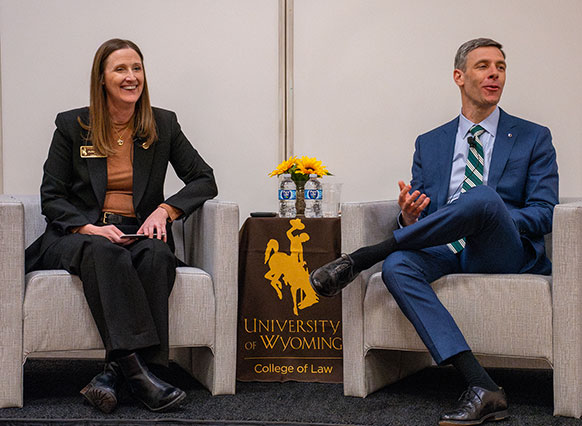
U.S. Comptroller of the Currency Jonathan Gould (right) discussed federal banking regulations, crypto currencies and digital assets at the University of Wyoming’s College of Law Thursday, April 9, with Dean Julie Hill during a lunch and conversation with faculty, students, the public and members of the Wyoming Bankers Association. (UW Photo)
U.S. Comptroller of the Currency Jonathan Gould discussed federal banking regulations,
crypto currencies and digital assets at the University of Wyoming’s College of Law
Thursday, April 9, during a lunch and conversation with faculty, students, the public
and members of the Wyoming Bankers Association.
Julie Hill, dean of the College of Law, described the event as a unique opportunity
to hear directly from the head of a federal agency whose work has a big impact in
Wyoming.
“We are grateful to Comptroller Gould and the OCC (Office of the Comptroller of the
Currency) staff for their willingness to visit Wyoming and engage on a variety of
banking topics,” Hill says.
During Gould’s visit, Hill asked Gould questions related to the OCC’s proposal on
implementing the GENIUS Act; what success looks like at the OCC; and the dynamics
between large banks and community banks. Other questions included the relationship
between traditional banks and the crypto industry, and interagency coordination with
the Federal Deposit Insurance Corp. (FDIC) and the Federal Reserve. A question-and-answer
session was available to attendees toward the end of the event, and attendees received
one hour of continuing legal education credit.
“Thank you to the University of Wyoming College of Law for the warm welcome and to
Dean Julie Hill for hosting a thoughtful and engaging discussion,” Gould says. “I
appreciate the opportunity to hear perspectives on financial regulation outside of
the D.C. bubble. The intellectual leadership of schools like the University of Wyoming
and scholars like Dean Hill inspires and informs our federal policies. I look forward
to working with them and the next generation of policymakers that they are shaping
to ensure our banking system remains relevant, safe and strong.”
Gould serves as the 32nd comptroller of the currency, the chief officer of the OCC
and administrator of the federal banking system. As the comptroller, he is responsible
for chartering, regulating and supervising national banks, federal savings associations
and federal branches and agencies of foreign banks. Gould also sits on the board of
the FDIC.
“What that means in practice is that it is Comptroller Gould’s responsibility to keep
the U.S. banking system from imploding,” Hill says. “Although he’s only been a comptroller
for about eight months, he’s already managed to have some success, at least as I measure
it.”
The OCC finalized its rule on reputation risk earlier last week, she adds. It also recently released a proposed set of rules related to the Guiding and Establishing National Innovation for U.S. Stablecoins (GENIUS) Act. Signed into law in July 2025, the GENIUS Act tasks the OCC with creating and implementing a regulatory framework for payment stablecoins.
The OCC and the GENIUS Act
“The OCC is really excited about the role that Congress assigned it under the GENIUS
Act,” Gould says. “We’re obviously one banking agency among many, both at the federal
and at the state level, and Congress has kind of divvied up responsibilities accordingly.
The OCC was responsible for so-called federal qualified payment stablecoin issuers
and foreign issuers.”
Some of what the OCC has been asked to do under the act is similar to what it was
originally created to do in the 1860s, which was “ensure that the notes that banks
were issuing were backed by a common and standard set of assets underlying them,”
Gould says.
The OCC’s legal team was looking at developing the regulatory framework ahead of President
Donald Trump’s signing of the law, Gould says. This served as the first step of the
proposal.
“We’re really proud of what we produced, a month ago or so now, in terms of our proposal
for how to implement the GENIUS Act, or again, that subset of payment stablecoin issuers
that we’re charged with regulating and supervising,” Gould says.
Gould complimented the Wyoming Division of Banking and its commissioner, Jeremiah
Bishop, for the leadership they have taken in thinking about a regulatory framework
for stablecoins.
In answer to Hill’s question on comments regarding the proposal, Gould says robust
and informed comments are welcome from all who are inclined to comment.
“There are a host of issues -- we asked, I think, 211 questions in there. We’re asking
those questions because we want people’s thoughts on our proposal,” Gould says. “It
is just a proposal. I think it’s an intellectually defensible proposal; we try to
adhere to the language and the plain text of the statute, namely, the GENIUS Act.
That doesn’t mean we made the right decisions or got everything right, or even aspirationally
… but I do think it’s an intellectually defensible proposal.”
A separate proposal with the Department of the Treasury addressing additional portions
of the GENIUS Act is coming soon, Gould says, adding that the FDIC, which works closely
with OCC, issued its own similar proposal that week.
“We’ve tried to create a proposal that gives us enough flexibility to respond to the comments that you all and others submit. Just from an administrative law standpoint, we have to ensure that whatever we finalize is the logical outgrowth of whatever we propose,” he says.
Success at the OCC
Asked by Hill what success looks like at the OCC, including in the banking system
and integration of digital assets, Gould mentions the implementation of the GENIUS
Act and, more generally, having the OCC be more technology agnostic. While the OCC
has long claimed to be technology agnostic, it has not always lived up to that, he
says.
For banks that want to engage in some form of digital asset technology or usage for
themselves or their customers, Gould hopes the OCC will provide more clarity for banks
to do so in a safe and sound manner, rather than “putting all the onus on the banks
to come up with, ‘How do we do it in a safe and sound manner?’”
Too often, federal banking agencies, including the OCC, have issued unhelpful guidance
about digital assets and other innovations, Gould says -- “basically saying, ‘Well,
you know, technically, this is all legally permissible somehow, but we just don’t
see how you can possibly do it in a safe and sound manner. So good luck with that.’”
In his opinion, this is unhelpful and creates a dynamic where only the largest banks
pursue things such as digital asset technology because they are the only ones with
the necessary resources.
“To me, success is not a situation in which only the very largest banks in our country
can engage in a digital asset activity or use a new technology, whether it’s blockchain
technology or AI. That’s a movie we’ve seen so many times before, and we all know
how that movie ends,” Gould says. “We’re heading toward a banking oligopoly. We’ve
been heading toward a banking oligopoly for 20 or 30 years now, and we need to stop
this two-tiered system.”
Whether it’s with digital assets, or other new developments, including technology
such as artificial intelligence (AI), success looks like a system where banks can
engage in activities and embrace technologies, regardless of the size or sophistication
of the bank, he says.
The Value of State Charters
In response to a related question regarding the dynamic between large banks and community
banks, Gould says, in his opinion, unelected federal officials have, through discretionary
policies, made decisions following the 2008 financial crisis that allow the largest
banks to flourish. Gould’s not criticizing these banks, he says -- they’re responding
to the incentives that have been created for them. Gould is trying to end the idea
of “too small to succeed,” he adds, while noting community banks perform an outsized
share of agricultural lending, small business lending and commercial real estate lending.
“It is absolutely the case that they fulfill a critical and, to some extent, increasingly
unmet need across U.S. communities,” Gould says.
Changes need to be made on the regulatory and supervisory levels to address a dynamic
where “only the very largest banks are winning at the end of the day,” Gould says.
Part of what Gould is trying to do as comptroller and an FDIC board member is provide
bank management and boards with the space and time needed to “think about what’s right
for them, what is their long-term strategy to viability, and what path is right for
them?”
Gould also spoke to the benefits of a banking system based on choice.
“It’s absolutely critical that we have some states, including particularly states
like Wyoming, that are willing to take chances and are willing to actually embrace
innovation with a speed that, let’s face it, the U.S. Congress cannot,” Gould says.
“That is one of the strengths of the state bank chartering framework, that you have
a much more responsive and much more potentially innovative (system). It doesn’t mean
that every one of the 50 states is going to be innovating in this area or that area.
But as long as some are, that’s absolutely critical, and that constructive tension
between the federal chartering authority, now just the OCC, and the 50 state chartering
authorities is a positive good for the overall system.”
For more information on the OCC, visit www.occ.treas.gov/
For more information on UW’s College of Law, visit www.uwyo.edu/law/index.html.

The University of Wyoming has earned its Research Level 1 (R1) status from the Carnegie Classification of Institutions of Higher Education, placing Wyoming's only four-year university with the top research universities in the United States.