
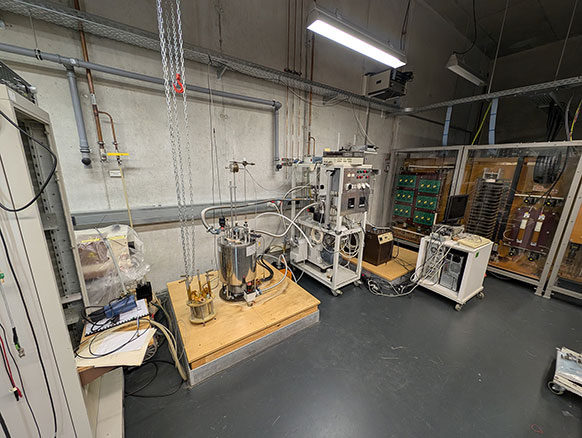
This is part of the 58-Tesla pulsed high magnetic field experimental system, now designated as the Wyoming Pulsed High Magnetic Field Facility, showing the cryostat that holds the magnet. (Alex Petrovic Photo)
The University of Wyoming has gained a new asset that will elevate its national leadership
in critical minerals, rare-earth magnetics, advanced materials and quantum technologies
-- with the potential to drive advancements that specifically help Wyoming industries.
UW has received a rare and strategically important gift from Germany’s Goethe-Universität
Frankfurt: a fully functional 58-Tesla pulsed high magnetic field experimental system,
now designated as the Wyoming Pulsed High Magnetic Field Facility (WYPulse). This
gift instantly elevates UW into a national-capability tier in quantum materials and
advanced materials research, as the university is one of only three academic institutions
in the United States with access to a pulsed magnet facility of this class.
“As the only pulsed-field facility of its kind in the Mountain West, WYPulse positions
Wyoming as a national research destination, setting the stage for new federal funding
and industry partnerships while building a Wyoming-based workforce aligned with national
energy, defense and quantum priorities,” UW President Ed Seidel says. “WYPulse is
not only a transformational scientific asset for UW; it also is a strategically aligned
investment in Wyoming’s economic future, energy transition and critical-minerals leadership.”
High magnetic fields are not simply stronger laboratory tools; they are fundamental
control parameters that allow scientists to access, manipulate and discover entirely
new quantum states of matter. Fields above 50 Tesla are required to suppress superconductivity,
reveal hidden electronic phases, drive quantum phase transitions and probe exotic
phenomena such as topological states, spin liquids and unconventional superconductors.
These experiments cannot be performed using standard laboratory magnets.
The donated Frankfurt system constitutes a complete, operational national-scale experimental
platform, including a capacitor bank, high-voltage power supply and switching systems
with integrated safety devices; isolation transformers; three pulsed field coils;
a liquid-nitrogen cryostat; a 4-helium bath cryostat; a 3-helium cryostat insert for
experiments at extremely low temperatures; and a dedicated control and data-synchronization
unit. This is not a single instrument, but a fully integrated high-field laboratory.
Only two comparable pulsed-field facilities currently exist in the United States:
one at Los Alamos National Laboratory in New Mexico and one at Clark University in
Massachusetts. UW’s facility will be embedded directly within the university’s Center
for Quantum Information Science and Engineering, making it the only pulsed-field academic
facility in the nation integrated into a quantum research center.
Scientifically, WYPulse enables a class of experiments central to modern condensed-matter
physics, quantum information science and advanced materials research. For UW’s seven
condensed-matter physicists, high-field capability is essential to their core research
programs. Beyond physics, the facility will support materials science, electrical
engineering, chemistry and mechanical engineering research, creating a shared campus
asset with broad interdisciplinary impact.
The magnet system is being installed in the basement of the Physical Sciences Building
on campus.
“WYPulse represents an exceptional return on investment for the University of Wyoming
and for the state of Wyoming. Constructing a comparable pulsed-field system from scratch
would require a multimillion-dollar investment and years of development,” says Parag
Chitnis, UW’s vice president for research and economic development. “Through this
international partnership, UW acquires a field-proven, operational system at a fraction
of that cost, instantly placing the university into a rare and strategically important
national research niche.”
The high-field laboratory at the Goethe-Universität Frankfurt was founded in 1995
by Professor Bruno Lüthi and his collaborator, Bernd Wolf, within a program set up
by the Federal Ministry of Education, Science, Research and Technology. The focus
of the project was the development of advanced experimental techniques, such as phase-sensitive
detection of sound velocity, for investigating materials with strongly correlated
electrons in high magnetic fields. These activities were continued by Professor Michael
Lang, who succeeded Lüthi in 2000, until Lang’s retirement in 2026.
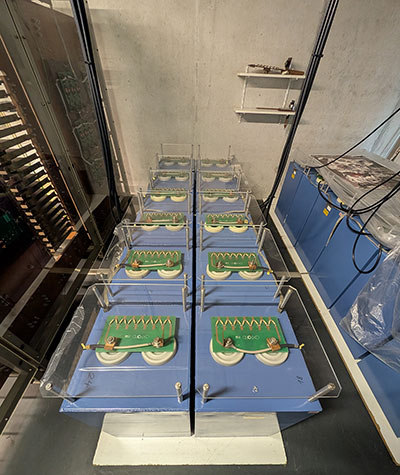
This is part of the capacitor bank that powers the Wyoming Pulsed High Magnetic Field Facility. (Alex Petrovic Photo)
“Due to a shift in research priorities, experiments in high magnetic fields will no
longer be performed here at Goethe University,” Lang says. “We are very pleased that,
under the new leadership of Professor Alex Petrovic and his colleagues at the University
of Wyoming, our pulsed-field facility is looking at a bright future with foreseeable
broad impact to various fields. Researchers from the Goethe University will be happy
to provide advice and assistance to put the system into operation at the new site
and to collaborate on various aspects of quantum materials in the future.”
Ownership of a rare national-scale research facility improves UW’s prospects for major
federal awards from the National Science Foundation, the U.S. Department of Energy’s
Office of Science and other agencies, particularly in quantum information science,
quantum materials and mid-scale research infrastructure programs. In practical terms,
WYPulse becomes an “infrastructure anchor” that turns UW proposals from strong scientific
ideas into national-capability proposals.
One example of the facility’s potential to boost an existing Wyoming industry is the
development of sodium-ion battery technology. Wyoming is the world’s leading producer
of trona and soda ash, foundational feedstocks for sodium-based industrial chemistry.
Sodium-ion batteries are emerging as a lower-cost, geopolitically resilient alternative
to lithium-ion batteries, particularly for grid-scale energy storage. High magnetic
fields play a critical role in understanding and improving sodium-ion battery materials.
Using WYPulse, UW researchers can probe sodium-ion transport mechanisms; study defect
formation and phase stability during charge-discharge cycles; test new sodium-rich
electrode materials; and discover compounds with unusually fast sodium mobility. This
puts UW at the intersection of quantum materials science, sodium chemistry and grid-scale
energy storage, directly supporting Wyoming’s long-term strategy to add value to its
trona and soda-ash resources.
WYPulse also strengthens Wyoming’s growing role in critical minerals and strategic
materials. High magnetic fields enable the discovery and characterization of new magnetic
and functional materials; the study of rare-earth compounds relevant to advanced permanent
magnets; and the evaluation of material reliability under extreme electromagnetic
conditions. These capabilities align directly with Department of Energy and Department
of Defense priorities and reinforce UW’s leadership in materials research tied to
national security and energy independence.
Finally, WYPulse strengthens UW’s ability to attract elite graduate students, postdoctoral
fellows and high-impact faculty members, while training Wyoming-based students in
advanced quantum and materials technologies.
“In practical terms, WYPulse converts a modest operational investment into a durable engine for federal funding growth, industry partnerships, workforce development and resource-to-technology innovation,” Seidel says. “It exemplifies a high-leverage strategy in which a single international partnership gift yields long-term financial, scientific and economic returns for Wyoming’s university and the state.”

The University of Wyoming has earned its Research Level 1 (R1) status from the Carnegie Classification of Institutions of Higher Education, placing Wyoming's only four-year university with the top research universities in the United States.