
UW Ph.D. Student Makes Breakthrough with Potential to Revolutionize Materials Development
Published April 13, 2026
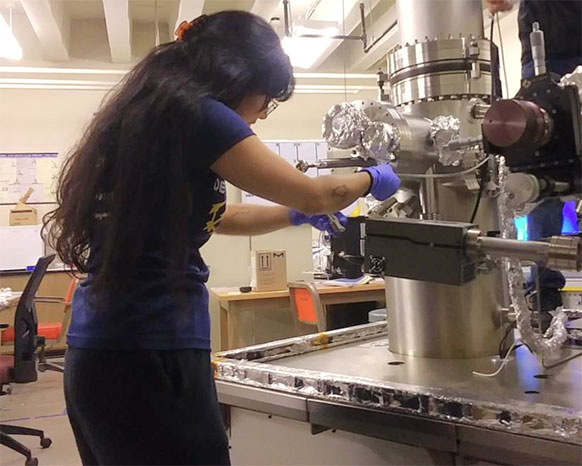
UW’s Lauren Kim, here working in the lab, has solved a persistent problem in the cutting-edge field of high-entropy alloys, a class of materials with great potential in modern engineering, electronics and energy applications. (Alex Quinn Photo)
The University of Wyoming’s Lauren Kim has solved a persistent problem in the cutting-edge
field of high-entropy alloys, a class of materials with great potential in modern
engineering, electronics and energy applications -- such as jet engines, nuclear reactors,
chemical processing systems, batteries and supercapacitors -- along with cryogenics
systems.
Kim, from Fairport, N.Y., was a Ph.D. student in UW’s Department of Physics and Astronomy
who graduated in December, working under the direction of Professor TeYu Chien. Their
article, “Revealing the Existence of the Surface Local Chemical Ordering in High Entropy
Alloys,” appeared this month in the academic journal Nature Communications.
In it, Kim and co-authors describe their research into a novel method of identifying
the chemical arrangement of the surfaces of this specialized class of alloys.
Traditional alloys generally feature only two elements in combination, with one in
greater abundance. High-entropy alloys combine five or more elements in nearly equal
proportions. This greater number of elements allows for the development of materials
with greater strength with increased entropy, ideal for applications requiring high
strength, corrosion resistance and thermal stability.
The elements in high-entropy alloys, however, exist in a solid solution crystalline
structure and, while the distribution of the atoms of each element is not fully random,
neither is it regular. So, the precise location of each element relative to another
in the alloy, or local chemical ordering, has not been unambiguously determined with
available detection technologies.
While it is reasonable to assume that the existence of local chemical ordering may
affect the material properties -- such as mechanical strength, catalytic activities,
corrosion resistance and thermal stability -- establishing these relationships with
the existence of local chemical ordering on an alloy has been nearly impossible.
This is what makes Kim and her team’s recent breakthrough so exciting. Their methodology
has, for the first time, made it possible to characterize surface local chemical ordering
of high-entropy alloys.
This work, made possible through a National Science Foundation grant, is a result
of collaboration between Kim and Chien at UW, together with Ganesh Balasubramanian
and Prince Sharma, from the University of New Haven (Sharma will join UW’s Department
of Mechanical Engineering this fall); Peter Liaw, from the University of Tennessee-Knoxville;
E-Wen Huang, from National Yang Ming Chiao Tung University in Taiwan; and Che-Wei
Tsai and Jien-Wei Yeh, from National Tsing Hua University in Taiwan. Notably, Yeh
was the first researcher to demonstrate the stability of high-entropy alloys more
than 20 years ago.
In particular, this team worked with the alloy CoCrFeMnNi (cobalt, chromium, iron,
manganese and nickel). The method involves using surface-sensitive scanning tunneling
microscopy to reveal elements at the atomic scale. This gives a good view of quasi-long-range
ordering, which is the atomic distribution ordering detectable at a slightly larger
scale. Next, density functional theory calculations identify the finer resolution
of local chemical ordering within those quasi-long-range supercells. Through these
methods, the team directly observed and characterized surface local chemical ordering
of high-entropy alloys.
“This finding implies that the surface physical/chemical properties of high-entropy
alloys can be controlled together with controlling the local chemical ordering. And
we demonstrated a new tool/methodology to study local chemical ordering in high-entropy
alloys, which is unprecedented,” Chien says.
Kim’s methodology could lead to exciting advances in the ability to better control
the properties of alloys to yield custom materials with superior strength, stability
and resistance to corrosion.
The full article is available at www.nature.com/articles/s41467-026-71170-z.

The University of Wyoming has earned its Research Level 1 (R1) status from the Carnegie Classification of Institutions of Higher Education, placing Wyoming's only four-year university with the top research universities in the United States.