
UW Student from Gillette Finds Hands-On Learning, Community in Environmental Science
Published April 23, 2026
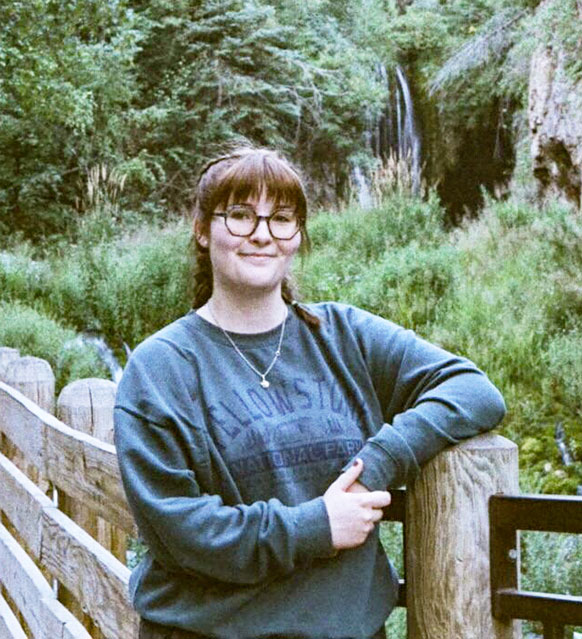
Alexandria Shinkle
Alexandria Shinkle credits her hometown of Gillette with giving her a head start on
her college education. The dual enrollment program with Gillette College allowed her
to take college courses during high school at her own pace.
“Any high school student can take college credit, and they can take as much or as
little as they want,” Shinkle says. “It’s a great way for students in our community
to get ahead, figure out what they want to do and save so much money in the long run.”
Now a junior studying environmental systems science, and environment and natural resources
at the University of Wyoming’s Haub School of Environment and Natural Resources, Shinkle
is experiencing the hands-on education she was looking for.
“You don’t sit in a lecture as often as people outside of the Haub School,” she explains.
“You get to go out and about. We talked to a geologist about Pilot Hill while we were
standing directly on Pilot Hill. We’ve been to Hutton Lake and the Laramie River.”
The program’s flexibility allows students to tailor their learning to their interests.
“I had an assignment where you got to pick your own place to research and explore
outside of class,” Shinkle says. “If you’re more interested in geology, you can make
it that way and focus on that specific aspect.”
Beyond academics, Shinkle values the tight-knit community she has found at the Haub
School.
“Every time I go into a new class, I see a face that I recognize, and I can have somebody
to sit next to,” she says. “They can help me; I can help them. I love this small community
and how everybody’s pretty tight.”
After graduation, Shinkle hopes to work for the U.S. Forest Service or National Park
Service, bringing her hands-on education full circle to serve public lands.
Three Decades of Impact
UW’s Haub School prepares the next generation of natural resource professionals while
serving Wyoming’s wild and working lands and communities. With 1,275 alumni (1996-2025),
many working across the state in government, private industry, nonprofits and education,
the school offers six undergraduate and seven graduate programs integrating science,
policy, law, economics and community engagement.
The school brings about $2 million annually in research funding to Wyoming while supporting
communities through four dedicated centers and institutes. Recent milestones include
a $5 million gift from Jay and Karen Kemmerer in 2025 to establish the Wyoming Outdoor
Recreation, Tourism and Hospitality (WORTH) Institute, supporting the state’s second-largest
industry.
Haub School programs, including the Wyoming Conservation Corps, have trained more
than 150 young adults and veterans since 2021, while the Biodiversity Institute connects
people of all ages to Wyoming’s wildlife through 40-plus annual programs reaching
over 3,500 participants statewide. The school’s Ruckelshaus Institute facilitates
collaborative, long-term solutions to natural resource challenges, offers professional
workforce development, and publishes the award-winning Western Confluence magazine,
reaching nearly 4,000 readers across the state. Learn more at www.uwyo.edu/haub.
Additionally, the Haub School’s Tomé Scholars to Fellows Program -- established in 2021 through a major gift from UW alumni Carol and Ramon Tomé -- provides exceptional students with full-ride, four-year scholarships and experiential learning opportunities to address complex environmental challenges. Recent expanded support from the Tomé Foundation has doubled the number of scholars on campus. Learn more at www.uwyo.edu/haub/academics/academic-advising/tome-scholars-to-fellows.html.

The University of Wyoming has earned its Research Level 1 (R1) status from the Carnegie Classification of Institutions of Higher Education, placing Wyoming's only four-year university with the top research universities in the United States.