
UW Student Turns Love of Bighorn River into Environmental Law Career Path
Published April 09, 2026
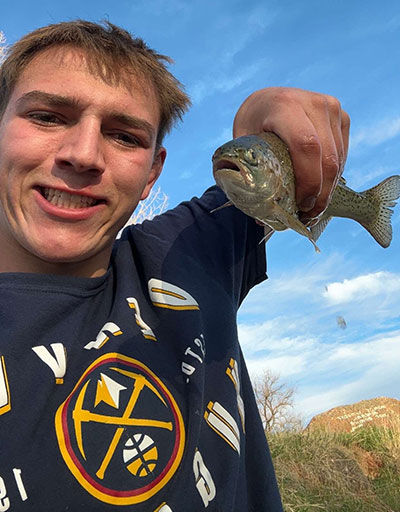
Brody Sorensen
Growing up in Thermopolis, Brody Sorensen spent his days on the Bighorn River, one
of Wyoming’s most fished and floated waterways. Those experiences shaped his understanding
of environmental protection.
“The Bighorn River gave us a strong outdoor community and a lot of opportunities to
just be with the environment,” Sorensen says. “It showed me what there was to lose
if we aren’t careful. It made me realize that there have to be people doing work to
fix our environment.”
Now a freshman studying at the University of Wyoming’s Haub School of Environment
and Natural Resources, Sorensen plans to pursue the joint Juris Doctor and Master
of Arts in environment and natural resources degree program after completing his undergraduate
studies.
“I want to do something that is protecting the environment and working for a better
future,” he explains.
Finishing his first semester, Sorensen was surprised by the program’s hands-on approach.
“We weren’t in the classroom very much. We actually got to go around Laramie looking
at different projects,” he says. “We went to Pilot Hill and learned about the Casper
Aquifer and how that helps supply water to everyone.”
That field-based learning has deepened his connection to the work.
“You get to see these beautiful landscapes and learn about the biology and biodiversity,
what’s going on in the area and why that area is important to the state,” he says.
What inspires him most?
“Being able to step out my front door and see this beautiful landscape,” Sorensen
says. “UW is one of the most outdoor schools there is. It gives me hope for the future.”
Three Decades of Impact
UW’s Haub School prepares the next generation of natural resource professionals while
serving Wyoming’s wild and working lands and communities. With 1,275 alumni (1996-2025),
many working across the state in government, private industry, nonprofits and education,
the school offers six undergraduate and seven graduate programs integrating science,
policy, law, economics and community engagement.
The school brings about $2 million annually in research funding to Wyoming while supporting
communities through four dedicated centers and institutes. Recent milestones include
a $5 million gift from Jay and Karen Kemmerer in 2025 to establish the Wyoming Outdoor
Recreation, Tourism and Hospitality (WORTH) Institute, supporting the state’s second-largest
industry.
Haub School programs, including the Wyoming Conservation Corps, have trained more
than 150 young adults and veterans since 2021, while the Biodiversity Institute connects
people of all ages to Wyoming’s wildlife through 40-plus annual programs reaching
over 3,500 participants statewide. The school’s Ruckelshaus Institute facilitates
collaborative, long-term solutions to natural resource challenges, offers professional
workforce development, and publishes the award-winning Western Confluence magazine,
reaching nearly 4,000 readers across the state. Learn more at www.uwyo.edu/haub.
Additionally, the Haub School’s Tomé Scholars to Fellows Program -- established in 2021 through a major gift from UW alumni Carol and Ramon Tomé -- provides exceptional students with full-ride, four-year scholarships and experiential learning opportunities to address complex environmental challenges. Recent expanded support from the Tomé Foundation has doubled the number of scholars on campus. Learn more at www.bit.ly/tomescholars.

The University of Wyoming has earned its Research Level 1 (R1) status from the Carnegie Classification of Institutions of Higher Education, placing Wyoming's only four-year university with the top research universities in the United States.