
UW’s Clementz Co-Writes Paper Connecting Volcanic Eruptions, Global Cooling
Published April 14, 2026
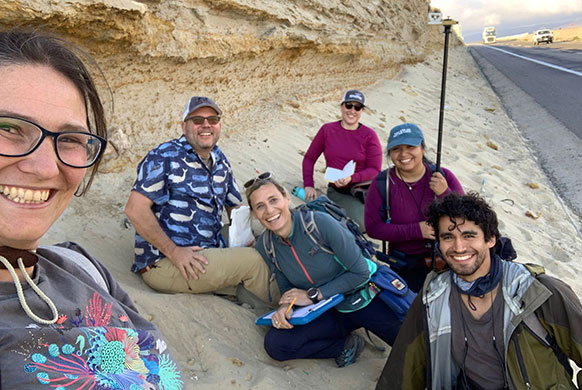
Researchers work in the field at Cerro Ballena near Caldera, Chile, as part of a study showing that an increase in volcanic activity in the Andes in the Late Miocene Epoch likely resulted in a cooling of the Earth between 5.4 million and 7 million years ago. From left are Carolina Gutstein, Mark Clementz, Barbara Carrapa, Whitney Worrell, Priscilla Martinez and Fabían Muñoz. (Carolina Gutstein Photo)
Mark Clementz, a professor in the University of Wyoming Department of Geology and
Geophysics, and colleagues have produced a compelling study that shows that an increase
in volcanic activity in the Andes in the Late Miocene Epoch likely resulted in a cooling
of the Earth between 5.4 million and 7 million years ago.
The volcanic activity produced a biological boom in the Southern Ocean, which led
to a drawdown of atmospheric carbon dioxide that resulted in global cooling, Clementz
and co-authors concluded. Their findings are in a new article, titled “Andean volcanism,
ocean fertilization, marine ecosystem turnover, and global cooling in the Late Miocene,”
published this week in the journal Nature Communications Earth and Environment.
The Late Miocene, Clementz says, “represents a pivotal transition in Earth’s climate
system, marking the shift toward the modern climatic regime and the establishment
of many of today’s floral and faunal assemblages. Identifying the mechanisms that
drove this transition is critical, particularly for understanding how Earth systems
may respond to ongoing and future climate change.”
The research was funded by the National Science Foundation and involves an international
collaboration among Clementz; Barbara Carrapa, Priscilla Martinez and Kaustubh Thirumalai,
all from the University of Arizona; Nicolás Cosentino, Universidad de Buenos Aires;
Pedro DiNezio, University of Colorado-Boulder; Pam Vervoort, University of Birmingham;
Jordan Abell, Lehigh University; Dominik Hülse, University of Bremen; and Carolina
Gutstein, from Universidad Santo Tomás.
By combining multi-proxy data from field and laboratory research with multiple computer
modeling simulations using known and extrapolated data, the study shows a potential
link between sustained, large-scale volcanism in the Altiplano-Puna volcanic complex,
the largest active silicic magma system on Earth, and global climatic and ecological
change.
Volcanic ash is known to contain important nutrients, including phosphorus, iron and
silicon. A significant increase in volcanic activity in the Andes peaking between
4 million and 8 million years ago, therefore, likely delivered a significant pulse
of nutrients -- especially iron -- to the Southern Ocean.
This increase in nutrients, in turn, would have stimulated an increase in diversity
and abundance of marine life -- notably microscopic, single-celled algae called diatoms,
which are not only one of the largest producers of chlorophyll in the world, pulling
carbon dioxide from the atmosphere, but also essential to ocean food chains.
This corresponds to available fossil records, which show big changes in marine vertebrate
populations during this period. Cetaceans, the order of marine mammals to which whales
belong, went through significant evolutionary shifts, including the development of
larger bodies, greater diversification and long-distance migratory behaviors.
Whales sink to the ocean floor when they die, sequestering carbon. But they also produce
large volumes of carbon-rich feces, which may have been responsible for producing
toxic algal blooms that killed off other marine life on a mass scale, greatly increasing
the carbon stored in the ocean. This, together with the photosynthetic activity of
diatoms and other concurrent events, would have contributed significantly to a drawdown
of atmospheric carbon dioxide. And, indeed, models confirm that carbon dioxide levels
in the atmosphere fell by about 10-15 parts per million, subsequent to these events
preserved in the geological record, resulting in global cooling within the warmer
climate of the Miocene.
“This work improves our understanding of how natural processes can regulate Earth’s
climate, which is directly relevant to anticipating future climate change and its
impacts on society,” Clementz says. “By identifying links between volcanism, ocean
productivity and carbon dioxide drawdown, it provides insight into mechanisms that
can influence global climate over long time scales.”
Clementz hopes his research will help inform science-based decision-making related
to natural resources, climate resilience and environmental change. He is excited that
this study positions Wyoming at the forefront of both cutting-edge Earth system science
and, through its extensive fossil record from earlier periods, situates Wyoming’s
paleontological resources in a broader, global context of ecosystem change through
time.
The full article is available here: www.nature.com/articles/s43247-026-03457-4. To learn more about the history of the ideas behind the research on Carrapa’s blog, go to https://communities.springernature.com/posts/andean-volcanism-ocean-fertilization-marine-ecosystem-turnover-and-global-cooling-in-the-late-miocene-eb21fc68-b275-4df4-9f34-8b03d417a375.

The University of Wyoming has earned its Research Level 1 (R1) status from the Carnegie Classification of Institutions of Higher Education, placing Wyoming's only four-year university with the top research universities in the United States.