
UW’s Storey Makes Winning Presentation at Wyoming Chapter of Wildlife Society Meeting
Published April 22, 2026
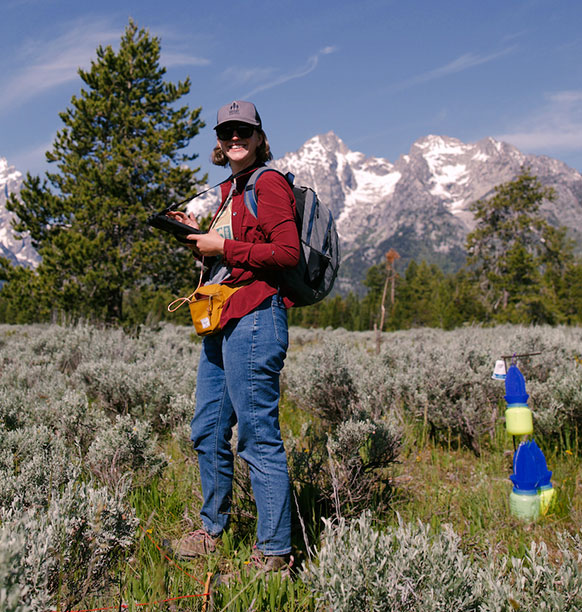
Amy Storey, a University of Wyoming third-year master’s student in zoology and physiology, completes a field survey for a collection site in Grand Teton National Park. This included taking habitat measurements about the floral and bee community as well as collecting environmental data, such as wind speed and land use. Storey’s presentation, titled “Parasites and Bumble Bee Decline in Wyoming,” was named the winning entry for a master’s student at the Wyoming Chapter of the Wildlife Society meeting in Sheridan April 8. (Rebecca Armentrout Photo)
Wild bumble bees are in decline, and various parasites may be a major cause. But there
hasn’t been any data on whether Wyoming bees have parasites and to what degree --
until now.
Amy Storey, a University of Wyoming third-year master’s student in zoology and physiology,
shed light on her research when she took center stage at the recent Wyoming Chapter
of the Wildlife Society meeting in Sheridan.
Her presentation, titled “Parasites and Bumble Bee Decline in Wyoming,” was named
the winning entry for a master’s student at the event April 8.
“I think my project presentation won because the project has had a lot of time to
mature into a cohesive story due to where I am in my degree,” says Storey, of Grand
Junction, Colo. “I also think these results are interesting for audiences to hear
about because bees are charismatic and folks understand how important pollination
is. They’re also interesting results because they’re the first; these are the first-ever
parasite rates in Wyoming. Researchers of bee parasitism in the Rocky Mountains now
have baseline infection rates to work from.”
While Storey says she didn’t get much in the way of specific feedback from judges,
who submitted ratings through an anonymous system, she did pocket $100 for her winning
effort.
Parasites can seriously decrease the health of bees and can lead to fewer bee colonies
found each spring. The parasites Apicystis bombi, Vairimorpha bombi and Vairimorpha ceranae are all known in bumble bees, and all three are present in wild bumble bees in Wyoming,
Storey says.
“In specific cases, we have seen parasites directly linked to bee decline, and we
also have seen that parasites can move from commercial bees to wild bees easily,”
Storey says. “Yet, we haven’t had any confirmation of whether three of the most common/most
researched parasites are present in our area. I used a molecular lab method called
PCR to screen wild bumble bees from across the state for these parasites and found
higher rates than we expected.”
“We had no idea what proportion of bumble bees were infected in the Intermountain
West before Amy Marie conducted her study. Parasites are thought to be the main reason
bumble bees are declining, but we lacked information,” says Lusha Tronstad, lead invertebrate
zoologist with the Wyoming Natural Diversity Database and Storey’s adviser. “Amy Marie’s
study showed that most bumble bees in Wyoming are infected with at least one of these
three parasites, which are all capable of causing bumble bee loss. Surprisingly, bumble
bees from Wyoming towns to wilderness were equally infected by some parasites.”
However, Tronstad says there is good news from the study.
“Amy Marie’s results showed that more flowers in an area related to fewer infected
bees,” Tronstad says. “So, planting more flowers that bloom throughout the summer
supports our native bees.”
While Storey’s recent presentation took 15 minutes, she will go more in depth on the subject when she defends her thesis Friday, April 24.

The University of Wyoming has earned its Research Level 1 (R1) status from the Carnegie Classification of Institutions of Higher Education, placing Wyoming's only four-year university with the top research universities in the United States.