
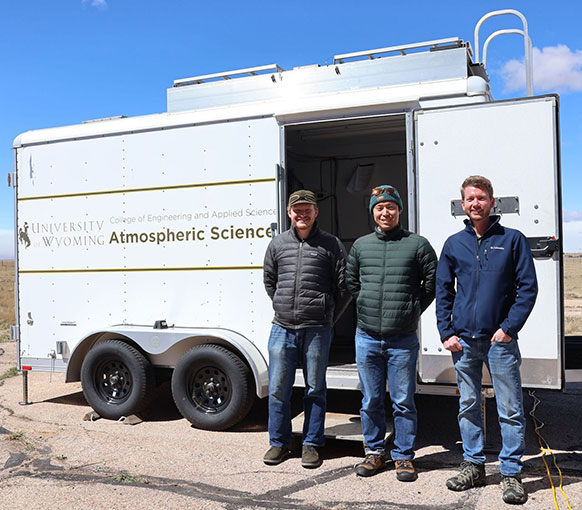
From left, Owen Cruikshank, Masa Saito and Coltin Grasmick pose with the newly completed University of Wyoming mobile atmospheric remote sensing trailer during testing at UW’s King Air Atmospheric Research Aircraft facility. (UW Photo)
Over the course of three days in early April, the University of Wyoming Department
of Atmospheric Science took advantage of incoming weather systems in Laramie to test
its new mobile atmospheric remote sensing (MARS) trailer for the first time.
This interdisciplinary project, in collaboration with Noriaki Ohara, a UW civil engineering
professor, was funded by a $25,000 UW Tier-1 Engineering Initiative interdisciplinary-collaborative
seed grant. The grant was used to modify an unused mobile trailer to host remote sensing
instruments for atmospheric research. It also was used to pay faculty, scientists
and a graduate student for their time to make modifications, perform initial testing
and conduct a three-day MARS trailer operation.
The remote sensing instruments -- Wyoming cloud radar (WCR) and Wyoming cloud lidar
(WCL) -- have been developed over decades at the UW King Air Atmospheric Research
Aircraft facility and supported through cooperative agreements with the National Science
Foundation.
Radar uses radio waves to bounce pulsed signals off of objects or particles to take
measurements. For clouds, this makes it effective for recording velocity, estimating
water droplet and particle sizes, and observing the height of a cloud system. But
it also can pick up signals from aerosols in the air, such as dust or smoke, for example.
Lidar, however, uses ultraviolet light from a rapidly firing laser in the same way.
Because it has a short wavelength, it is able to achieve fine resolution for measurements
and information about droplet sizes and their phase states. But, because the signal
attenuates, or absorbs quickly, researchers can only obtain information about the
bottom of a cloud layer.
Used together, these instruments fill in each other’s deficiencies and vastly improve
the ability to depict fine-scale structures, compositions and behavior of clouds.
To date, the WCR and WCL have only been utilized on airborne field campaigns. So,
the team is excited to now be able to deploy these remote sensing instruments from
the ground anywhere the trailer can travel, greatly adding to the amount and type
of data that can be collected about weather systems in Wyoming and beyond.
Masa Saito, the project lead and a UW assistant professor of atmospheric science,
is excited about the new strengths the MARS trailer will bring to atmospheric research
at the university and the corresponding benefits to scientists in other College of
Engineering and Physical Sciences units through atmospheric interdisciplinary research.
Saito cites both the trailer’s mobility for measuring particular target atmospheric
phenomena and cost-effectiveness.
“Atmospheric phenomena/processes -- for example, snowstorms, wildfires and dust storms
-- involve fine-scale processes, and it is not easy to measure these phenomena at
a permanently fixed location and predetermined observational period,” Saito says.
“A mobile platform will give us flexibility in the deployment location and period
to measure target atmospheric processes.”
Because the trailer can collect critical remote sensing data inexpensively, Saito
anticipates that the project will be very attractive to new funding sources for investment
as well.
Coltin Grasmick and Owen Cruikshank, both associate research scientists in the UW
Department of Atmospheric Science, conducted the initial data collection over three
days with the MARS trailer in early April, measuring cloud composition, height and
internal dynamics. Grasmick focused on the radar data processing, while Cruikshank
handled the lidar data processing. This data will support future external funding
proposals.
Already, the team has secured a Tier-1 Engineering Initiative one-time purchase grant
of about $39,000 to upgrade a ground-based lidar system for the MARS trailer operation. If
the team can operate these instruments from both the airborne and ground-based platforms
simultaneously, it will be able to collect unique and even more high-quality data,
raising the visibility of UW’s atmospheric science capabilities across the nation.
Not only will the trailer collect meteorological data important to understand weather
phenomena such as winter storms, which are critical to daily life in Wyoming; it also
will play a key role in training future atmospheric professionals.
During the initial testing, graduate students who are taking Physical Meteorology
II, a graduate-level course in cloud microphysics, took a field trip to watch the
MARS trailer collect data live in the field and to learn how the instruments work.
The trailer also will be used for additional graduate-level atmospheric science courses.
“The MARS trailer offers students both hands-on and hands-off experiences in atmospheric
research,” Saito says. “Knowledge and techniques in remote sensing are specialized
skills that will help students’ careers.”
These skills are critical for professionals from NASA to the National Weather Service
to the private sector and academic tracks, he says.
Moreover, the trailer will be a valuable addition to the department’s popular STEM
outreach programs with Wyoming schools, helping inspire new generations of atmospheric
scientists.

The University of Wyoming has earned its Research Level 1 (R1) status from the Carnegie Classification of Institutions of Higher Education, placing Wyoming's only four-year university with the top research universities in the United States.