
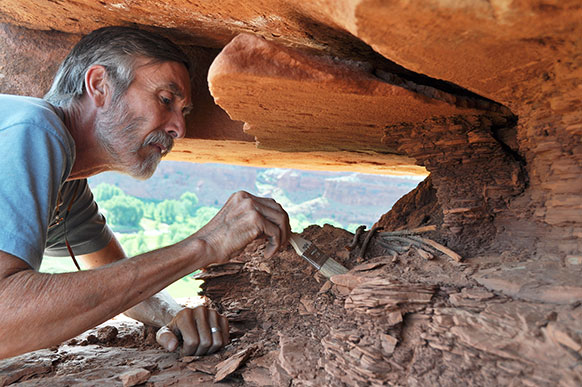
UW Professor Emeritus Robert Kelly, here excavating a site in Wyoming, has become only the second UW faculty member in history to be named to the National Academy of Sciences. (Madeline Mackie Photo)
Robert Kelly, a professor emeritus of anthropology at the University of Wyoming, has
been elected to the prestigious National Academy of Sciences (NAS) in recognition
of his distinguished and continuing achievements in original research.
Kelly is only the second UW faculty member to receive this honor, joining the late
George Frison, a renowned archaeologist and former longtime UW faculty member.
“What an incredible honor for one of our most accomplished, internationally recognized
faculty members,” UW President Ed Seidel says. “Dr. Kelly’s accomplishments are amazing,
and this recognition not only puts him in extremely select company -- it lifts the
profile of Wyoming’s university.”
NAS announced the election of 120 members and 25 international members this year,
bringing its total active membership to 2,705 and its international membership to
557. Established in 1863 under a congressional charter signed by President Abraham
Lincoln, the NAS is a private, nonprofit institution that recognizes achievement in
science through election to membership. Along with the National Academy of Engineering
and the National Academy of Medicine, it provides independent advice to the federal
government and other organizations on matters related to science, engineering and
health.
“This is unexpected, flattering and humbling,” Kelly says. “I am grateful for the
guidance and assistance from colleagues, friends and family over the last 50 years.”
Kelly became involved in archaeology in 1973, when he participated as a high school
student in an excavation of a cave site in Nevada alongside David Hurst Thomas of
the American Museum of Natural History. He continued to work in Nevada for more than
a decade, eventually conducting his doctoral field research there.
He earned his bachelor’s degree in anthropology from Cornell University in 1978, a
master’s degree from the University of New Mexico in 1980 and a Ph.D. from the University
of Michigan in 1985.
Before joining UW in 1997, Kelly held a faculty position at the University of Louisville,
where he directed the department’s archaeology program and served as department head.
At UW, he also served as department head from 2005-08, helping lead the planning and
construction of the Anthropology Building and contributing to the development of the
department’s doctoral program.
A prolific scholar, Kelly is the author of more than 200 articles, books, reviews
and commentaries and is among the top 2 percent of cited scientists in the world.
He is the author, with Thomas, of “Archaeology,” the most widely used undergraduate
textbook in archaeology, and “The Lifeways of Hunter-Gatherers,” which has been in
print since 1995. Written for the public, his award-winning book “The Fifth Beginning:
What Six Million Years of Human History Can Tell Us about Our Future” has been translated
into Chinese, Korean, German and Slovakian. His research spans archaeology, ethnology
and ethnography, with archaeological fieldwork conducted across the U.S. and ethnographic
fieldwork in Madagascar.
Since coming to Wyoming, Kelly has researched Paleoindian archaeology, most recently
at the LaPrele site in eastern Wyoming, and the links among climate, demography and
hunter-gatherer lifeways at cave sites in the Bighorn Mountains. He led a project
to create a radiocarbon database for the U.S., which is now an open resource for other
researchers.
His recent work includes a project in Glacier National Park investigating ice and
snow patches for artifacts exposed by climate change, aiming to connect current and
past climate changes.
Kelly has secured more than $2 million in research funding and has been a strong advocate
for public engagement and Native American involvement in archaeology. He founded the
“Explore Wyoming’s Cultural Heritage” website to promote tourism and education around
the state’s archaeological and historic sites and has delivered numerous public lectures
across Wyoming.
He is a past president of the Society for American Archaeology (SAA), a former secretary
of the Archaeology Division of the American Anthropological Association, and past
editor of American Antiquity, the SAA’s flagship journal. Kelly has been a distinguished
lecturer at numerous American and international universities, including those in China,
the United Kingdom, Japan, Germany, Finland, Norway, Argentina and the Netherlands.
He also has served on the National Science Foundation’s proposal review panel, holds
a senior Humboldt Fellowship in Germany and is a fellow of Peterhouse College at the
University of Cambridge and the Chinese Academy of Sciences.
Kelly’s election to NAS represents one of the highest distinctions in the scientific
community and underscores the global impact of his scholarship and leadership in archaeology.
“This honor speaks not only to Dr. Kelly’s extraordinary contributions to archaeology,
but also to the kind of curiosity-driven, field-shaping work valued in the College
of Arts and Sciences,” says Scott Turpen, dean of the UW College of Arts and Sciences.
“His scholarship, leadership and dedication to students have left an enduring mark
on our college and have elevated the reputation of the University of Wyoming on a
national and global stage.”
For more information about Kelly’s research, email him at rlkelly@uwyo.edu.

The University of Wyoming has earned its Research Level 1 (R1) status from the Carnegie Classification of Institutions of Higher Education, placing Wyoming's only four-year university with the top research universities in the United States.