
UW Interprofessional Education Workshop Looks at Opioid Patient Care
Published May 12, 2026
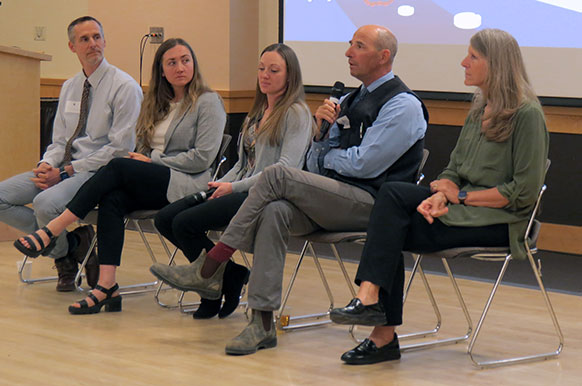
From left, panelists Dr. Todd Guth, Jordan Dyett, Bree Gray, Dr. Tom Radosevich and Nancy Halsey take questions from students in UW’s College of Health Sciences on opioid patient care and treatment. (UW Photo)
The University of Wyoming’s College of Health Sciences recently hosted its annual
Interprofessional Education Forum in the Wyoming Union, including students from the
Wyoming WWAMI Medical Education Program, the Fay W. Whitney School of Nursing, the
UW Division of Social Work and the UW School of Pharmacy.
The event, officially titled “Opioid Workshop: An Interprofessional Learning Experience,”
had as its goal to create a dynamic workshop on opioid use, pain management and collaborative
care. This interactive event brought together about 75 students and faculty members
from multiple health professional disciplines to explore the complexities of opioid
use disorder and the importance of interprofessional teamwork in the care of patients.
Dr. Kaylin Llie, a physician specializing in family medicine at UCHealth Center for
Dependency, Addiction and Rehabilitation and keynote speaker for the workshop, talked
with students about opioid-related care, prevention and treatment, and how their future
health professions would interact with opioid care, both singularly and across disciplines.
A highlight of the day included a panel discussion in which presenters took questions
from students about real-life experiences the panelists -- all local and regional
healthcare professionals -- had in providing opioid-related care.
The panel featured Bree Gray, an emergency department pharmacist at Banner Wyoming
Medical Center in Casper; Dr. Tom Radosevich, a family physician and director of Wyoming
Recovery in Casper; Jordan Dyett, an assistant professor within the UW Division of
Social Work; Dr. Todd Guth, an emergency physician and director of Wyoming WWAMI (Washington,
Wyoming, Alaska, Montana and Idaho) Medical Education; and Nancy Halsey, a family
nurse practitioner at Albany Community Health Clinic.
Student questions for the panel ranged from what successful management and treatment
of opioid patient care looks like to what steps are taken by healthcare providers
if a return to opioid use outside of normal treatment becomes evident.
“As a social work researcher, clinician and educator, it was an honor to represent
social work’s role in interdisciplinary responses to the opioid crisis,” Dyett says.
“In addition, the entire junior cohort of bachelor-level social work students was
able to attend the event. Seeing the next generation of professionals inspired by
these high-level dialogues reinforces the importance of interprofessional education
and ongoing discussion about substance use in our communities.”
“A key takeaway from the workshop is the opportunity for health professions students
to begin to understand the other students’ roles and responsibilities in clinical
settings,” Guth says. “It’s also great to hear directly from the other health professions
students about the training and what got them to this point in their education.”
The opioid workshop concluded with participants interacting with other health professional
students in small working groups on patient scenario problem-solving. A main focus
was how students from each healthcare profession would, at some point, engage with
a different profession with the goal of achieving optimal patient care.
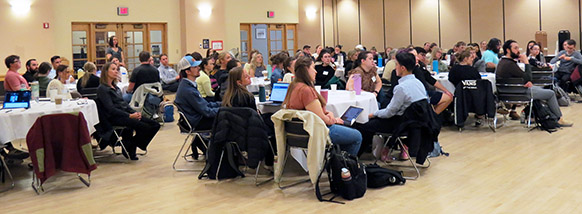
The College of Health Sciences’ interprofessional education event brought together about 75 students and faculty members from multiple health professional disciplines to explore the complexities of opioid use disorder and the importance of interprofessional teamwork in the care of patients. (UW Photo)
“It gave me a really good mock trial of how it might be when you are placed in a group
of people with different career backgrounds; I really liked that,” says Maria Iroz,
a social work student from Cheyenne. “It helped to see how the different careers work
in a broader setting and how this can help create change for individual clients.”
“This event was helpful and very informative. The lecturer and panelists were all experts in treating opioid use disorders, and I learned a lot. It also was great to be able to discuss with other students for the interdisciplinary perspectives,” says Mia McCabe a third-year psychiatric mental health nurse practitioner student from Laramie.
“I very much appreciated the event, and what I found the most interesting and helpful
were the insights from the panel and comments and questions from the audience,” says
Mechelle Rivera, another third-year psychiatric mental health nurse practitioner student
from Deaver.
“This event reflects our commitment to preparing students to work collaboratively
across disciplines to address complex healthcare issues like opioid use and substance
use disorders,” says Patrick Hardigan, dean of the College of Health Sciences. “Experiences
like this foster mutual respect, shared knowledge and team-based problem-solving --
skills that are critical to delivering high-quality, patient-centered care. I want
to sincerely thank the Interprofessional Education Forum Committee and participating
faculty for their leadership in creating such a meaningful and impactful learning
opportunity.”
Students who participated, listed by hometown, are:
Third-year family nurse practitioner students
Casper -- Lauren Menter.
Denver, Colo. -- Allyson Medor.
Evanston -- Steve Aragon.
Gillette -- Christina Rozier.
Jackson -- Julia Bloom.
Lander -- Jayson Simpson.
Riverton -- Ella Erickson.
Saratoga -- Chanel Thrasher.
Steamboat Springs, Colo. -- Joanna Farrell.
Third-year psychiatric mental health nurse practitioner students
Abilene, Texas -- Sheri Scott.
Casper -- Sara Keate, Samantha Skogen and Gabrielle Reimann.
Deaver -- Mechelle Rivera.
Denver, Colo. -- Samuel Garcia.
Laramie -- Maia McCabe and Caitlin McNair.
Riverton -- Robbalee Olson.
St. Louis, Mo. -- Paul Plohr.
Wyoming WWAMI Medical Education Program students
Cheyenne -- Erica Farris, Samantha Johnson, Winston Littlejohn, Brooklyn Prince and
Daniel Shumway.
Gillette -- Dalton Nichols.
Evanston -- Linsey Lancaster.
Jackson -- Elizabeth Girling, Annable Hagen and Rachale Harrower.
Kemmerer -- Alexis King.
Moorcroft -- Cherol Minton.
Powell -- Jordan Moore.
Rawlins -- Easton Couch.
Rock Springs -- Ali Lange.
Sheridan -- Logan Jensen, Margaret Kuehl and Zoe Robison.
Wheatland -- Carlos Garcia.
Pharmacy students
Broomfield, Colo. -- Pierce Bernard.
Brush, Colo. -- Daylie Fuller.
Casper -- Savannah Barkhoff.
Cheyenne -- William Manker, Brynn McKenna and Trevor Stephen.
Cowley -- Trace Moss.
Evanston -- Quetzalli Penaloza Orozco.
Fairfax, Va. -- Daisy Grado.
Fountain Vally, Calf. -- Sage Grimmell-Roewer.
Greeley, Colo. -- Miranda Hanks.
Laramie -- Michael Kleiber, Kate McCune, Nick Montano, Anna Nevshemal, Kalli Pierantoni,
Elicia Sanchez, Finnegan Stubson and Gannon Thompson.
Meriden -- Hunter Petsch.
Moorcroft -- James Croff.
Nashville, Colo. -- Jill Goldstein.
Torrington -- Kameron Stitt.
Wheatland -- Ethan Gustin.
Windsor, Colo. -- Bailey McAlister.
Social work students
Casper -- Jasmine Watson.
Cheyenne -- Maria Iroz and Cody Zimmerman.
Gillette -- Marlee Fager.
Jackson -- Ashley Hernandez-Lopez.
Laramie -- Abby Kersey and Samantha Kitchen.
Riverton -- McKenzie Dykman.
Rock Springs -- Delaney Mei Hua Lew.
Sheridan -- Joseph Bybee.
Worland -- Brittany Deniz.

The University of Wyoming has earned its Research Level 1 (R1) status from the Carnegie Classification of Institutions of Higher Education, placing Wyoming's only four-year university with the top research universities in the United States.