
UW-Led Article Highlights Virtual Fencing’s Potential to Transform Conservation on Working Rangelands
Published May 07, 2026
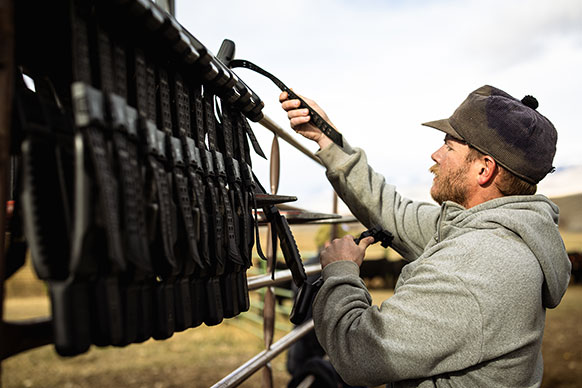
Ben Anson, manager of the Pitchfork Ranch in Park County, arranges collars used in the ranch’s virtual fencing effort. A new article published in the journal Biological Conservation, led by UW researchers, argues that virtual livestock fencing could reshape how ranchers and conservationists manage working lands. (Lindsay Coe/Property and Environment Research Center Photo)
A new perspective article in the journal Biological Conservation argues that virtual
livestock fencing could reshape how ranchers and conservationists manage working lands.
The article was led by Drew Bennett, the Whitney MacMillan Professor of Practice in
the University of Wyoming’s Haub School of Environment and Natural Resources, and
co-written by Haub School colleagues Temple Stoellinger and Jacob Hochard, and UW
Department of Zoology and Physiology faculty members Jerod Merkle and Kurt Smith.
Other collaborators were with the Property and Environment Research Center; the Stone
Center for Environmental Stewardship at the University of California-Berkeley; the
World Wildlife Fund; the Greater Yellowstone Coalition; and the Wyoming Wildlife Federation.
Managing livestock on working rangelands has long depended on physical fencing --
infrastructure that is costly to build and maintain, difficult to adapt and increasingly
recognized as a barrier to wildlife movement and habitat connectivity. In the article,
“Advancing Conservation Through Virtual Livestock Fencing,” the authors argue that a new generation of technology could fundamentally change
that equation.
Virtual fencing uses GPS-enabled collars and software-defined boundaries to contain
and direct livestock without physical infrastructure, allowing managers to remotely
adjust grazing areas in near-real time; exclude animals from sensitive areas during
critical periods; and move herds with a precision that traditional fencing makes difficult
or impossible. The authors contend that this flexibility gives ranchers greater control
over how they graze their land while opening significant new possibilities for conservation.
“Virtual fencing has the potential to do for conservation what barbed wire did for
agricultural management in the 19th century -- it can fundamentally transform how
we manage livestock across landscapes,” Bennett says. “What excites me most is that
this technology doesn’t force trade-offs between ranching and conservation. Done right,
it can genuinely make both better at the same time.”
In the article, the authors make the case that virtual fencing isn’t just a ranching
tool; it can deliver genuine conservation benefits on the same lands where livestock
graze. By reducing physical fencing infrastructure that fragments habitats and threatens
wildlife, enabling precise and adaptive exclusions of sensitive areas and facilitating
more flexible and targeted grazing rotations, the technology has the potential to
benefit wildlife and livestock operations simultaneously, the authors argue.
The paper highlights current pilot projects where several co-authors are directly
involved, including work to improve migration corridors for ungulates in Wyoming;
reduce sage grouse fence collisions in Montana; protect creek corridors in Colorado;
manage livestock-wolf conflicts in Oregon; and use targeted grazing to reduce wildfire
fuel loads in California.
“This technology opens up a new playbook for conservation organizations,” says co-author
Travis Brammer, a UW alumnus and conservation director at the Property and Environment
Research Center. “Conservation groups can now design projects and cost-share arrangements
that would have been logistically impossible with traditional fencing. The win-win
opportunities are real, and we’re already seeing them play out across the West.”
The authors also address barriers to broader adoption, including cost, technological limitations, animal welfare concerns, data privacy and the added complexity of deploying the technology for conservation outcomes rather than production alone.
“We’re really just beginning to understand the ways this technology can address environmental
challenges on rangelands here in Wyoming and around the world,” Bennett says. “The
creativity and ingenuity of livestock producers, conservation practitioners and researchers
will be essential in shaping how it develops and unlocking its full potential.”
The article concludes by outlining a range of opportunities for conservation organizations,
policymakers and livestock producers to work together to realize the technology’s
potential, from policy reforms and innovative conservation agreements to on-the-ground
pilot projects and interdisciplinary research. The authors argue that the technology’s
rapid evolution makes now the right moment to begin building those partnerships in
earnest.
For more information about the article, email Bennett at drew.bennett@uwyo.edu.

The University of Wyoming has earned its Research Level 1 (R1) status from the Carnegie Classification of Institutions of Higher Education, placing Wyoming's only four-year university with the top research universities in the United States.