
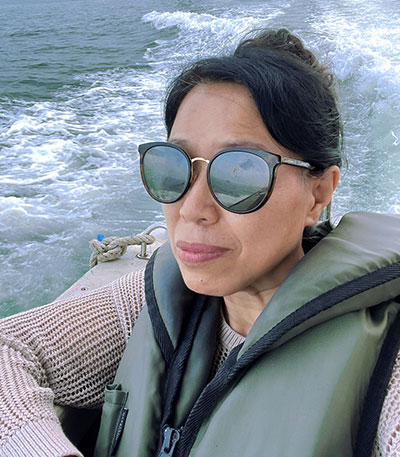
Yan Zhang
Whether she continues to build upon the Chinese language program minor she created
at the University of Wyoming in 2002 or expands study-abroad trips to other countries,
Yan Zhang’s commitment to teaching the Chinese language shows.
Zhang, a senior lecturer of Chinese and section head in the UW Department of Modern
and Classical Languages, is the recipient of the 2026 John P. Ellbogen Lifetime Teaching
Award. The Ellbogen award recognizes the long, distinguished and exemplary career
of one senior faculty member who has excelled as a teacher at UW.
“This award is both a great honor and a moment of reflection for me. It makes me pause
and look back on a long journey shaped by my students, colleagues and family,” Zhang
says. “What has meant the most to me over the years is not just what I teach, but
what I witness -- students gaining confidence, stepping beyond their comfort zones
and growing into ambassadors, leaders and contributors on a global scale.”
“Yan Zhang is that truly unusual educator whose enthusiasm and impact today remains
what it was when she first began her teaching career,” says Caroline McCracken-Flesher,
a UW professor of English and director of the Center for Global Studies, who nominated
Zhang.
McCracken-Flesher points to numerous programs that Zhang created to expand opportunities
and exposure of the Chinese language to students. This includes making the Lunar New
Year a staple on the university calendar, an event that hosts renowned Chinese artists
and troupes; leading the STARTALK initiative, a summer program where high school students
can learn Chinese; organizing eight-week trips where she took college students to
China each summer; and developing a live international virtual exchange with Tianjin
University -- an exchange that engaged about 400 students.
Peng Yu, a principal lecturer of Chinese and Chinese program adviser at the University
of New Mexico, lauded Zhang’s 24 years of teaching, to date, at the university.
“As the founding faculty member of the UW Chinese program, Ms. Zhang has built a sustainable,
community-engaged model of experiential education that is highly regarded by peers
in our field,” Yu wrote in his nomination letter. “Her teaching philosophy -- centered
on the belief that learning becomes transformative though meaningful community engagement
-- represents the ‘gold standard’ for modern language instruction.”
Yu noted that Zhang has directed study-abroad programs for 16 years, including recent
community-based, service-learning initiatives in Singapore and Malaysia.
Students, too, had high praise for Zhang.
Campbell Grabow, a 2024 UW graduate, was taught by Zhang during six semesters and
spent time as her teaching assistant.
“As her TA, I bore witness to her attentiveness when it came to lesson planning and
student involvement, both inside and outside of the classroom,” Grabow says of Zhang.
“More often than not, I saw first-year Chinese students find community through extracurricular
activities that were spearheaded by Professor Zhang.”
Lotus Tai, a UW alumna, says one of the defining experiences of her education and
life was the opportunity to study abroad in Harbin, China, which she credits to Zhang’s
encouragement and guidance.
“My time in Harbin changed the trajectory of my life,” says Tai, who wrote a nomination
letter for Zhang. “It strengthened my language skills, broadened my worldview and
instilled in me a confidence I had never known before. That experience continues to
influence my career, my relationships and my understanding of the world.”
Zhang came to UW in 2002 to establish the Chinese program. Since that time, she has
helped the Chinese program develop from offering one elementary language course into
a full Chinese minor, which includes an intensive, faculty-led study-abroad program
in Asia.
As the director and founder of the Chinese language program, Zhang is responsible
for teaching Chinese classes, recruiting new students, and supervising and training
the Chinese professors during the UW summer study-abroad program. Zhang teaches various
language courses, including beginning Chinese to advanced Chinese classes, Business
Chinese, a Chinese movie class and the first-year seminar class.
Her research interests have included business Chinese; artificial intelligence (AI)-assisted
teaching and learning; experiential and community-based learning; and Chinese culture.
Zhang received her master’s degree in public policy making from Heilongjiang Academy
of Social Sciences in Heilongjiang Province, China, and her bachelor’s degree in ideology
and politics, and economic management from the Harbin Institute of Technology in Nangang,
Harbin, Heilongjiang, China.
“In the age of AI, information is everywhere, but perspective is rare,” Zhang says. “This award reminds me that the most meaningful part of teaching is helping students become someone AI cannot replace. It is not just a recognition of what I have done, but a reflection of the people who have walked this journey with me.”

The University of Wyoming has earned its Research Level 1 (R1) status from the Carnegie Classification of Institutions of Higher Education, placing Wyoming's only four-year university with the top research universities in the United States.