
Four UW Students Earn Awards at American Society of Reclamation Sciences Conference
Published June 23, 2026
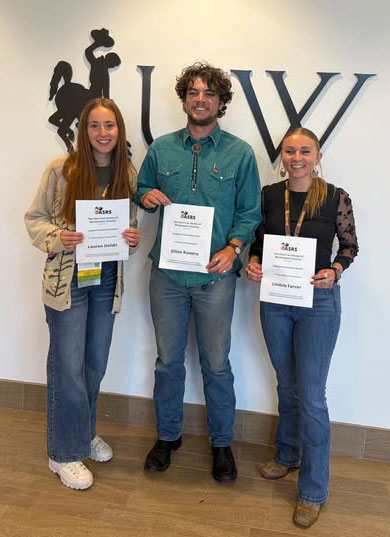
Four University of Wyoming students won awards at the American Society of Reclamation Sciences (ASRS) Conference, the bulk of which took place June 7-11 at the Marian H. Rochelle Gateway Center. Three of the students are pictured here. From left are Lauren Sielski, who placed second in the poster session competition; Dillon Romero, who took first in the oral presentation category; and Lindsie Farver, who won the poster session competition. (UW School of Energy Resources Photo)
Four University of Wyoming students were recognized at the recent American Society
of Reclamation Sciences (ASRS) Conference, the bulk of which took place June 7-11
at the Marian H. Rochelle Gateway Center in Laramie.
The event was co-hosted with UW’s School of Energy Resources, with a theme of “Landscapes
in Reclamation.” The conference focused on the research, technical and regulatory
issues associated with the land and water implications of anthropogenic land disturbances.
The conference included some optional field trips to local reclamation sites related
to the Wyoming Abandoned Mine Land Program.
The four UW students who won awards are:
-- Dillon Romero, a second-year master’s student from Cody studying soil science,
took first place with his oral presentation, titled “Assessing Microbial Communities’
Functional Response to Smooth Brome Presence and Restoration Efforts in the Sagebrush
Steppe of Grand Teton National Park.”
-- Miles Milbrath, a second-year master’s student from Durand, Ill., majoring in zoology,
tied for third with his oral presentation, titled “Beaver Dam Analogs for Stream Reclamation:
Influences on Food Web Structure, Function and Water Quality.”
-- Lindsie Farver, a second-year master’s student from Saratoga studying soil science
with a graduate certificate in reclamation and restoration ecology, placed first in
the poster competition with her project, titled “Soil Properties from Traditional
and Geomorphic Reclamations at an Abandoned Uranium Mine in Wyoming.”
-- Lauren Sielski, a first-year master’s student from Kewaskum, Wis., studying soil
science, took second with her poster session project, titled “Assessing Coal Char
as an Alternative Soil Amendment in Wyoming Semi-arid Agroecosystems.”
“I played a small role on the ASRS Conference planning committee and had seven presentations
at this conference, two of which Miles Milbrath was a part of,” says Michael Curran,
CEO and principal ecologist of Abnova Ecological Solutions, who graduated from UW
in 2020 with a doctorate in ecology. “I have worked with Miles and his adviser, Lusha
Tronstad, for two years now, as well as with others at the Wyoming Natural Diversity
Database on research collaborations. Though I cannot say I’m a direct mentor to Miles,
I have funded some of his master’s program through research grants.”
Curran has been working to improve reclamation and its monitoring and reporting practices
since his time at the university, where he examined methods at well pad and right-of-way
locations.
In all, there were 87 student oral presentations and 12 poster presentations -- representing
24 universities -- at the conference.
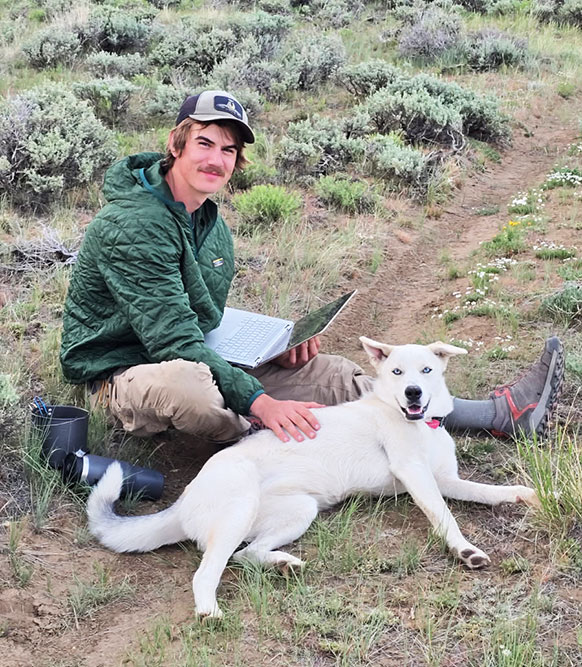
Miles Milbrath, a second-year master’s student from Durand, Ill., majoring in zoology, tied for third with his oral presentation at the recent ASRS Conference. Here, Milbrath relaxes with his dog, June, at his fieldwork campsite in the Muddy Creek drainage area south of Rawlins. (Miles Milbrath Photo)
At the professional level, Wyomingites took home three awards. Jasmine Allison, director
of government and regulatory affairs for PureWest Resources in Pinedale, became the
first female from the oil and gas industry to win the Reclamationist of the Year award.
Kyle Wendtland, Wyoming Energy Authority director of fossil fuel development in Cheyenne,
and Ron Schriebies, founder and owner of Rocky Mountain Reclamation in Laramie, won
the Pioneer in Reclamation Awards.
For more information, go to www.asrs.us/society-awards.
“Wyoming has been the nation’s leader in reclamation since 1984, with most of our
initial pioneers coming from Wyoming’s mining industry,” Curran says. “Partnerships
with industry, government agencies and the University of Wyoming, over time, have
fostered an outstanding track record of success stories for UW students from various
programs, including the School of Energy Resources (SER), the Program in Ecology and
many of the colleges and departments it is affiliated with.”
The Wyoming Reclamation and Restoration Center has helped create unique opportunities for an undergraduate minor in reclamation
and restoration ecology as well as a graduate certificate program at UW, he says.
“In the past, Steve Williams and Pete Stahl -- now both professor emeritus -- did
a great job mentoring students and setting them up with internships during their times
as directors of the Wyoming Reclamation and Restoration Center,” Curran says. “Currently,
it seems as if Jennifer Bell is revamping the program. As Wyoming is a leader in natural
resource extraction, it is important that we thrive as a state in reclaiming and restoring
these lands to provide suitable wildlife habitat, prevent erosion and other multiple
land use. Accordingly, UW has been a leader at the national level for many years providing
education to students at the undergraduate and graduate levels.”
Bell is the SER assistant professor of soil science and reclamation, and assistant
professor of soil in science in the UW Department of Ecosystem Science and Management.
Bell is a faculty adviser to Farver, Romero and Sielski.
The ASRS (formerly the American Society for Mining and Reclamation) has been hosting annual
meetings across the country since 1984. In 1995 and 2007, the annual meeting took
place in Gillette. Until this year, Laramie last hosted the conference in 2013, Curran
says.
About the American Society of Reclamation Sciences
The America Society of Reclamation Services (ASRS) evolved from a small West Virginia advisory council, which began in 1968. The organization changed its name to the American Society for Surface Mining and Reclamation in 1982. In 2020, the organization adopted the revised name of the ASRS to better reflect the broadening area of applications and interests of its membership.

The University of Wyoming has earned its Research Level 1 (R1) status from the Carnegie Classification of Institutions of Higher Education, placing Wyoming's only four-year university with the top research universities in the United States.