
Three UW Researchers, University Spin-Out Featured at Symposium in South Korea
Published June 12, 2026
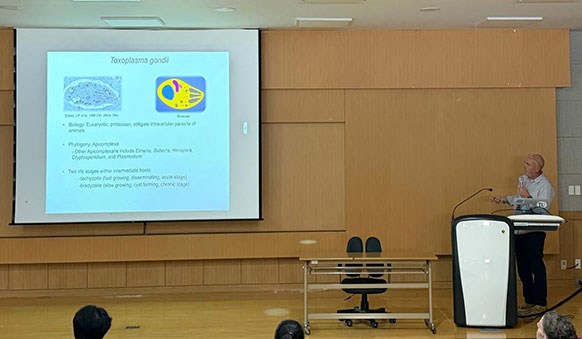
Jason Gigley, a University of Wyoming professor of molecular biology, discusses the immune response to Toxoplasma gondii infection during a session at the 2026 Medical-Bio Convergence Symposium, which took place May 28-29 at Hallym University in South Korea. Three UW faculty members and the CEO of a UW spin-out biotech startup were among the featured participants at the international symposium on infection and immunity. (Hallym University Photo)
Three University of Wyoming faculty members and a UW spin-out biotech startup were
among the featured participants at an international symposium on infection and immunity
hosted by Hallym University in South Korea last month.
The 2026 Medical-Bio Convergence Symposium, which took place May 28-29, was hosted
by Hallym University’s College of Medicine and its Research Institute of Medical-Bio
Convergence. The symposium brought together scholars from institutions including UW,
Harvard University and Seoul National University, along with the CEO of Innocorelix
LLC, a biotech company that spun out of UW.
The event was organized to strengthen global research networks and expand collaboration
among universities, industry and local communities.
Dan Levy, Jason Gigley and Eunsook Park -- all faculty members in the UW Department
of Molecular Biology in UW’s College of Agriculture, Life Sciences and Natural Resources
-- each delivered presentations across the symposium’s three sessions. The sessions
were built on the “One Health” framework -- the idea that human, animal and plant
health are interconnected.
In the immunity and disease session, Levy, a professor of molecular biology, presented
his research on the relationship between cell nucleus size and disease. During the
session on interactions between infectious pathogens and their hosts, Gigley, a professor
of molecular biology, discussed the immune response to Toxoplasma gondii infection. Park, an assistant professor of molecular biology, explained how plants
mount immune defenses against fungal infection.
The symposium also featured Harvard University’s Kang-San No, who made a presentation
on the role of lymphatic vessels in multisystemic smooth muscle dysfunction, and Seoul
National University’s Young-Ran Park, who discussed the genome packaging and immune-regulatory
mechanisms of viral RNA-binding proteins.
In the final session, focused on infectious disease and therapeutic development, Jongchan
Woo, Innocorelix CEO and founder, presented recent advances in developing antifungal
and antiparasitic agents for use in both humans and crops. Woo outlined the industrial
potential of the work and a path for collaboration among industry, academia and research.
“This symposium has provided fresh academic inspiration from the Hallym University
community, and we will continue to strengthen the foundation for medical-bio convergence
research and expand industry-academia-research collaboration,” Park says.
The symposium was co-chaired by Hallym University professors Won-Keun Kim, from the Department of Microbiology, and Kyung-Won Kim, of the Department of Life Science. The event was part of Hallym’s “Glocal University 30” initiative, a South Korean program connecting universities with regional and global research ecosystems.

The University of Wyoming has earned its Research Level 1 (R1) status from the Carnegie Classification of Institutions of Higher Education, placing Wyoming's only four-year university with the top research universities in the United States.