
University of Wyoming Hosts Community College Summer Institute for First Time
Published June 04, 2026
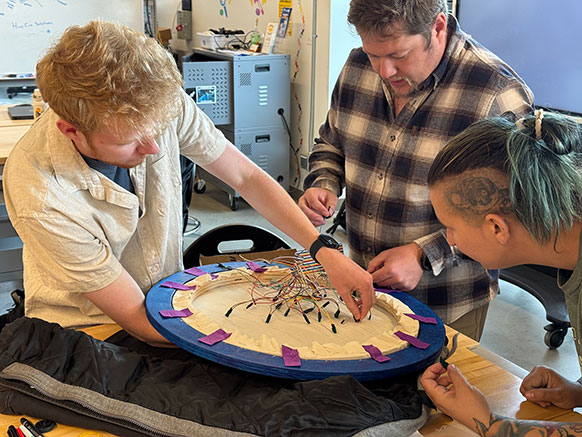
From left, UW graduate student Alex Kurtt, Austin Conklin, an NWC professor of biological sciences, and UW graduate student Sabrina White work to finish the visualization of a social network based on the principles of change theory.
The University of Wyoming hosted its first Community College Summer Institute, a five-day
program that taught students with a variety of learning backgrounds from UW and four
of its community colleges the science of learning while also allowing them to engage
in collaborative, problem-based learning.
The Community College Summer Institute (CCSI), which took place May 26-30, was designed
by Rachel Watson, director of the UW Science Initiative’s Learning Actively Mentoring
Program, with the original concept coming from Vicky Mayfield, a retired Eastern Wyoming
College (EWC) mathematics professor, who collaborated with Sherri Warren, an EWC faculty
member. A small seed grant was obtained through the NASA Space Grant Consortium for
CCSI, and Watson used the Science Institute’s network to gather “UW graduate and undergraduate
peer mentors, as well as space and resources,” she says.
With the seed grant, five community college students participated in the program where,
using the science of learning and collaboration, they worked to address housing insecurity
and habitat loss in the face of environmental change.
The issue of housing insecurity and habitat loss connected to environmental change
was identified from community college students’ applications, where they were asked
which “wicked problems” interested them the most.
To support the students’ problem solving during CCSI, Mayfield designed an escape
room puzzle. Then, a team of experts spoke to students housing insecurity and habitat
loss. Kristy Oster, director of community engagement at the Natrona County Collective
Health Trust, spoke about the housing crisis in Natrona County, and UW Ph.D. students
Alex Kurtt, of West Des Moines, Iowa, and Sabrina White, of Orlando, Fla., related
the human housing crisis to habitat loss in insect populations. Kurtt and White’s
teaching included innovative strategies insects have used to cope with temperature
shifts and extreme weather events.
“I learned that. while I am a mentor, there is plenty to learn from mentees,” Kurtt
says of CCSI.
Following the speakers, the institute’s student learners explored specimens from UW’s
Insect Museum and gained knowledge to apply biomimicry to their solutions for the
human housing crisis, which were built in the Innovation Wyrkshop.
Emily Leinen, of the Innovation Wyrkshop, provided its use for CCSI, and Christi Boggs,
associate director of online and digital teaching in the Ellbogen Center for Teaching
and Learning, provided mentoring support.
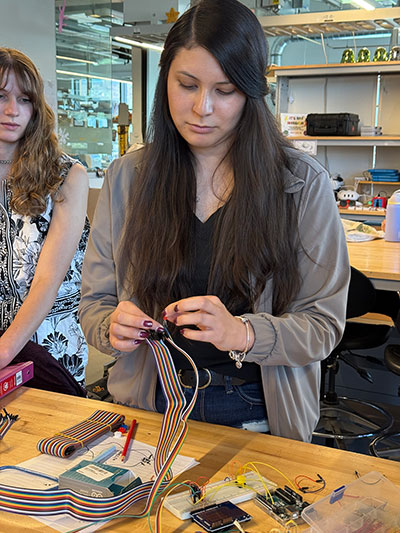
Alexxa Barazza places bulbs on wires during the University of Wyoming’s first Community College Summer Institute.
The first student team included Valentino Palato, a Casper College student from Casper
transferring to UW-Casper; Kayla Horsen, a Northwest College (NWC) student from Meeteetse
transferring to UW; Asher Wolf, a Laramie County Community College student from Cheyenne;
Natalie Speckner, a UW undergraduate from Lingle; and Dylan Chatterley, a UW undergraduate
from Rock Springs.
“The overall experience was a large inspiration, in many ways, from my academic to
my personal life,” Wolf says.
“I have honestly learned so much from everyone here. Everyone’s perspectives have
opened my mind to new ways of thinking,” Horsen says.
The team conceptualized, built and showcased the “Hive Five Solution,” a community
center modeled on a beehive that contains a library, job-skills classroom, shared
kitchen, aquaculture and hydroponics, and a pollinator garden. Intended to support
an existing project in Casper, Goodwill Landing, the team’s center would ensure previously
unhoused residents have food dignity, knowledge dignity and creative dignity. Palato
coined, defined and copyrighted the term “worthonomics,” which he describes as the
practice of building human economic capacity from the inside out, starting with the
restoration of a person’s sense of worth.
“I feel confident that CCSI will be a great benefit to students, instructors and the
community in the future,” Palato says.
“I feel inspired,” Speckner says of her experience. “This group of people helped me
grow and learn about my power as a catalyst to change hearts, minds and wicked problems
in my own backyard.”
The second student team included Alexxa Barraza, a Laramie Community College student
from Calexico, Calif., who is transferring to UW; Amber Rogers, an NWC student from
Powell transferring to UW; Xander Lindsey, a UW undergraduate from Crosby, N.D.; and
Chaley Dimmoff, a UW graduate student from Laramie.
“CCSI was a truly invaluable experience. My problem-solving and collaboration skills
have increased dramatically this week,” Lindsey says.
Austin Conklin, an NWC professor of biological sciences, walked alongside this team
throughout the problem-solving process, helping them propose and build a social network
based upon principles of change theory. Leveraging existing change agents and opinion
leaders within Natrona County, this proposed network would enable the web of community
support needed to allow the housing effort to take hold. The network’s visual representation
was an electrical grid wired to small lightbulbs, with its code written by the team.
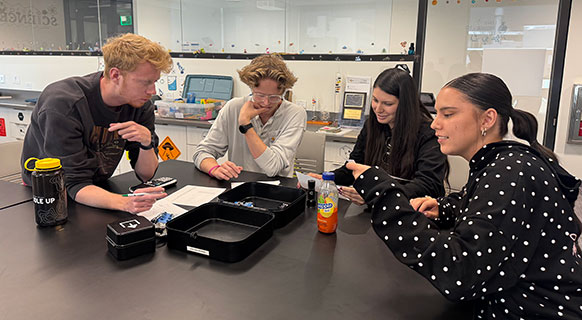
University of Wyoming graduate student Alex Kurtt (left) and undergraduate students Xander Lindsey, Alexxa Barazza and Kayla Horsen work to solve an escape room puzzle during the first night of the Community College Summer Institute, which was hosted by UW. The first-time event was a five-day program that taught students with a variety of learning backgrounds from UW and four of its community colleges the science of learning while also allowing them to engage in collaborative, problem-based learning.
“After collaborating with members of the CCSI and completing the project, I feel more
confident in my ability researching and understanding wicked problems,” Rogers says.
“I was able to learn a lot from my peers and gain new skills through team effort,
creativity and problem-solving,” Barraza says.
All learners across levels -- from the community college students to UW faculty --
self-assessed their growth throughout the week. Collectively, they grew most in their
understanding of insect resilience with changing environmental conditions; their relationships
with each other; their ability to use the Innovation Wyrkshop resources; the neuroscience
of deep learning; and the knowledge that they have skills invaluable to problem solving.
The solutions envisioned by the cross-level teams will be shared with the Natrona
County Collective Health Trust Friday, June 5, after which teams hope they can find
support to further explore these innovative ideas.
The first CCSI is a dream come true, Mayfield says, adding that she and her colleague
Warren couldn’t have envisioned a learning environment more transformative for community
college students.
CCSI brought together a diverse group of learners from community colleges students
to a retired faculty member, Watson says.
“The CCSI was a proof of concept for me,” Watson says. “We brought together learners from across the lifespan with the knowledge that this should bring greater creativity to problem solving. It did just that!”

The University of Wyoming has earned its Research Level 1 (R1) status from the Carnegie Classification of Institutions of Higher Education, placing Wyoming's only four-year university with the top research universities in the United States.