
UW College of Health Sciences Faculty and Student Research Explores Cancer Ghosting
Published June 01, 2026
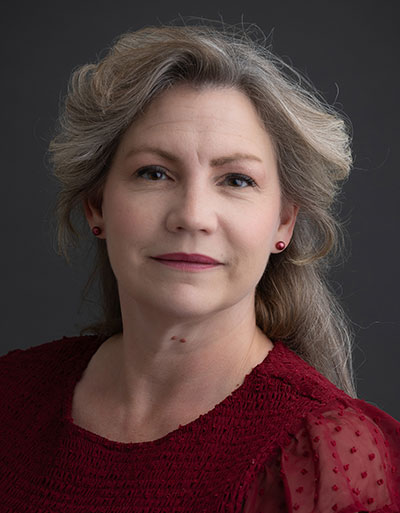
Jennifer Stephens
A University of Wyoming associate professor with the Fay W. Whitney School of Nursing
recently presented research focused on a newly understood phenomenon affecting cancer
patients’ experiences for the Association for Netnographic Research (ANR).
Jennifer Stephens presented her research, titled “Using Netnography in Nursing Research:
The Example of Cancer Ghosting,” to the ANR, a registered nonprofit corporation dedicated
to advancing netnographic research globally.
Principles of netnography research methods include immersion over extraction, context
sensitivity, reflexivity and digital ethics.
According to Stephens’ research, cancer ghosting is the sudden and deliberate ending
of a relationship with someone who is diagnosed with cancer. Objectives presented
by Stephens during her presentation included illuminating the phenomenon; exploring
the qualitative method of netnography and why it suited this healthcare-related project;
briefly describing the cancer ghosting study; discussing knowledge translation; and
speaking to barriers and successes.
Contributors to the project included Carlos Garcia, of Wheatland, a first-year student
with the Wyoming WWAMI Medical Education Program, and Jenifer Thomas, a professor
with the nursing school and co-investigator on the project.
Stephens is enthusiastic about the oncology community’s response to the netnographic
study that provided the first definition of cancer ghosting.
“Up until our presentation at the Oncology Nursing Society Congress in 2025, oncology
nurses and providers were only marginally aware of this phenomenon,” Stephens says.
“Our study has helped give a voice to those who have been ghosted and has increased
awareness of ghosting in the cancer healthcare provider community.”
Cancer ghosting can take the form of actual social cutoff by friends and family in
person or on social media platforms. While different levels of this type of ghosting
can occur -- either resulting from a person’s awkwardness in dealing with an acquaintance
having been diagnosed with cancer or a complete termination of a relationship -- the
effects on the patient can be devastating.
“Patients with cancer often represent a uniquely vulnerable and medically complex
population,” Garcia says. “This project stands out because of both its technical approach
and its focus on improving patient-centered outcomes. Participating in this research
has provided valuable insight into some of the most challenging experiences these
patients face, and I hope it contributes to continued progress in destigmatizing their
struggles.”
Stephens’ research has two clear goals: to generate foundational knowledge about cancer
patients’ experiences being ghosted and to recommend interventions by oncology providers
that could specifically address cancer ghosting as a phenomenon affecting emotional,
physical and mental health.
“This research reflects the important role our faculty and students play in addressing
complex and often overlooked challenges affecting patient well-being,” says Patrick
Hardigan, dean of the College of Health Sciences. “Dr. Stephens and her collaborators
are advancing understanding of the emotional and social dimensions of cancer care
through innovative research that gives voice to patient experiences and helps inform
more compassionate healthcare practices. We are proud to see this work gaining national
attention and contributing to meaningful conversations within oncology and nursing.”
Stephens’ research clearly points to the netnographic research method as useful for
nursing research and patient experience studies involving cancer ghosting.
Stephens’ research is funded by the Fay W. Whitney School of Nursing Humenick Grant. The research is in phase two of qualitative interviewing with participants and is using critical incident theory.

The University of Wyoming has earned its Research Level 1 (R1) status from the Carnegie Classification of Institutions of Higher Education, placing Wyoming's only four-year university with the top research universities in the United States.