
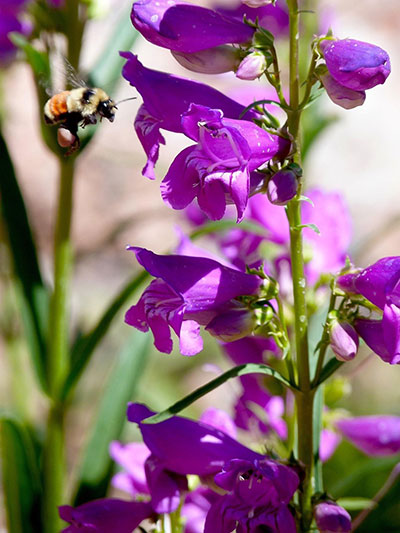
This bee hovers near a flower in the Berry Prairie, located just outside of the University of Wyoming Berry Biodiversity Conservation Center. The Bee Jubilee, hosted by the UW Biodiversity Institute, is scheduled Saturday, June 20, from 10 a.m.-noon. The event, which is open to the public, includes various activities and information about bees and other native pollinators. (Abbey Morales Photo)
A doubleheader event is on tap at the University of Wyoming with a Bee Jubilee and
summer solstice celebration scheduled Saturday, June 20.
The University of Wyoming Berry Biodiversity Conservation Center will be all abuzz
celebrating these important insects during the Bee Jubilee, scheduled from 10 a.m.-noon,
while the UW Art Museum will host summer solstice events from 11 a.m-2 p.m. to celebrate
the longest day of the year. Both family-friendly events are free and open to the
public.
Bringing the buzz
“Bees and other pollinators are extremely important to the ecosystems in Wyoming and
the world, with 75 percent to 85 percent of the world’s flowering plants requiring
insect or animal-mediated pollination,” says Erin Bentley, associate director and
program manager for the UW Biodiversity Institute. “Bees themselves are key for ecosystem
functioning, with the products of pollination, such as fruits and seeds, making up
a large part of the diets of many birds and mammals -- including humans -- across
the food chain.”
Approximately 35 percent of the world’s food crops are pollinated by bees, and 700
to 800 of the approximate 4,000 bee species in the United States are found in Wyoming,
Bentley adds.
Event attendees will have the opportunity to learn about bees directly from educational
partner booths. Attendees also can engage in live pollinator catching; kid-focused
activities; wildflower seed-bomb crafting; and learn how to craft their gardens to
be welcoming to native plants and pollinators.
Additionally, there will be a pollinator yoga class led by a UW group fitness yoga
instructor from 10-10:30 a.m. on the tree deck outside the Berry Center. Yoga mats
will be provided. Pre-registration is required, as there is a cap of 20 participants.
To register, go here.
There also will be several crafting activities, both at the Berry Biodiversity Conservation
Center, located at Lewis and 10th streets, and at the UW Art Museum, located at 2111
E. Willett Drive.
Bee Jubilee event partners are the UW Art Museum, Williams Conservatory, Rocky Mountain
Herbarium, Science Initiative Roadshow, Half Acre Recreation and Wellness Center,
Science Loves Art and Scott Shell, an assistant extension entomologist in UW Extension.
Here comes the sun
The summer solstice, which falls on June 20 this year, will provide just over 15 hours of daylight, with sunrise at about 5:30 a.m. and sunset scheduled at 8:40 p.m., says Cassidy Post, interim master teacher at the UW Art Museum.
“We hope visitors leave with a greater appreciation for artmaking and community, and the summer solstice is really a great moment to pause, reflect and celebrate long days of sunshine and summertime,” Post says. “By combining artmaking, science and community gathering, we hope participants experience a sense of wonder, curiosity and connection to both the natural world and one another.”
Activities will include screen printing, cyanotypes, butterfly crafts and the “Shining of the Coin” ceremony at noon. Cyanotypes are one of the earliest forms of photography. Artists place objects such as plants, leaves or other materials on specially coated UV-sensitive paper or fabric and then expose them to sunlight, Post says.
“The paper develops into a deep blue image, creating a photographic print that uses the power of the sun itself as part of the artistic process,” she says.
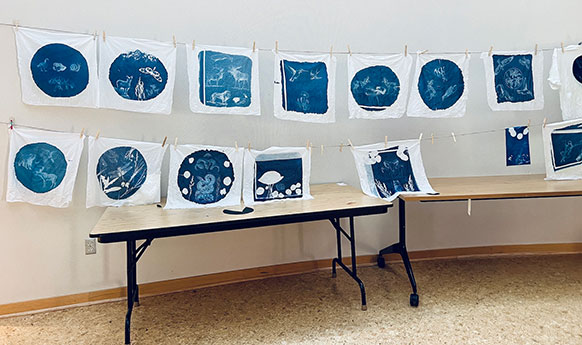
These cyanotypes were created on bandanas at last year’s summer solstice event. Cyanotypes are considered one of the earliest forms of photography. This year’s summer solstice event is scheduled from 11 a.m.-2 p.m. Saturday, June 20, in the UW Art Museum. (Cassidy Post Photo)
The “Shining of the Coin” happens when the sun reaches its highest point in the sky. At solar noon, a beam of sunlight passes through a small aperture in the Art Museum’s ceiling, designed by architect Antoine Predock, and briefly illuminates a commemorative coin embedded in the center of the museum’s rotunda gallery.
“This unique moment highlights the building’s connection to the movement of the sun and serves as a reminder of our relationship to the natural world, the changing seasons and humanity’s long history of observing celestial events,” Post says.
This year’s event is especially exciting because it is being presented in collaboration with the Biodiversity Institute’s Bee Jubilee, bringing together art, science, pollinators and community celebration in a shared event, Post says.
Bentley concurs.
“We are really excited to partner this year with the University of Wyoming Art Museum’s summer solstice to encourage cross-pollination between science and art, and at two awesome locations on campus -- the Berry Center and the Art Museum,” Bentley says.
For more information about the Bee Jubilee, call Bentley at (307) 766-5169 or email
her at ebentley@uwyo.edu. For more information about the summer solstice celebration, call Post at (307) 766-3515
or email her at cpost2@uwyo.edu. A Facebook page includes information on both events.
About the UW Biodiversity Institute
The UW Biodiversity Institute fosters conservation of biodiversity through scientific
discovery, creative dissemination, education and public engagement. In this setting,
scientists, citizens, students and educators come together to share a wealth of perspectives
on the study and appreciation of biodiversity -- from microbes to poetry and ecosystems
to economics. Learn more at www.wyomingbiodiversity.org.
About the UW Art Museum
The UW Art Museum exhibits, preserves and interprets visual culture from around the world to engage academic, local, state, national and global communities. The museum is located in the Centennial Complex at 2111 E. Willett Drive in Laramie. Hours are Tuesday through Saturday from 10 a.m.-5 p.m. Admission is free.

The University of Wyoming has earned its Research Level 1 (R1) status from the Carnegie Classification of Institutions of Higher Education, placing Wyoming's only four-year university with the top research universities in the United States.