
UW’s Biodiversity Institute to Host Summer Moose Day Weekend July 18-19
Published June 10, 2026
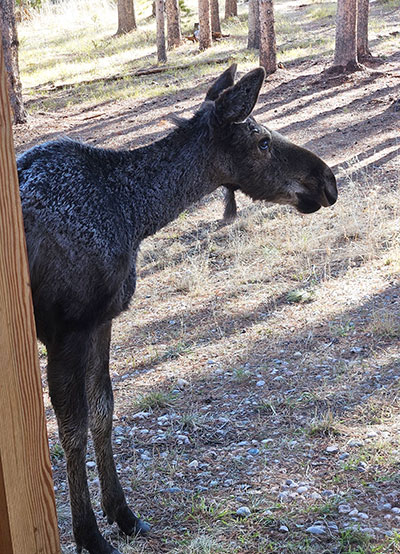
This young moose was spotted at a private residence near some of the Summer Moose Day routes area, but the photo was not actually taken as part of the UW Biodiversity Institute’s 2025 Summer Moose Day weekend. This year’s Summer Moose Day weekend is scheduled Friday-Saturday, July 18-19. (James Rinehart Photo)
Summer Moose Day activities will span a weekend -- Saturday-Sunday, July 18-19 --
again this year, and volunteers will head out on various hiking routes along creek
beds and trails or drive U.S. Forest Service roads to spot and count moose in the
mountains outside of Laramie.
The event will kick off with a group hike starting at 7:30 a.m. Saturday at the Curt
Gowdy State Park Visitor Center. The hike will start with a short moose biology talk,
followed by a Moose Day survey conducted by the group using Moose Day protocol. Participation
in the guided hike requires the purchase of a daily Wyoming State Parks pass for Curt
Gowdy.
“We’ll explore one of the trails behind it. This will be a combination Moose/BioBlitz Walk, because Summer Moose Day coincides with the statewide Wyoming BioBlitz,” says Mason Lee, senior project coordinator of the University of Wyoming Biodiversity Institute. “So, we’ll document all of the nature that we see on iNaturalist as we walk the trail in search of moose or signs of moose. I’m excited to offer this Moose/BioBlitz Walk again in collaboration with Curt Gowdy State Park.”
For the traditional portion of Summer Moose Day, volunteers can look for moose either Saturday or Sunday but do not have to participate both days. There are slightly more routes than during Winter Moose Day because there are a few routes volunteers can drive rather than hike, Lee says. There are 22 routes in the Snowy Range; 19 in the Pole Mountain area, which includes Happy Jack and Vedauwoo; and one route in the Arlington area. Hiking routes range from 2 to 8 miles in length, and all are considered moderate in difficulty. For driving routes, motorists will go approximately 20 miles per hour. Volunteers can view the routes here.
Registration for Summer Moose Day is now open at www.wyomingbiodiversity.org/index.php/community-science/bi-annual-moose-day/registration and will close Wednesday, July 15. Multiple groups will be allowed to sign up per
route, and participants can choose whether they conduct their survey Saturday or Sunday.
New volunteers or volunteers who haven’t participated in a Moose Day in a few years will need to watch an hourlong, prerecorded training and take a quiz before receiving their route maps and data sheets, Lee says.
While volunteers can make their treks any time of day, Lee strongly recommends an early morning start, as that is when moose are most active. Community scientists will record observations of moose or their signs, which include tracks/hoofprints, bed areas, scat droppings and browse on aspen and willows.
During the 2025 Summer Moose Day, eight moose were spotted. Two were males, three
were females, two were calves and one moose was of an unknown sex, Lee says. Other
mammals observed included mule deer, a marmot and a mountain snail. The record of
16 moose spotted on Summer Moose Day was first set in 2016 and matched again in 2022.
The data gathered from Summer Moose Day are shared with biologists at UW. These biologists
use the data collected by community scientists to further their understanding of the
population densities of local moose, their reproductive rates, summer habitat quality,
their winter ranges and how these variables change over time.
More will be learned after Dave Christianson, an associate professor in the UW Department of Ecosystem Science and Management, and his graduate students analyze the Summer Moose Day data as well as external
factors that can affect moose counts, Lee says.
Both summer and winter Moose Day events are geared toward increasing the public’s understanding of moose in the Laramie area and involving the public in asking and answering questions. These events are an extension of the original program, Moose Day, held by Nature Mapping Jackson Hole (NMJH) in Jackson each winter. NMJH is a citizen science program created by the Jackson Hole Wildlife Foundation.
About the University of Wyoming Biodiversity Institute
The UW Biodiversity Institute fosters conservation of biodiversity through scientific discovery, creative dissemination, education and public engagement. In this setting, scientists, citizens, students and educators come together to share a wealth of perspectives on the study and appreciation of biodiversity -- from microbes to poetry and ecosystems to economics. Learn more at www.wyomingbiodiversity.org.
For more information, email Lee at mlee37@uwyo.edu .

The University of Wyoming has earned its Research Level 1 (R1) status from the Carnegie Classification of Institutions of Higher Education, placing Wyoming's only four-year university with the top research universities in the United States.