
UW’s Surovell, Colleagues Defend Findings at Famous South American Archaeological Site
Published June 18, 2026
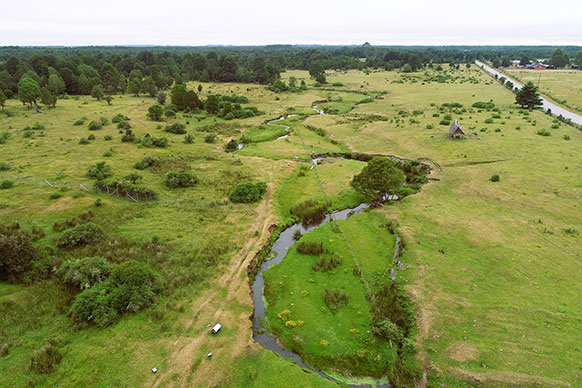
The Monte Verde archaeological site in southern Chile is situated on the banks of Chinchihuapi Creek, a tributary of the Maullín River located 36 miles from the Pacific Ocean. (Todd Surovell Photo)
University of Wyoming Professor Todd Surovell knew that a paper he and colleagues
published in March in the journal Science would shake the world of archaeology.
That has indeed been the case, as their study -- showing that the famous Monte Verde
archaeological site in southern Chile is only 4,200-8,200 years old, not 14,500 years
old as posited by researchers who worked on the site from the 1970s through the 1990s
-- has drawn intense criticism from those earlier researchers and others, as well
as support from a number of archaeologists.
Now, Surovell and his colleagues -- Claudio Latorre, César Méndez and Juan-Luis García,
of Pontificia Universidad Católica in Santiago, Chile; Christopher Luthgens, of BOKU
University in Vienna, Austria; and Jay Thompson, of the U.S. Geological Survey --
are responding to the criticisms. A separate response addressing the genetics of the
first Americans was co-written by University of Alaska-Fairbanks archaeologist Ben
Potter and an international team of geneticists and archaeologists, including David
Reich of Harvard University. The responses are published in the “eLetters” section
under the original Science paper, “A mid-Holocene age for Monte Verde challenges the timeline of human colonization of
South America.”
“Our letters not only correct misrepresentations of our work in published commentaries,
but also provide additional evidence supporting our primary conclusion: that the Monte
Verde 2 component is much younger than previously believed,” Surovell says.
The paper published in March by Surovell and his colleagues reinvigorated the debate
over the peopling of the Americas, in which many now doubt the long-held consensus
that the first Americans were hunter-gatherers who entered North America from Asia
via the Beringia land bridge up to 14,200 years ago -- and then dispersed southward
between two large glaciers that then covered much of the continent.
While not all archaeologists accept the conclusion that the Monte Verde site is 14,500
years old -- almost 1,500 years older than firmly dated encampments of so-called Clovis
people in North America, and 500 years older than the earliest confirmed human sites
in Alaska -- the previously purported Monte Verde findings had gained wide acceptance.
To account for the early age and location of Monte Verde deep in the Southern Hemisphere,
some had concluded that the first Americans must have skirted the North American ice
sheets along the Pacific Coast and continued to migrate along a coastal corridor all
the way to South America.
The Monte Verde site is situated on the banks of Chinchihuapi Creek, a tributary of
the Maullín River located 36 miles from the Pacific Ocean. The new study is the first
investigation of the site, independent of the original researchers, in the nearly
50 years since its discovery.
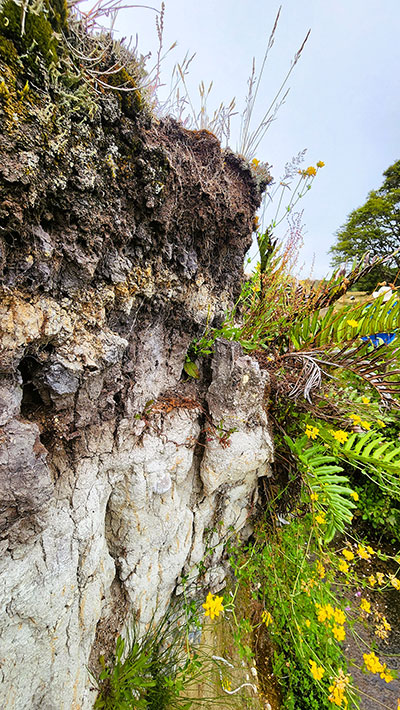
This outcrop along Chinchihuapi Creek shows stratigraphy that includes wood, volcanic ash and peat. (Todd Surovell Photo)
The study involved sampling and dating nine alluvial deposits along the banks of Chinchihuapi
Creek. Essentially, the researchers found that the dating of materials found at Monte
Verde to 14,500 years ago can be explained by erosion or “redeposition” along the
creek. Deposits along the creek are replete with Ice Age wood that became incorporated
into younger archaeological deposits. This explains how a site that is younger than
9,000 years old can produce radiocarbon dates from more than 14,000 years ago. Much
like directly dating the stone from which an artifact is made does not tell you the
date of manufacture of a tool, dating wood at Monte Verde does not date the occupation
of the site.
The researchers also identified an 11,000-year-old volcanic ash layer, a regional
stratigraphic marker, that predates formation of the surface on which the Monte Verde
occupation rests. If human presence at Monte Verde dates to 14,500 years ago, this
ash should occur above the occupation layer. It does not.
In fact, Surovell and colleagues argue that the surface on which the Monte Verde materials
came to rest did not exist 14,500 years ago -- rather, it formed sometime after 8,600
years ago. That essentially eliminates Monte Verde as a pillar of the theory of the
coastal colonization of the Americas, they say.
Critics of the study have alleged that it contains fundamental errors and incorrect
interpretations, including their reliance on observations from outcrops located between
164 feet and about 2 miles from the original site. They also disagree with the conclusions
regarding erosion and redeposition; they dispute the presence of the 11,000-year-old
volcanic ash layer; and they argue that the latest human genetics research supports
pre-Clovis population of the Americas.
In their rebuttal, Surovell and his colleagues stand by their conclusions and provide
additional evidence supporting them. One response documents multiple, independent
lines of evidence showing that Ice Age wood was redeposited into younger sediments.
Another response provides additional evidence supporting the identification and significance
of the 11,000-year-old volcanic ash layer in the valley. The authors also argue that
genetics cannot independently determine the age of Monte Verde, because no human remains
older than about 12,900 years have yet been genetically analyzed in the Americas.
At the same time, they invite more study and scrutiny of their findings.
“We encourage independent researchers to evaluate our work and that of the original researchers through direct study of the Monte Verde site, its collections and associated records,” Surovell and his colleagues wrote.

The University of Wyoming has earned its Research Level 1 (R1) status from the Carnegie Classification of Institutions of Higher Education, placing Wyoming's only four-year university with the top research universities in the United States.